

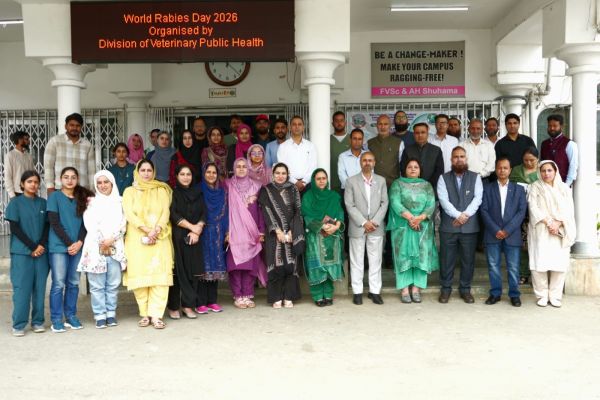

SRINAGAR: Sher-e-Kashmir University of Agricultural Sciences and Technology-Kashmir (SKUAST-K) on Monday organised a symposium and panel discussion on the implementation of the National Action Plan for Rabies Elimination (NAPRE) in Jammu and Kashmir to mark World Rabies Day 2026.
The programme, organised by the Division of Veterinary Public Health and Epidemiology, Faculty of Veterinary Sciences and Animal Husbandry (FVSc & AH), was held under the One Health framework and centred on the global theme, “Stronger Together.”
The event brought together experts from veterinary sciences, public health, healthcare, wildlife management, education and allied sectors to discuss strategies for rabies prevention and elimination in the Union Territory.
Director Extension, SKUAST-K, Prof Raihana Habib Kanth, who attended as chief guest, highlighted the importance of prompt medical intervention following dog bites or suspected rabies exposure. She urged people to wash wounds thoroughly and seek immediate medical care rather than relying on traditional remedies.
Dean, Faculty of Veterinary Sciences and Animal Husbandry, Prof Riyaz Ahmad Shah, stressed the need for coordinated action between human and animal health sectors to prevent rabies. He outlined the faculty’s work in diagnostics, vaccination, awareness programmes, research and dog population management.
The keynote address was delivered by Dr Suhail Manzoor, Epidemic Intelligence Service Officer at the National Centre for Disease Control (NCDC), New Delhi. He spoke on strengthening surveillance, integrated reporting systems, vaccination coverage and inter-sectoral coordination to achieve India’s goal of eliminating human deaths caused by dog-mediated rabies.
A panel discussion on the implementation of NAPRE in Jammu and Kashmir focused on improving rabies surveillance and reporting mechanisms, enhancing coordination among departments, expanding vaccination campaigns, increasing public awareness and strengthening capacity-building initiatives.
The panel included representatives from Government Medical College Srinagar, Sher-i-Kashmir Institute of Medical Sciences (SKIMS), the Animal and Sheep Husbandry departments, the Directorate of Health Services, NCDC and SKUAST-K, as well as officials from the education sector.
The programme concluded with participants emphasising the importance of a coordinated One Health approach involving human, animal and environmental health sectors to advance rabies control and elimination efforts in Jammu and Kashmir.