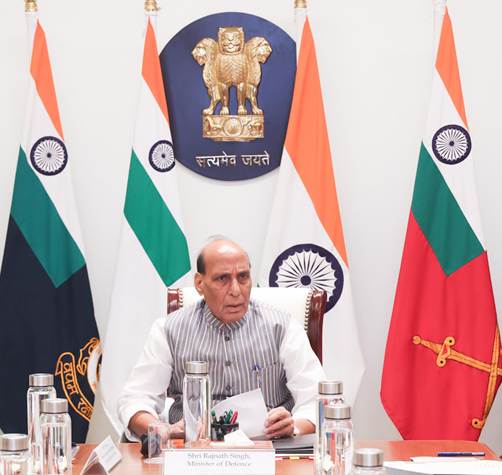
NEW DELHI: Defence Minister Rajnath Singh on Sunday said India does not seek to occupy the territory of any country but will take necessary steps to safeguard its security and strategic autonomy when threatened.
Addressing a defence conclave in New Delhi, Singh said India was committed to peace and global stability but would not compromise on its strategic interests.
“There can be no scope for dialogue with any country that promotes terrorism against India,” the minister said, adding that nations using terrorism as an instrument of state policy or providing support to terrorists must be held accountable. Referring to Prime Minister Narendra Modi’s recent remarks at the Shanghai Cooperation Organisation (SCO) meeting, Singh said India remained entitled to take all necessary measures against terrorism as long as a neighbouring country continued to support it.
The defence minister also stressed that national security was a collective responsibility and called on citizens to rise above divisions based on religion, caste, language and region.
Describing India as a “civilisational power”, Singh said the country’s rise was based on inclusive development and cooperation rather than confrontation. He highlighted India’s outreach to developing nations through initiatives such as Vaccine Maitri and the Voice of Global South Summits, saying India had supplied more than 30 crore COVID-19 vaccine doses to over 100 countries and provided support in areas ranging from healthcare to digital payments.
On defence production, Singh said India was making significant progress towards self-reliance, with indigenous capabilities being developed in areas including aircraft, drone engines and advanced fighter aircraft programmes.
He said defence exports had increased from ₹686 crore in 2013-14 to a record ₹38,424 crore in 2025-26, with Indian defence products now reaching more than 100 countries. After surpassing the ₹30,000-crore export mark, the government has set a target of ₹50,000 crore in defence exports by 2029, he added.
The minister said growing international demand for Indian missiles, radars, ammunition and defence platforms reflected confidence in the country’s manufacturing and technological capabilities.
Singh also highlighted a rise in defence spending, noting that the allocation for 2026-27 had increased to ₹7.85 lakh crore from about ₹2.53 lakh crore in 2013-14. He said around ₹1.39 lakh crore, accounting for 75 per cent of the capital acquisition budget, had been reserved for procurement from domestic industry.
Addressing emerging security challenges, the minister said future conflicts would increasingly involve cyber, space, electronic and information warfare, alongside technologies such as artificial intelligence, autonomous systems, quantum technology and hypersonic weapons. He said India was working to build capabilities in these areas while reducing strategic vulnerabilities in sectors such as technology, energy, data and supply chains.
Singh said 509 defence equipment and weapon systems had been included in five positive indigenisation lists issued by the armed forces, while Defence Public Sector Undertakings (DPSUs) had identified over 5,400 items for indigenisation, of which around 3,300 had already been developed domestically.
He noted that India’s defence manufacturing ecosystem now includes more than 16,000 micro, small and medium enterprises (MSMEs), startups, universities and research institutions. Investment proposals worth about ₹70,000 crore have been received in the Uttar Pradesh and Tamil Nadu Defence Industrial Corridors, with around ₹10,000 crore already invested.
In a significant announcement, Singh said the government would transfer Defence Research and Development Organisation (DRDO)-developed technologies for conventional missile systems to eligible Indian companies, enabling private industry to undertake production. He said the move would strengthen military preparedness and allow DRDO to focus more on research and development while industry expanded manufacturing capacity.
The minister said the government’s long-term objective was to build indigenous capabilities across the entire defence spectrum, from components to complete weapon systems, to enhance strategic autonomy and strengthen the country’s defence-industrial base.