

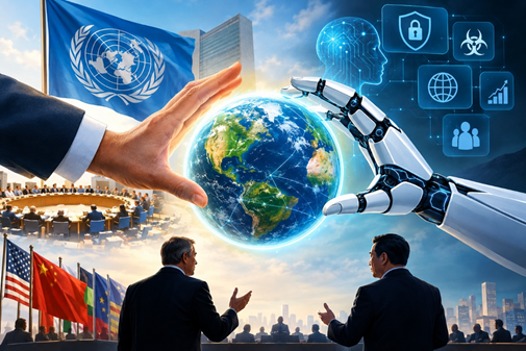
The United Nations Security Council enters 2026 facing an increasingly difficult question: how can an institution created to prevent wars remain effective in a world where conflicts, technology and geopolitical rivalries are changing faster than international institutions?
The Council’s immediate concerns remain familiar, wars and instability in Ukraine, the Middle East, Sudan and elsewhere. But alongside these crises is a new and less visible challenge: artificial intelligence. The UN Secretary-General has described war and peace, inequality, climate change and AI as four defining tests of global power.
The UN is also confronting a structural problem. Countries such as Brazil, Germany, India and Japan, the G4, continue to push for Security Council reform, arguing that its composition should better reflect today’s geopolitical realities. The absence of meaningful reform has contributed to questions about the Council’s legitimacy and effectiveness.
Peacekeeping itself is being reconsidered. In August, Secretary-General António Guterres called for a “reset” of UN peace operations, with greater emphasis on peace-making, preventive diplomacy, stronger partnerships with host countries and more adaptable mandates. His message is straightforward: peacekeepers cannot keep a peace that does not exist.
But perhaps the most striking development of 2026 is the arrival of AI at the centre of international security discussions.
On September 23, the Security Council held a high-level briefing on AI and international security, with OpenAI CEO Sam Altman, Anthropic CEO Dario Amodei, Hugging Face CEO Clément Delangue and AI scientist Yoshua Bengio among the briefers.
The concern is no longer simply that AI might replace jobs or spread misinformation. The deeper question is whether increasingly autonomous systems could eventually act faster than human institutions can understand or control them.
AI can already assist cyber operations, generate convincing disinformation and influence military decision-making. More capable autonomous systems could make these risks harder to contain. There are also concerns about AI lowering barriers to the development of biological or other dangerous weapons.
The technology leaders therefore made a case for stronger international cooperation. Altman argued that decisions about powerful AI should not be left to technology companies alone and called for democratic institutions and governments to have a central role. OpenAI has also proposed common technical standards, capability testing, incident reporting, and secure channels for governments to exchange information about emerging AI threats.
Amodei has similarly argued for greater caution in developing increasingly powerful systems, including independent evaluation and international coordination. Delangue has stressed another dimension of the problem: defensive cyber capabilities should not remain concentrated in the hands of a few powerful companies or countries.
Yet here lies the central contradiction. The world may agree that AI needs safeguards, but sharply disagrees over who should set them.
The United States has resisted broad international restrictions that could slow its technological development, while China has called for international cooperation and safeguards, while also warning against technological monopolies. The disagreement reflects a larger struggle over technological leadership, security and economic power.
This creates a difficult lesson for the UN. The world cannot ask technology companies to regulate themselves, but neither can governments treat AI simply as another instrument of geopolitical competition. If the most powerful countries see every safety measure through the lens of strategic rivalry, global cooperation will remain difficult.
Humanity therefore needs some basic boundaries. AI systems involved in warfare, cyber operations or critical infrastructure should remain subject to meaningful human control. Major incidents should be reported internationally. Advanced systems should undergo independent safety evaluations, and governments should have channels for rapidly sharing information about dangerous failures or emerging threats.
The most difficult task will be bringing the major AI powers into a common conversation. Cooperation does not require countries to surrender technological sovereignty. It requires agreement that some risks are too consequential to be managed through competition alone.
The UN was created after humanity experienced the devastating consequences of weapons and conflicts that exceeded existing systems of control. AI presents a different kind of challenge: not necessarily a weapon invented to destroy humanity, but a technology whose capabilities may eventually move faster than humanity’s ability to govern them.
The question facing the Security Council is therefore larger than AI regulation. It is whether nations can cooperate before a crisis forces them to.
The UN can debate wars, reform peacekeeping and defend the principles of its Charter. But if humanity is creating technologies capable of making decisions at machine speed, diplomacy must learn to move faster too.
The ultimate safeguard cannot be the machine. It must remain human judgment, international cooperation, and the willingness to put human survival above technological or geopolitical advantage.


