

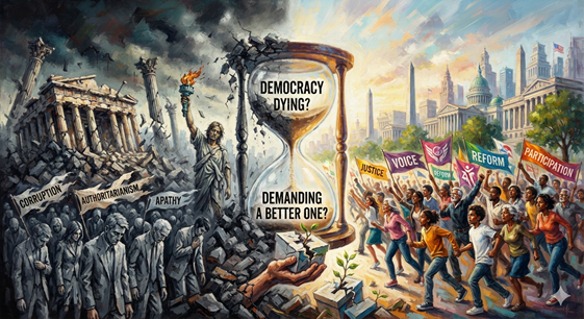
For decades, democracy was presented almost as the inevitable destination of human political evolution. Dictatorships would fall, people would vote, institutions would strengthen, and freedom would expand. The collapse of communism seemed to confirm the triumph of the democratic idea.
But today, that certainty looks increasingly naïve.
Freedom House says global freedom declined for the 20th consecutive year in 2025. V-Dem’s 2026 assessment estimates that nearly three-quarters of the world’s population now lives under autocratic rule. Democracy is retreating in parts of the world, institutions are being weakened, political polarisation is deepening, and citizens are becoming increasingly distrustful of the very systems meant to represent them.
So, is democracy dying?
Or are we asking the wrong question?
Perhaps what is dying is not democracy itself, but the old version of democracy.
The uncomfortable truth is that people are not necessarily turning against freedom. They are turning against governments that promise freedom but deliver frustration, inequality, political theatre and endless confrontation. They are tired of elections that change governments without changing their lives.
What good is one person, one vote when economic power is concentrated in the hands of a few? What does political equality mean when opportunity is so unequal? And why should citizens trust institutions that appear more interested in winning the next election than solving the problems of the present?
These are not questions authoritarian leaders invented. Democracies created them by failing to answer them.
And when democracy fails to deliver, someone else offers an answer.
Enter the strongman.
He promises order instead of chaos, certainty instead of debate, action instead of compromise. He tells frustrated citizens that the problem is not the complexity of the world but the weakness of their leaders. He identifies an enemy – immigrants, minorities, elites, foreigners, intellectuals, the media, global institutions – and promises to defeat it.
It is a seductive proposition.
Democracy asks citizens to compromise with people they disagree with. Populism asks them to defeat people they fear.
Which message is easier to sell?
Technology has made the battle even more dangerous. The public square has moved into algorithms that reward outrage, fear, and certainty. Citizens increasingly inhabit separate information universes. We no longer simply disagree about what governments should do; we increasingly disagree about what is real.
Can democracy survive when citizens cannot agree on the facts?
Perhaps the greatest threat, however, comes from democracy’s own success.
Leaders no longer necessarily need tanks in the streets to destroy democratic institutions. They can win elections and then quietly weaken the institutions that might remove them.
Courts can be pressured. Independent media can be attacked. Election institutions can be questioned. Legislatures can be neutralised. Civil society can be portrayed as disloyal. Constitutional safeguards can be stretched until they become meaningless.
The ballot box remains, but does genuine democratic choice remain?
This is the question democracies must confront.
A country does not become democratic merely because people are allowed to vote. It becomes democratic when those in power can be questioned, challenged, and peacefully removed.
Yet declaring democracy dead would also be premature.
Democracy possesses an extraordinary advantage: it contains the possibility of self-correction. Governments can be voted out. Institutions can push back. Citizens can protest. Courts can intervene. Journalists can investigate. Civil society can organise.
Authoritarian systems can sometimes make decisions faster. They can impose order more efficiently. They may even produce better short-term outcomes under capable leadership.
But what happens when the leader is incompetent?
What happens when the strongman becomes corrupt?
Who removes him?
Who questions him?
Who tells him he is wrong?
That is where authoritarianism carries its greatest weakness: it depends too heavily on the quality of the person at the top.
Democracy, at least in theory, is designed to survive bad leaders.
But democracy itself cannot survive indefinitely if its institutions become incapable of producing competent leadership, economic opportunity, or public trust.
This may be the real crisis.
The world may not be choosing between democracy and dictatorship. It may be choosing between a dysfunctional democracy and an attractive illusion of authoritarian efficiency.
And that should alarm democrats far more than the rise of any individual strongman.
Because democracy cannot be defended merely by telling people that the alternative is worse.
It must prove that it is better.
It must deliver justice without revenge, authority without repression, freedom without disorder and prosperity without abandoning those left behind. It must learn to operate in an age of social media, artificial intelligence, global corporations, instant information and permanent political campaigning.
Above all, it must recover something that cannot be legislated into existence: public trust.
Perhaps democracy is therefore neither simply dying nor triumphantly reviving.
It is being tested.
And history has repeatedly shown that political systems do not survive because they are morally superior. They survive because they are capable of adapting to changing realities.
The danger is that democracy may discover its limits only after it has lost the confidence of its citizens.
The opportunity is that citizens may not be asking for the end of democracy at all.
They may be demanding a democracy worthy of defending.
So perhaps the most important question of our time is not:
“Is democracy dying?”
It is this:
If democracy cannot reform itself, will people abandon democracy, or will they finally force it to become the democracy it always promised to be?


