SRINAGAR: Building a sustainable cinematic ecosystem in Jammu and Kashmir requires a long-term focus on local talent, film education, skill development, policy support and ease of doing business, Chief Secretary Atal Dulloo said on Tuesday during a policy dialogue at the first International Film Festival of Jammu and Kashmir (IFFJK-2026).
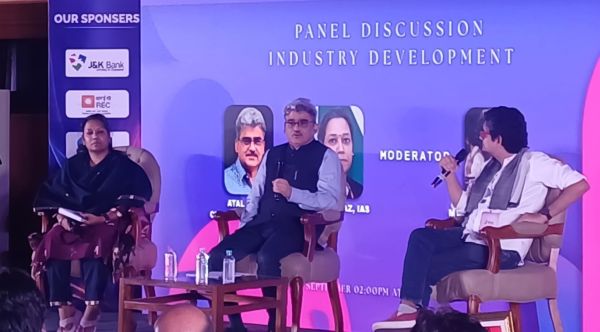
Participating in a panel discussion titled “How the J&K Film Policy, Single-Window Clearances, and Incentives Can Build a Sustainable Local Cinematic Ecosystem” at the Sher-i-Kashmir International Conference Centre (SKICC), Dulloo said the festival had been conceived as a platform to reconnect Jammu and Kashmir with the film industry and channel the creative energies of local youth towards filmmaking and allied professions.
The session, moderated by film critic and journalist Mayank Shekhar, also featured Commissioner Secretary, Information Department, R. Alice Vaz.
Dulloo recalled Jammu and Kashmir’s long association with Indian cinema, particularly during the 1970s and 1980s when the region’s landscapes featured prominently in films. He said the objective now was not merely to attract film shoots but to create a sustainable ecosystem capable of nurturing local talent and supporting a wide range of film-related professions.
He noted that cinema was a collective endeavour involving not only actors and directors but also technicians, writers, cinematographers, editors, designers and numerous other professionals whose contributions were essential to film production.
The Chief Secretary said the government was exploring avenues to provide scholarships to students interested in different aspects of filmmaking at reputed national institutions. He added that efforts were also underway to facilitate partnerships with such institutions for conducting specialised filmmaking courses and training programmes within Jammu and Kashmir.
Highlighting the role of skill development, Dulloo said the Skill Development Mission could play a key role in creating training opportunities related to filmmaking and allied sectors in local institutions.
On the regulatory front, he stressed the need to further simplify procedures for filmmakers and production houses. He said the Single Window Clearance System should be strengthened and made more efficient to remove procedural bottlenecks. He also referred to the proposed Ease of Doing Business Bill, saying it was expected to support further deregulation and facilitate a more conducive business environment for the film industry.
Dulloo also underscored the importance of encouraging local storytelling. Referring to efforts in Maharashtra to promote original writing, he said similar initiatives in Jammu and Kashmir could help identify talented storytellers whose narratives could be developed into film scripts.
“We have numerous stories here. What is required is to hone and chisel this talent and present these stories in the right form and style,” he said.
Commissioner Secretary Information R. Alice Vaz outlined the incentives available under the J&K Film Policy and said the policy was designed not only to attract productions from outside the Union Territory but also to encourage local filmmakers, artists and creative professionals.
She said special incentives had been incorporated for regional filmmakers and productions involving substantial local participation. The policy also provides benefits for films that undertake more than 50 per cent of their shooting in Jammu and Kashmir and encourages the engagement of local artists and technical personnel.
According to Vaz, these measures are aimed at creating a cycle in which increased filmmaking activity generates employment and opportunities for local talent while also showcasing Jammu and Kashmir’s landscapes, heritage and culture to wider audiences.
She also highlighted the strong connection between filmmaking and tourism, noting that greater visibility through cinema could contribute to destination promotion and wider economic activity for local communities.
The panel discussion focused on policy, regulation, education, creativity and economic opportunities linked to the emerging film ecosystem in Jammu and Kashmir. Participants emphasised that the long-term goal should be to move beyond facilitating individual film projects and instead build a sustainable ecosystem capable of supporting local talent while attracting national and international productions.
The second day of IFFJK-2026 also featured a series of creative, technical and industry-oriented sessions.
Filmmaker Sriram Raghavan conducted a masterclass on directing romantic comedies, while cinematographer Anil Mehta participated in an in-conversation session discussing the role of framing, lighting and visual composition in storytelling.
A panel moderated by Dhwani Desai examined the convergence of traditional regional art forms with animation, artificial intelligence and computer-generated imagery (CGI). The discussion featured Sanat P.C., Ujjwal Nirgudkar, Hetal Soliya, Jitin Masand, Bharath Laxmipati, Jividha Sharma and Kanika Gautam.
Another round-table discussion on film festival selections and independent cinema, moderated by Sourav Kanti Datta, brought together C.S. Venkateshwaran, Siladitya Sen, Nirmal Dhar and Reema Borah to deliberate on evolving trends in film curation and access.
The day’s proceedings concluded with a panel on acting and character development moderated by Mandar Bam and featuring Sulakhyana Barua, Rahul Bhatt and Ashoke Viswanathan.
The four-day festival has brought together filmmakers, policymakers, industry professionals, artists and students from India and abroad, with discussions spanning cinema, technology, tourism, policy and creative collaboration. Organisers said the event aims to position Jammu and Kashmir as a destination not only for film shoots but also for film education, production and creative entrepreneurship.
Bollywood must seize growing passion in J&K to revive cinematic ties: Sriram Raghavan
Filmmaker Sriram Raghavan on Tuesday said that Bollywood must seize the growing passion and confidence in Jammu and Kashmir to rekindle its cinematic bond with the region.
Raghavan, director and screenwriter known for films like Ek Hasina Thi, Johny Gaddaar, Agent Vinod and Badlapur, attended the second day of the first International Film Festival of Jammu and Kashmir (IFFJK) at the SKICC.
He conducted a masterclass on direction and screenplay writing.
“The Hindi film industry just has to sort of take up, seize the opportunity, actually. There is so much regional cinema which is also doing well, and every state has got its own culture of films. If you take Malayalam films and so on, they are doing so much right now.
“So likewise, it can happen here too, right? It will happen. That’s what I feel,” Raghavan told reporters when asked about whether Bollywood needs to fill the gap with Jammu and Kashmir, especially after the Pahalgam terror attack last year.
He asserted that there was growing passion and confidence in Jammu and Kashmir, and said the film policy framed by the UT government would “really help as there is so much confidence now.
“The assurance people have that, ‘ Okay, we can come here and make a film’, it will not be like bureaucratic red tape; it is not like that. There is love and passion. So, I think it will happen (the gap will be filled),” he added.
The filmmaker said there were so many opportunities for the people of Jammu and Kashmir in filmmaking and the festival would provide a boost to that.
“Filmmaking requires so many people, so many competent technicians and everything. I think because of the festival, I feel there will be a little boost for those who are interested in this field. Now they feel, ‘yes, we can also try’, that kind of thing. So, I think that will help. You will not notice the result very soon, but you will see it in a couple of years,” he said. (PTI)