Baramulla: A day when religious devotion filled the streets of Baramulla in three different colours, the historic town offered a powerful reminder of something deeper than celebration, a living tradition of religious harmony, amity, brotherhood and coexistence.
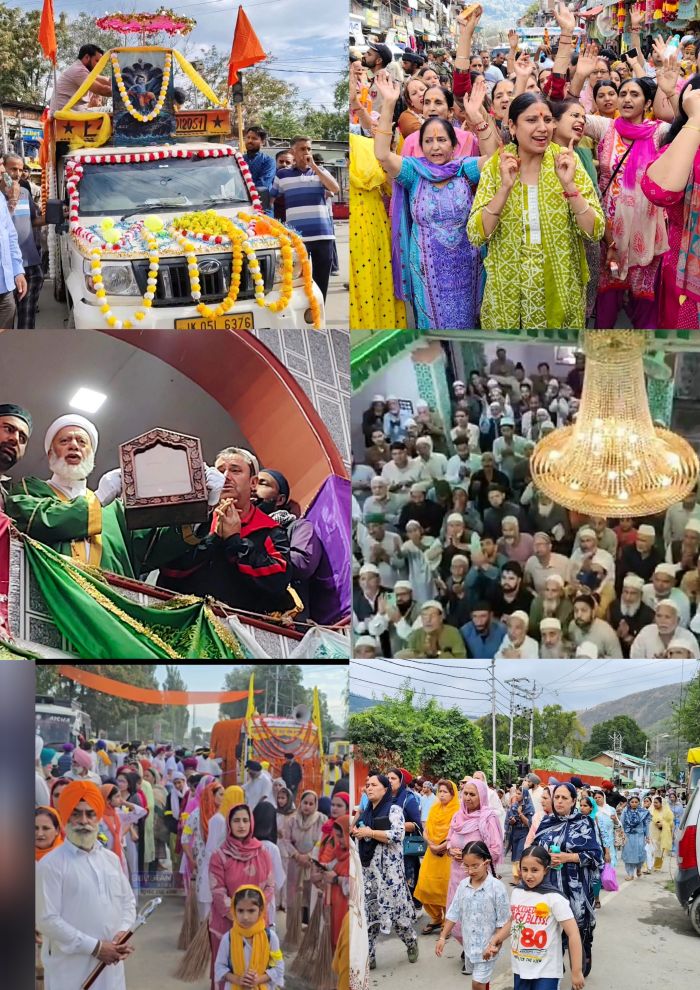
As Hindu devotees carried a colourful Jhanki from Khwajabagh to Raghunath Mandir, Muslims gathered at shrine of Dargah Aliya locally known as Nabi (SAW) Shab Shrine to mark following Friday of Eid Milad-un-Nabi (SAW), while the Sikh community took out a Nagar Kirtan from Kanispora Gurduwara Baramulla.
The coincidence of the three religious observances turned the town into a remarkable tableau of Kashmir’s composite culture, where prayer, devotion, hospitality and respect for one another transcended religious boundaries.
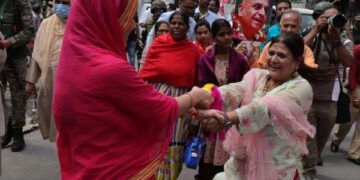
The Janmashtami celebrations began with devotees gathering at Pandit Colony, Khwajabagh, from where a colourful Jhanki procession proceeded towards the historic Raghunath Mandir Chowk.
A large number of men, women and children from the Kashmiri Pandit community participated in the procession, many dressed in traditional attire. Decorated tableaux depicting episodes from the life of Lord Krishna moved through the town amid devotional songs, bhajans and chants.The procession was not, however, confined to one community.
Muslims and Sikhs joined the celebrations along the route, with local people arranging water and juice for the devotees, turning what could have been a purely religious procession into a shared expression of neighbourhood solidarity.
At Raghunath Mandir, devotees offered prayers and sought blessings. The temple and surrounding areas were decorated for the occasion, while religious programmes continued through the day.
“I express my heartfelt gratitude to people from all sections of society for their love and support on this auspicious occasion. We are thankful to the civil administration and police for their support,” Ashwani Kumar Bamo said.
For devotees, Janmashtami was not merely about observing the birth of Lord Krishna but about keeping alive a tradition passed from one generation to another.
“Janmashtami is a celebration of faith, devotion and our cultural heritage. The Jhanki from Khwajabagh to Raghunath Mandir gives us immense happiness, but what makes the occasion more special is the affection and support we receive from people of other communities,” said Rinky Koul, a devotee.
Janmashtami is being observed across India on September 4 this year, with the midnight worship associated with Krishna’s birth extending into the early hours of September 5.
Only a short distance away, another part of Baramulla was immersed in devotion as Muslims observed second Friday following Eid Milad-un-Nabi (SAW), commemorating the birth anniversary of Prophet Muhammad (SAW).
At Dargah-e-Aliya Shere Khaas, the Holy Relic were displayed after Fajr prayers and again after every prayer up to Maghrib. A large number of devotees gathered for the glimpse of sacred relic added another deeply spiritual dimension to a day already marked by religious activity across the town.
Recent Eid Milad observances in Baramulla have also seen a major procession from the Syed Janbaz Wali (RA) shrine through the Main Market towards Dargah Aaliha Asar-e-Sharief, drawing large numbers of devotees.
The message emerging from the religious gatherings was one of peace, compassion, brotherhood and mutual respect—the values repeatedly associated with the Prophet’s teachings in Milad addresses.
Adding another dimension to the town’s religious landscape was the Sikh Nagar Kirtan, which drew participation from members of the Sikh community and passed through the town amid devotional recitations and traditional religious fervour.
The presence of the three celebrations on the same day created a rare visual and emotional spectacle: a Janmashtami Jhanki moving through one part of town, Milad devotees gathering at revered Muslim shrines and a Sikh Nagar Kirtan making its presence felt on Baramulla’s streets.
For many residents, it was a reminder that Baramulla’s identity has never been confined to a single faith.
What stood out was not merely the number of people participating in the celebrations but the ordinary acts of kindness along the roads—people offering water, helping devotees, allowing processions to pass and extending greetings across religious lines.
For an elderly resident watching the Janmashtami procession pass through the town, the scene carried memories of an older Baramulla.
“Festivals come and go, but the real festival is when your neighbour’s happiness becomes your happiness. This is the Baramulla we know where different communities pray differently but stand together when it matters,” said Shamas Manknoo as the sentiment was visible on the streets.
The Hindu devotees moved towards Raghunath Mandir; Muslim faithful made their way towards the shrines; Sikh devotees followed their religious tradition. Yet the boundaries between the communities appeared remarkably blurred in the public spaces of the town.
The celebrations therefore became more than three separate religious events. They became a portrait of Baramulla’s enduring tradition of unity in diversity.
At a time of religious animosity, conflict and division spread by vested interested people, the scenes from Baramulla offered a quieter but perhaps more powerful story: three faiths, three traditions and one town choosing to celebrate together.
As evening descended and the religious programmes continued, Baramulla’s streets carried a message that needed no loudspeaker—the message of faith with fraternity, devotion with dignity and diversity with brotherhood.
For one day, the town’s temples, shrines and streets told the same story in different languages of prayer.