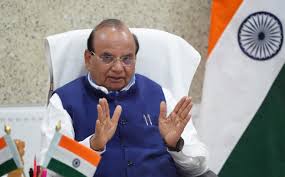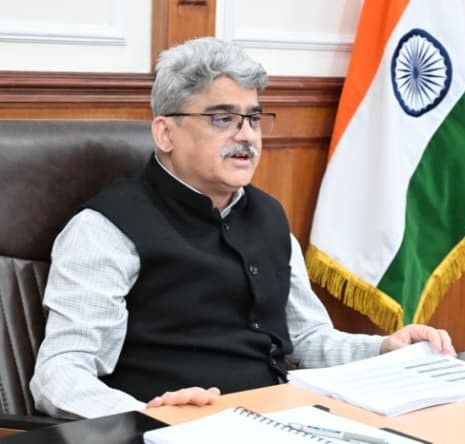
Srinagar: Chief Secretary Atal Dulloo on Friday directed officials to adopt a reliability-first and fiscally prudent approach to electric mobility in Jammu and Kashmir, stressing that expansion of electric vehicle (EV) adoption should be backed by adequate charging infrastructure, service readiness and performance validation in the Union Territory’s challenging climatic conditions.
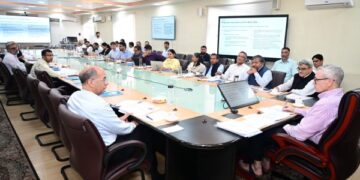
The directions were issued during a meeting convened to review the framework of the Draft Jammu and Kashmir Electric Vehicle (EV) Policy 2026, prepared by the Transport Department with support from the Centre for Innovation and Transformation in Governance (CITaG).
According to officials, Dulloo emphasised that implementation of the proposed policy should follow a phased and sequenced approach, with priority given to service preparedness before the expansion of charging corridors and wider market adoption. He said EV deployment must take into account Jammu and Kashmir’s terrain, harsh winters and sub-zero operating conditions, particularly on difficult routes, so that vehicle performance and infrastructure reliability are validated under actual field conditions before large-scale rollout.
Reviewing the fiscal framework, the Chief Secretary directed that government support should remain focused on addressing strategic gaps and building institutional capacity. He also stressed greater reliance on centrally sponsored schemes, including PM E-DRIVE, as the primary source of financial support for the EV transition. He further asked the Law Department to complete legal vetting of the draft policy before its finalisation.
On electrification of the government fleet, Dulloo directed that replacement of government vehicles should be undertaken in a phased and need-based manner, taking into account the terrain, climatic conditions and operational requirements of different regions of the Union Territory.
During the meeting, Transport Secretary Avny Lavasa said the proposed policy has been structured around eight strategic pillars covering vehicle adoption, charging infrastructure, workforce development, fiscal support, power-system integration and environmental outcomes. She said the policy envisages measurable targets over a six-year period.
Under the proposed framework, EVs are targeted to account for 40 per cent of new personal four-wheeler registrations, 35 per cent of two-wheeler registrations, 30 per cent of buses and 25 per cent of taxis and shared mobility vehicles within six years of the policy’s adoption.
To support these targets, the policy proposes expanding the public charging network from the existing 180 stations to 450 charging sites within three years and 900 sites within six years. The plan includes development of 140 priority fast-charging hubs, each expected to maintain at least 98 per cent monthly uptime.
Officials said the draft policy also proposes a dedicated Winter Validation Protocol to assess battery performance, charging efficiency and the impact of low temperatures on EV operations. It recommends incentives for early adopters through either an interest subvention of up to three per cent annually or a rolling top-up support mechanism, with beneficiaries eligible for only one of the two options.
The policy further proposes an annual scrappage exchange bonus for up to three years through authorised scrappage channels and seeks integration of EV charging demand with the power system through Time-of-Day tariffs and solar-hour charging. It targets 40 per cent renewable energy integration in EV charging operations during the policy period.
The proposed policy is expected to serve as the roadmap for electric mobility in Jammu and Kashmir, balancing environmental goals with infrastructure readiness, fiscal sustainability and the region’s unique geographical and climatic challenges.