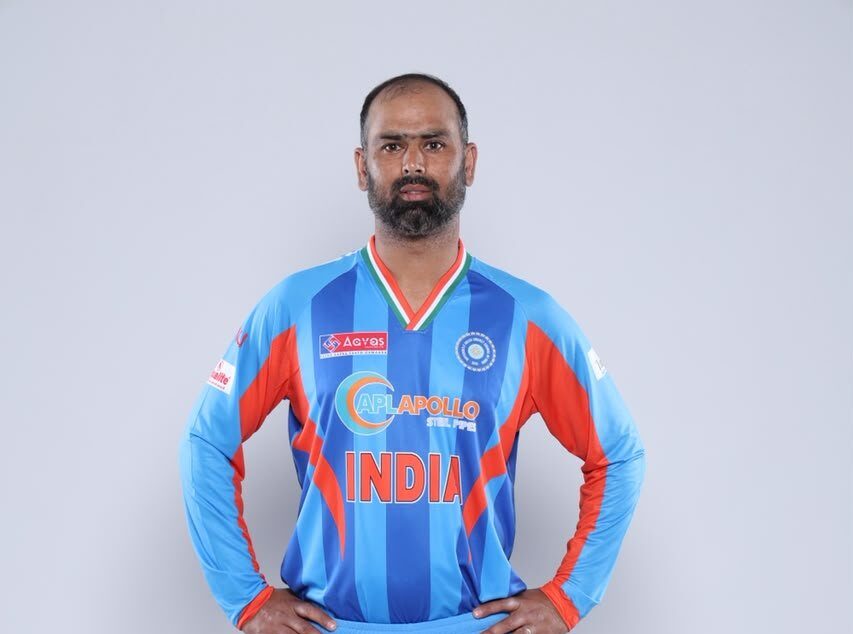
For most cricketers, the road to the national team is measured in runs, wickets and performances. For Majid Magray, it was also measured in kilometres.
Long before he was named captain of India’s mixed disability cricket team, the cricketer from Jammu and Kashmir routinely travelled 50 to 60 kilometres just to attend training sessions. With little infrastructure for differently abled cricketers in Kashmir and limited opportunities to compete, every practice session demanded as much determination as talent.
On August 19, that journey will reach one of cricket’s most revered venues—Lord’s Cricket Ground in London—where Magray will lead India in the final match of a seven-match Mixed Disability T20I series against England.
It is a story that extends far beyond cricket.
A five-year wait
Magray began pursuing his dream in 2018, but earning an India cap proved anything but easy. Despite consistent efforts, he waited five years before finally making his international debut in 2023.
Rather than discouraging him, the delay strengthened his resolve.
“I was trying to join the team since 2018. I struggled for five years. My family supported me. My father and mother supported me; my brother also supported me a lot. It is like a dream to play at Lord’s,” he told PTI.
The support of his family became the foundation that kept him going through years of uncertainty, while the absence of specialised infrastructure in Kashmir meant he often had to work much harder simply to stay competitive.
Breaking barriers in Kashmir
For differently abled athletes in Jammu and Kashmir, the challenge often begins long before competition.
Training facilities remain limited, forcing players to travel long distances in search of suitable grounds and organised coaching.
“Our infrastructure is very limited in Kashmir. We have to travel 50-60 kilometres for practice. We have to prepare well. We have to play here and there,” Magray said.
Yet his appointment as captain represents an important milestone—not only for him personally but also for disability sports in the Union Territory.
It sends a powerful message that international sporting success is possible despite geographical and infrastructural disadvantages.
More than a cricket series
India’s 16-member squad, selected by the Differently Abled Cricket Council of India (DCCI), will tour England from August 5 to 19, playing seven T20Is across Derby, Leicester, Hove, Arundel and Lord’s.
The series showcases one of cricket’s most inclusive formats.
Mixed disability cricket brings together players with different disabilities—including physical disabilities and hearing impairments—into one team, demanding communication, adaptability and mutual trust alongside cricketing ability.
Vice-captain Sai Akash Saivamani, who previously played at Lord’s in 2025, believes the format offers a unique sporting experience.
“It is mixed disability cricket. Some are physically disabled, some are deaf. It is a good experience. Everyone gets equal opportunities,” he said.
He acknowledged that building understanding among players from diverse backgrounds is just as important as preparing on the field.
A sport finding its place
Disability cricket in India has expanded considerably since the country’s triumph in the 2019 Physical Disability World Series.
According to Magray, standards have improved steadily, with greater competition and increasing participation.
“It is increasing day by day. Since 2019, India won the World Series. Since then, there has been a lot of competition. There are ups and downs, but the boys have not given up their hard work,” he said.
The evolution is also visible in training standards.
Fielding coach Rohit Sharma said today’s players have access to facilities that increasingly resemble those available to mainstream cricketers.
“We use a Kookaburra ball to practice and play. We are provided with proper grounds to train. There’s not much difference, as the sponsors are trying to provide us with all these facilities,” he said.
For him, playing at Lord’s remains a dream shared by every cricketer, regardless of ability.
Inspiring a generation
Magray cites India captain Rohit Sharma as his cricketing inspiration, but his own journey may now inspire countless young athletes across Jammu and Kashmir.
His rise demonstrates that sporting excellence is not determined solely by facilities or circumstances. Persistence, family support and unwavering commitment can sometimes bridge the widest gaps.
As he walks out to lead India at Lord’s, Magray will carry more than the tricolour.
He will represent a growing movement in Indian disability sport, the aspirations of differently abled athletes who continue to push boundaries, and the hope that future generations from Jammu and Kashmir will not have to travel quite as far simply to chase their dreams.
This feature has been prepared by Kashmir Images based on inputs from Press Trust of India (PTI).