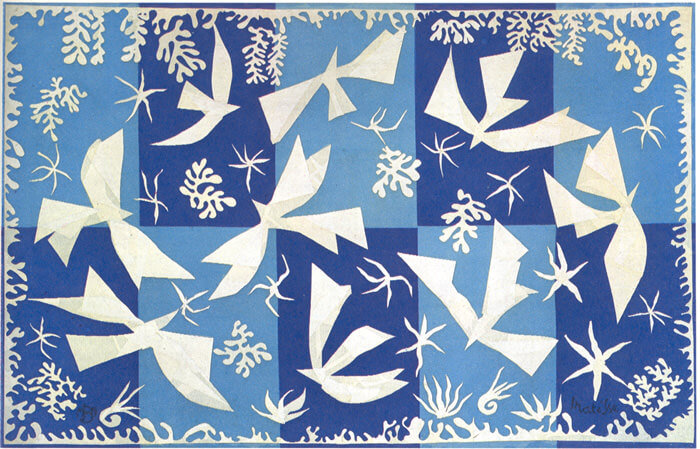
In the final decade of his life, Henri Matisse revolutionized his own art practice with a pair of scissors. No longer able to paint due to ill health, he turned to paper cut-outs, creating a striking body of work that became as iconic as his earlier paintings. These vibrant paper collages, often referred to as “cut-outs” or gouaches découpées, showcased Matisse’s enduring love for color, form, and rhythm in a bold new medium.
Rather than seeing his physical limitations as a setback, Matisse embraced them, inventing a new method of “drawing with scissors.” He would paint sheets of paper with bright gouache and then cut them into organic shapes—flames, leaves, coral, dancers, and stars—which were arranged into compositions of astounding harmony and energy. Some works remained small and intimate, while others, like The Snail or The Sheaf, exploded in scale, stretching across entire walls.
These cut-outs were not just decorative but deeply expressive. In pieces like Blue Nude II, Matisse explored the human form through pure, sculptural shapes. In Icarus , he fused myth and abstraction with emotional weight, as a dark figure flails in a field of stars and blood-red heart. His collages have a timeless joy and immediacy, revealing an artist who, even in old age, remained a relentless innovator.
Matisse’s cut-outs challenged the boundaries between painting and sculpture, craft and fine art. Far from being a footnote in his career, they are now regarded as masterpieces that redefined modern art. His s cut-outs ascertain the fact that material does not define your creativity its just matter of passion that separates great art as well as artist from the rest and it’s a proof that creativity can thrive even in the face of limitation.