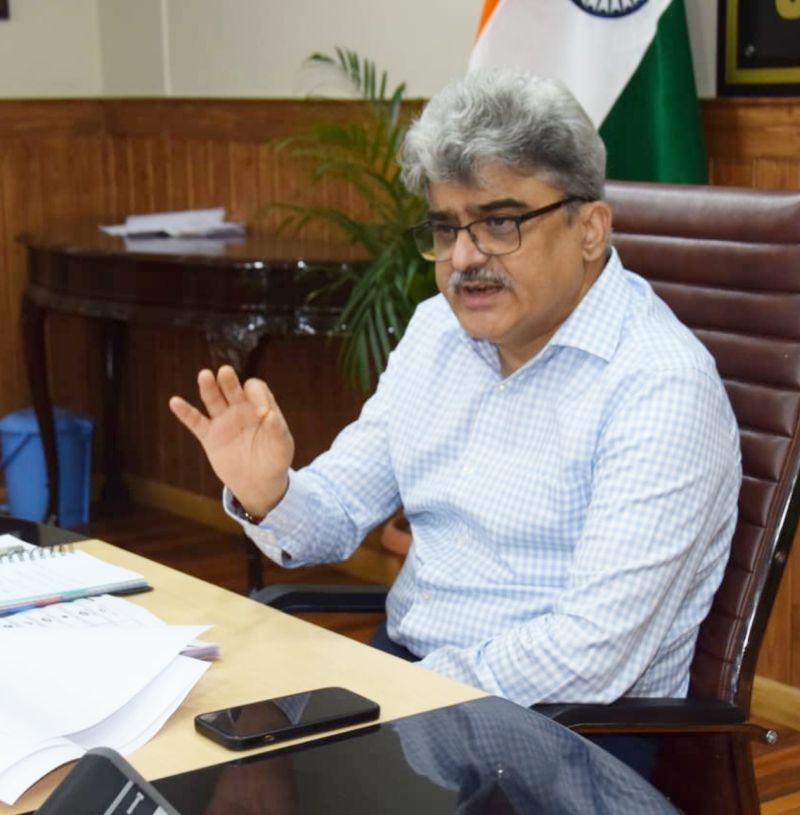
Srinagar: Chief Secretary Atal Dulloo on Friday reviewed governance and regulatory reforms adopted by Maharashtra and Gujarat, directing officials to examine their suitability for improving the ease of doing business (EoDB) and ease of living in Jammu and Kashmir.
Chairing a high-level meeting, Dulloo reviewed presentations on the business and governance reforms implemented by the two states, including measures aimed at simplifying regulatory procedures, promoting digital governance and improving citizen-centric service delivery.
The presentations highlighted initiatives such as reduction in regulatory compliances, end-to-end digitisation of government services, strengthening of single-window clearance systems, rationalisation of inspections, decriminalisation of minor regulatory offences, investor facilitation mechanisms, time-bound service delivery and simplification of land and construction-related approvals.
Officials also reviewed reforms undertaken under the Business Reform Action Plan (BRAP), District BRAP, deregulation initiatives and the Jan Vishwas framework.
During the meeting, the Chief Secretary said Jammu and Kashmir had already implemented several governance reforms but needed to accelerate administrative transformation by adopting proven national best practices suited to the Union Territory’s requirements.
He stressed that reforms aimed at improving the ease of living should complement economic reforms by ensuring easier access to government services, reducing procedural delays and improving service delivery.
Dulloo called for greater focus on rationalisation and whitelisting of services, simplification of regulatory processes, decriminalisation of minor offences and amendments to relevant laws and regulations to create a more investor-friendly environment.
He said governance reforms should be designed from the perspective of entrepreneurs and investors to simplify compliance procedures, speed up approvals and enhance transparency.
The Chief Secretary directed the Centre for Innovation, Transformation and Governance (CITaG) to undertake a comprehensive assessment comparing reforms already implemented in Jammu and Kashmir with those adopted by leading states and prepare a roadmap identifying gaps and future priorities.
He also asked CITaG to formulate a time-bound action plan with measurable milestones and coordinate with authorities in Maharashtra and Gujarat to better understand their implementation models and adapt suitable practices for Jammu and Kashmir.
The meeting concluded with a consensus that adopting proven governance models from other states, while tailoring them to local requirements, would help strengthen institutional efficiency, enhance investor confidence and improve ease of doing business and ease of living in the Union Territory.