

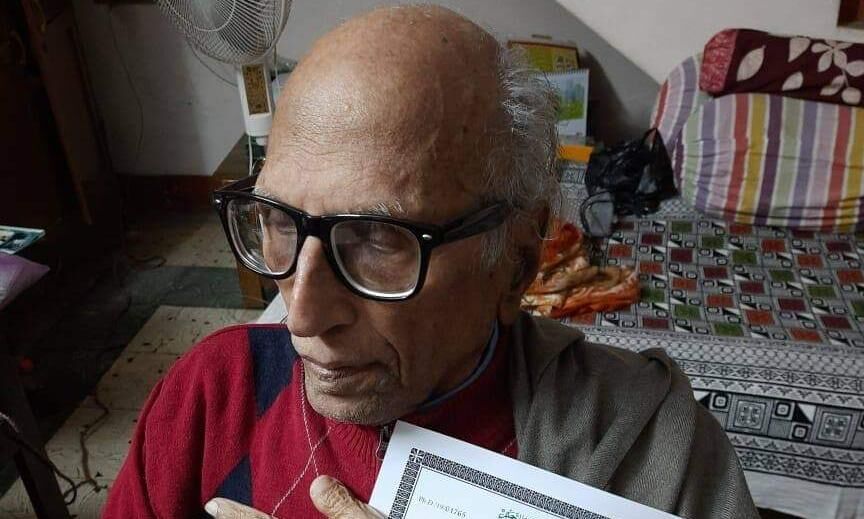
The world of Urdu literature has been left in deep grief after the passing of the renowned poet Bashir Badr, a literary figure whose poetry transcended pages and became the voice of countless hearts across generations. He was not merely a poet who composed ghazals; he was an emotion in himself, a living expression of human feelings, and a mirror reflecting the ordinary yet profound experiences of life. His words carried an extraordinary simplicity that concealed immense depth, blending warmth with pain, love with loneliness, hope with despair, and silence with meaning in a way that touched people at their very core. From literary gatherings and academic classrooms to tea stalls, radio programs, newspapers, and the vast world of social media, his poetry found a home everywhere, becoming part of everyday human expression rather than remaining confined to books alone.
Bashir Badr was born on February 15, 1935, in Ayodhya, Uttar Pradesh. His family had always been known for its education level. As a child, Bashir was interested in poetry and literature; thus, it is often claimed that at the age of seven, Bashir composed his very first sher.
He completed his higher studies from the Aligarh Muslim University from where he attained his Bachelor’s degree, Master’s degree, and later a PhD in Urdu literature. He gained popularity as a writer early on, and soon became a prominent figure among the academics of Urdu literature. He taught Urdu literature and later became the Head of the Urdu Department of Meerut College. In addition to being a teacher, he was a poet too, whose poems gradually made their way into every part of the Urdu-speaking world.
The thing that set Bashir Badr apart from all the other poets is that he was simple. He didn’t use fancy language that would make people think that they were reading an exceptionally brilliant poem. His poems were written in language which had a lot of feeling in it, and talked about love, loneliness, broken heart, memory, relation, silence, and changeability of life.
The well-known couplet of Bashir Badr:
“Log toot jaate hain ek ghar banane mein,
Tum taras nahi khate bastiyan jalane mein”
It is one of the most commonly quoted lines in Urdu poetry. This couplet has affected many because it is loaded not only emotionally but socially too.
There is another immortal couplet written by Bashir Badr:
“Ujale apni yaadon ke hamare saath rehne do,
Na jaane kis gali mein zindagi ki shaam ho jaye.”
These poems still have an impact on the minds of people as they touch upon various issues related to memories, emotions, and the unpredictability of life.
Bashir Badr has gained enormous popularity at mushairas in India and abroad. The manner in which he performed poetry was calm, elegant, and deeply emotional. The audiences would be eagerly waiting to hear him perform. As against most poets who used hard vocabulary and exaggerated performances, Bashir Badr used simplicity.
However, behind this beautiful poetry were many years of pain and agony. One of the hardest events that took place in his life happened in 1987 when communal riots erupted in Meerut. His house was burnt, and in that fire, thousands of books, letters, and unpublished manuscripts perished forever. To an author, losing years of literary works would be equivalent to losing an important part of oneself. This incident affected him very deeply.
What made Bashir Badr outstanding in the world of poetry was the fact that even after going through all those tragedies, there was no trace of anger or rage in his poetry. In spite of his pain and suffering, he kept speaking of man, of peace, of mercy, and of love.
He left Karachi after the riots and settled down in Bhopal where he passed his entire latter part of life. Regardless of all the hardships and problems that he faced, he continued to pen poetic verses that had an impact on the lives of people for generations. Some of his renowned poetry books include “Aamad,” “Aahat,” “Ikai,” “Image,” and “Ujale Apni Yaadon Ke.” His total literary contributions appeared in a collection called “Kulliyat-e-Bashir Badr.” Bashir Badr’s poetry was translated into various languages including English and French.
There could have been many factors responsible for his popularity, but one among them is his contribution that can be enjoyed by every generation. The youth found him appealing because of his simplicity in penning emotional expressions in verses. Even in today’s era of social networking sites, his couplets are used for declaring love, pain, memories, and other such feelings.
He had an influence not only in literature. Politicians, journalists, actors, singers, and public speakers cited lines from his poems frequently. He has authored many memorable verses. Here is one such couplet which demonstrates wisdom and dignity even during conflict:
“Dushmani jam kar karo lekin ye gunjaish rahe,
Jab kabhi hum dost ho jayein to sharminda na hon.”
Such poems proved Bashir Badr’s understanding of human relations and social dynamics.
Bashir Badr received numerous awards and honors throughout his life. The poet was conferred Padma Shri, one of the most esteemed Indian civil awards. Apart from this, he won the Sahitya Akademi Award and various other awards from literary societies across India. Despite being a celebrated poet, Bashir Badr always maintained his humility and soft nature.
Later on in his life, he was affected by dementia along with various other age-related ailments. Gradually, he started withdrawing himself from public mushairas and literary functions. His admirers were heartbroken when the news of the poet, who kept a lot of people’s memories alive in his poems, gradually began forgetting some memories of his own.
Bashir Badr died on May 28, 2026, in Bhopal, at the age of 91, following an illness. He was mourned throughout the country and the world. Writers, poets, journalists, students, fans, and others paid their last respects to him. He was not just regarded as a wonderful poet but a very humane person too.
Even after death, Bashir Badr lives in the form of his poetry. His poetry comforts the broken hearts of people, motivates young poets, and reminds people about the importance of simplicity and honesty in life. Even today, when everything around seems to be artificial, Bashir Badr’s poetry is like a soothing balm for everyone.
He did not merely write poetry. He gave a voice to human feelings.
And perhaps that is why Bashir Badr will always remain alive in the world of Urdu literature and in the hearts of people who continue to find themselves in his words.
The writer is a social activist and a nursing student. wania6817@gmail.com


