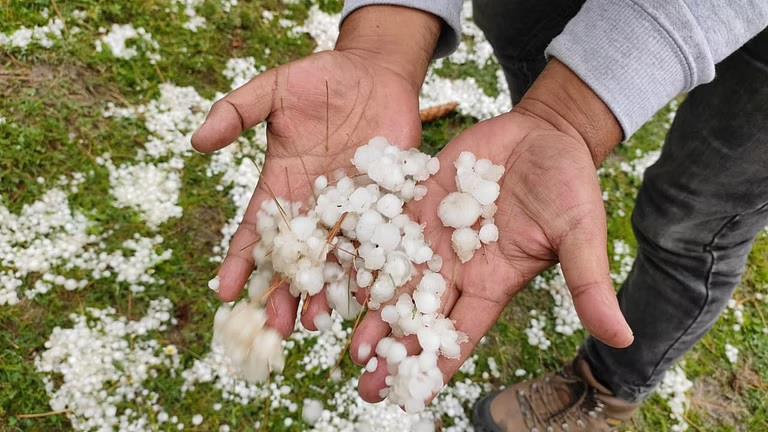
Srinagar: A severe hailstorm accompanied by heavy rainfall on Saturday damaged orchards and standing crops across several parts of Kashmir, including areas in Kulgam, Kupwara, and Baramulla districts, officials and locals said.
Farmers told Kashmir News Observer (KNO) that the sudden spell, marked by large hailstones and intense showers, struck during the afternoon, damaging apple blossoms and tender fruit at a critical stage of the growing season. They said the losses are likely to affect overall yield this year.
Residents have urged the administration to conduct an immediate assessment of the damage and provide compensation to affected growers.
Meanwhile, Sher-e-Kashmir University of Agricultural Sciences and Technology Kashmir issued a detailed advisory through its Directorate of Extension to help farmers minimise losses and prevent secondary infections in orchards and crops following the hailstorm.
The advisory emphasised immediate drainage of excess water to prevent waterlogging, which can lead to root suffocation and increase the risk of fungal diseases. Farmers were advised to carefully remove hail deposits and debris from trees to avoid bark injury and branch breakage.
It also recommended pruning of damaged branches using clean tools, followed by application of protective paste on cut surfaces to prevent pathogen entry. Partially uprooted trees should be repositioned and properly supported.
Highlighting the increased risk of disease after hail injury, the university advised growers to apply protective fungicide sprays once weather conditions improve. Specific formulations were suggested for apple at the fruitlet stage, as well as for other fruit crops including cherry, peach, plum, apricot, grapes, and pear, along with vegetables.
The advisory further recommended a follow-up nutritional spray, including urea solution after a few days, to promote recovery and new growth, along with micronutrient sprays at later stages to aid tissue repair.
Farmers were also advised to carry out spraying during cool and dry periods, avoid water stagnation, and maintain orchard sanitation by removing fallen leaves, fruits, and twigs to reduce the spread of disease.