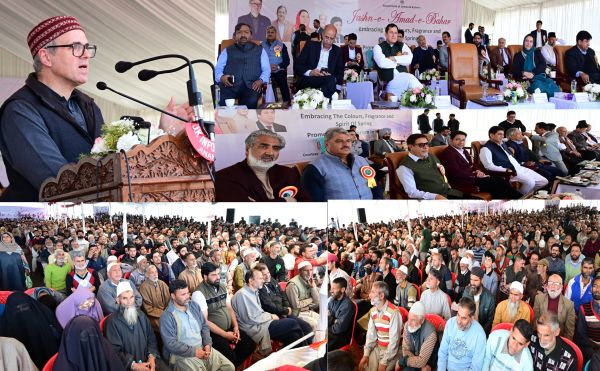
BIJBEHARA: Chief Minister Omar Abdullah on Tuesday inaugurated “Jashn-e-Amad-e-Bahar”, a spring festival organised on the occasion of Baisakhi at Jablipora in Bijbehara area of Anantnag district.
Addressing a large gathering, Abdullah described spring as a symbol of renewal and hope and said the festival marked not only a seasonal transition but also a new phase of development and governance in Jammu and Kashmir.
“We always celebrate the arrival of spring because spring is a new beginning for us. These celebrations are not only meant to welcome the season, but also to remind people that after the formation of our government, a new path has been created,” he said.
Referring to decisions taken during the recent budget session, the chief minister highlighted measures such as free six LPG cylinders for the poorest households and free electricity under the PM Surya Ghar Muft Bijli Yojana.
Abdullah also described the government’s decision to allow private universities in Jammu and Kashmir as a landmark step aimed at expanding access to quality higher education within the Union Territory.
He said students from Jammu and Kashmir often face financial and logistical difficulties while pursuing higher education outside the region and asserted that inviting private universities to establish campuses in the Union Territory would help address the issue.
The chief minister said his government was committed to strengthening rural livelihoods and boosting farmers’ income through a sustainable and self-reliant agriculture sector. He outlined several initiatives in the agriculture and allied sectors, including expansion of high-density plantations, development of cold storage and marketing infrastructure and greater use of technology in farming.
Highlighting the potential of south Kashmir, Abdullah said the region’s fertile land and favourable climate make it ideal for agriculture and tourism. He said the area’s lavender fields, mustard blooms and paddy landscapes could be promoted through agro-tourism to generate livelihood opportunities and showcase the region’s agrarian heritage.
He also said the government aims to turn the region into a hub of the “White Revolution” through modern dairy farming, including milk processing units, better veterinary support, high-yield cattle and stronger market linkages.
Present on the occasion were Health and Medical Education Minister Sakeena Masood Itoo, Agriculture Production Minister Javid Ahmad Dar, Advisor to the Chief Minister Nasir Aslam Wani and MLA Srigufwara-Bijbehara Bashir Ahmad Shah Veeri.
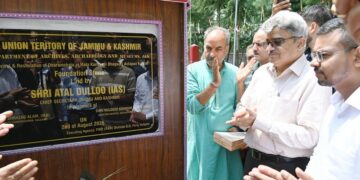
Separately, Abdullah inaugurated a “state-of-the-art” Fruit and Vegetable Processing Centre at the International Fruit Market in Jablipora, Anantnag.
The processing centre has been established at the International Fruit Market, Jablipora, at an estimated cost of ₹4.30 crore under the CAPEX budget. The project has been executed by Jammu and Kashmir Horticultural Produce Marketing and Processing Corporation Limited.
According to officials, the facility has been developed to strengthen post-harvest infrastructure and improve value addition for horticultural produce in the region.
Speaking at the inauguration, the chief minister said such modern infrastructure would help reduce post-harvest losses and ensure better returns for farmers. He said the government was working to build a robust value chain in the horticulture sector to enable local produce to compete in national and international markets.
The centre includes a fruit and vegetable canning and packaging unit, a sorting and grading pack house, a mushroom processing unit and a tomato puree manufacturing facility. It also houses a high-capacity fruit drying unit capable of processing 400 to 500 kilograms per hour, a 20 metric tonne freezing chamber and advanced packaging and storage facilities.
Abdullah said these facilities would significantly enhance processing capacity, extend shelf life and create new market opportunities for local growers and agri-entrepreneurs.
Earlier, the chief minister visited stalls put up by agriculture and allied departments and interacted with progressive farmers, agri-entrepreneurs and self-help groups. He appreciated the innovations and locally developed products on display and assured continued government support in the form of training, financial assistance and market linkages.