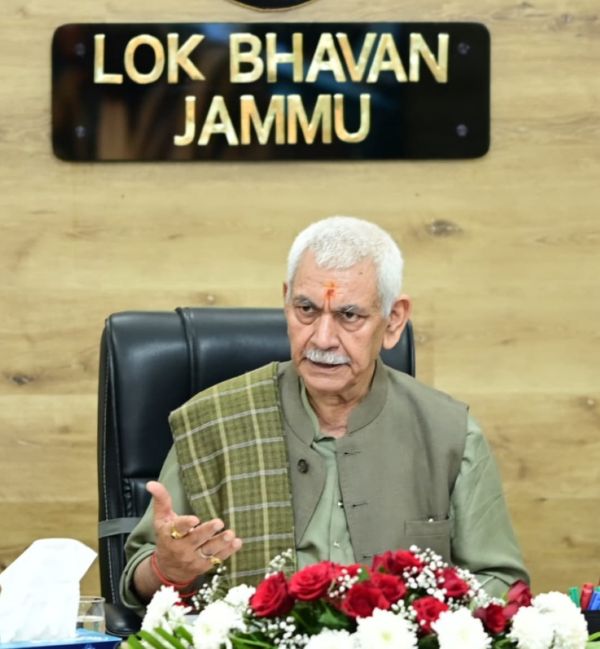
Jammu: Lieutenant Governor Manoj Sinha on Wednesday chaired a high-level meeting to discuss a strategic collaboration between SKUAST Jammu and the International Food Policy Research Institute (IFPRI) for strengthening evidence-based policy-making and sustainable agricultural transformation in the Union Territory, an official press release informed.
It said the meeting was attended by Atal Dulloo, Chief Secretary; Dr Ashish Chandra Verma, Additional Chief Secretary, Agriculture Production Department; Shailendra Kumar, Additional Chief Secretary, Finance Department; Dr Mandeep K. Bhandari, Principal Secretary to LG; Prof. B. N. Tripathi, Vice Chancellor, SKUAST-Jammu; Dr Shahidur Rashid, Director, IFPRI-South Asia; Dr Anjani Kumar, Senior Research Fellow, IFPRI-South Asia; Dr Sagar Doifode Dattatray, Mission Director, HADP; HoDs, faculty of SKUAST Jammu and other senior officials.
The LG welcomed the proposed collaboration with IFPRI, noting that its global expertise would significantly strengthen institutional capacities in the region.
The meeting discussed the establishment of a Centre of Excellence for Food Policy and Data Analytics at SKUAST-Jammu in collaboration with IFPRI. The proposed Centre is envisioned as a knowledge hub to support continuous monitoring, policy evaluation and data-driven decision making while also contributing to national and global discourse on agricultural transformation, particularly in mountain and high-value production systems.
Experts from IFPRI, including Dr Shahidur Rashid and Dr Anjani Kumar, shared insights on institutional and technical support required for revitalising agriculture and rural economies.
During the meeting, Dr Anjani Kumar presented a detailed presentation on “Institutional and Technical Supports for Revitalising Agriculture and Rural Economies in Jammu & Kashmir.”
The deliberations also underscored the importance of convergence across key initiatives such as HADP, JKCIP and Mission YUVA with a focus on improving farmer incomes, generating employment, strengthening value chains and promoting inclusive growth, particularly for smallholders, women and youth.