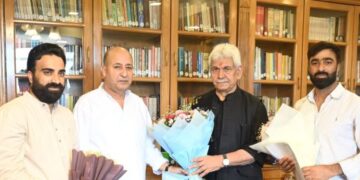
New Delhi: Bharatiya Janata Party (BJP) Jammu & Kashmir President and Member of Parliament (Rajya Sabha), Sat Sharma, raised a significant issue concerning the need for strengthening healthcare infrastructure in Jammu & Kashmir during Zero Hour in the Rajya Sabha.
While addressing the House, Sat Sharma emphasised that ensuring robust hospital infrastructure, adequate availability of doctors, and modern medical facilities across urban, rural, and border areas is essential to guarantee timely and quality healthcare for every citizen. He stressed that there is an urgent need to further modernise and expand healthcare services in Jammu & Kashmir, particularly in rural, remote, and border regions where access to quality medical care remains a challenge.
Sat Sharma underscored that Jammu & Kashmir has witnessed a remarkable transformation in the healthcare sector in recent years, driven by the visionary leadership of Prime Minister Narendra Modi, Union Home Minister Amit Shah, and Union Health Minister JP Nadda.
He noted that the historic abrogation of Article 370 paved the way for unprecedented policy interventions and liberal financial support, significantly accelerating infrastructure development in the region. He also expressed gratitude for landmark initiatives such as the sanctioning of two AIIMS in Jammu & Kashmir, besides more premier health, as well as health education institutions to strengthen tertiary healthcare capacity in the Union Territory.
Highlighting key achievements, Sat Sharma stated that over 1.78 lakh Ayushman Arogya Mandirs are operational across rural, urban, and tribal areas, providing primary healthcare services and enabling tele-consultation with specialists. He also mentioned the strengthening of human resources under the National Health Mission, including the recruitment of doctors, paramedical staff, and the deployment of thousands of ASHA workers.
He further lauded the implementation of Ayushman Bharat Pradhan Mantri Jan Arogya Yojana and the extended SEHAT scheme, which have ensured universal health insurance coverage for all residents of Jammu & Kashmir, offering cashless treatment up to ₹5 lakh per family annually at empanelled hospitals.
However, Sat Sharma expressed concern over persistent infrastructural gaps, pointing out that a significant number of doctor and nursing positions remain vacant in rural healthcare institutions. He noted that out of 1,677 sanctioned posts of doctors and medical officers in rural Primary Health Centres, only about 1,030 are filled, leaving around 647 positions vacant. Similarly, 177 posts of staff nurses remain unfilled, adversely affecting healthcare delivery.
He stressed that these gaps are particularly critical given the difficult terrain, high-altitude regions, and border districts of the Union Territory, where patients often have to travel long distances to reach tertiary care hospitals in cities like Jammu and Srinagar. In emergency situations, delays caused by distance, terrain, and weather can pose serious risks to lives.
Sat Sharma also highlighted ongoing infrastructure development initiatives, including the establishment of Critical Care Blocks in every district under the Ayushman Bharat Health Infrastructure Mission, aimed at strengthening secondary and tertiary healthcare capacity.
In his address, he urged the government to consider several key measures, including upgrading district hospitals and community health centres with advanced diagnostic and intensive care facilities, introducing special incentive packages for doctors serving in remote and border areas, expanding telemedicine platforms like e-Sanjeevani, establishing more medical and paramedical institutions in underserved districts, and improving emergency response systems through better road connectivity, ambulance networks, and air evacuation services.
Sat Sharma stated that access to quality healthcare is not merely a development indicator but a fundamental necessity for human dignity and social security. Strengthening the healthcare ecosystem in Jammu & Kashmir will not only improve health outcomes but also build confidence among people living in remote and border regions.
He urged the government to continue prioritising investments in hospital infrastructure, medical workforce, and digital healthcare services to ensure equitable, affordable, and quality healthcare for every citizen, irrespective of geography.