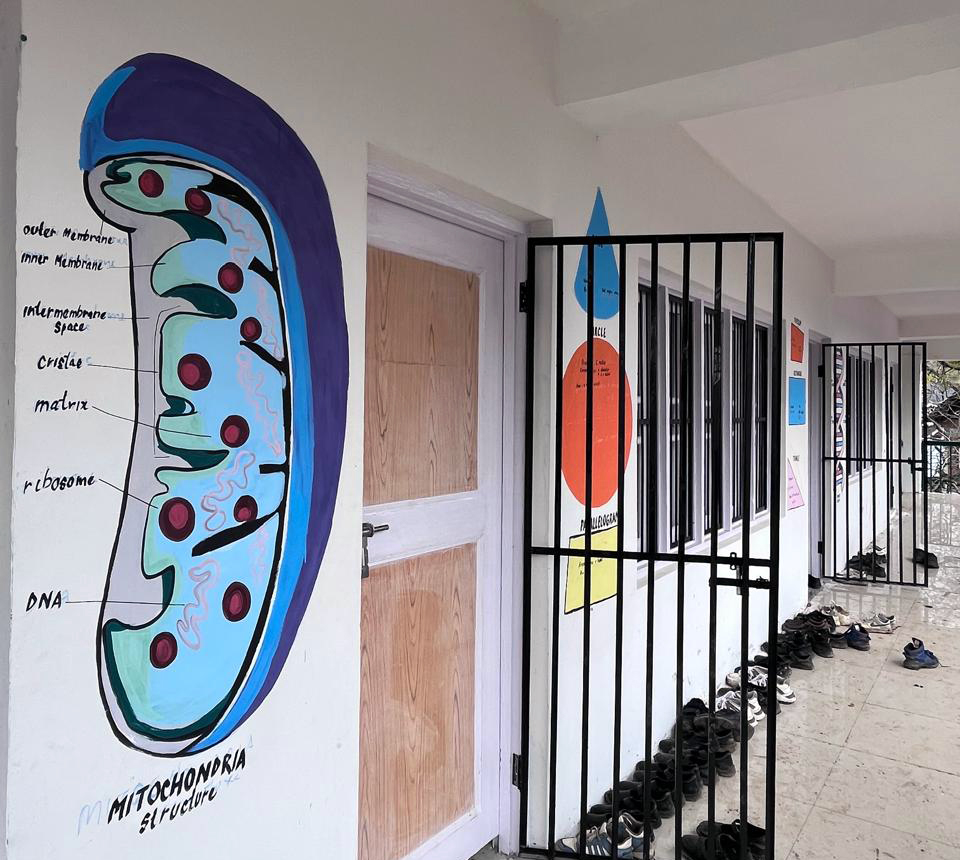
In many schools across India, the walls are no longer silent. They speak through numbers, maps, alphabets, and colorful diagrams that turn ordinary spaces into lively classrooms. This growing approach—often called “Learning from Walls”—is transforming school infrastructure into an active educational resource.
When I was a student, I do not recall seeing educational murals or thoughtfully designed wall graphics in my school. At most, there were a few posters made by students, usually as part of assignments—more like homework displays than tools that truly helped learning. The walls of classrooms and corridors were largely blank and uninviting, offering little more than a surface to lean against when tired.
Today, the situation in many schools has changed significantly. Classrooms, corridors, and even outer walls are often filled with educational murals—multiplication tables, grammar charts, maps, scientific diagrams, and inspiring illustrations. What were once empty spaces are now being used to reinforce lessons visually, turning the very walls of a school into s teachers. For young learners especially, this constant visual exposure helps reinforce lessons even outside formal teaching hours.
The idea draws inspiration from the Building as Learning Aid (BaLA) concept, developed to integrate school architecture with pedagogy. The program, promoted by organizations like UNICEF and implemented through India’s school infrastructure initiatives, encourages the use of walls, floors, windows, and outdoor spaces as teaching aids.
Education experts say the approach supports visual and experiential learning, a key principle emphasized in the National Education Policy 2020. Instead of relying only on textbooks, children interact with information around them, making learning more engaging and memorable.
Several states have embraced the concept enthusiastically. Government schools in cities and rural areas alike are turning blank surfaces into “learning murals.” In many places, teachers and local artists collaborate to create paintings that combine academic concepts with regional culture and art styles. These walls often include puzzles, number games, and illustrated stories designed to encourage curiosity.
Educators note that such visual tools are particularly effective for primary school children. Young learners absorb patterns, symbols, and colors quickly, and seeing them repeatedly throughout the school day strengthens understanding. At the same time, vibrant walls create a more welcoming environment that can improve student attendance and enthusiasm for learning.
Another advantage is cost. Compared with digital classrooms or expensive equipment, educational wall art is relatively inexpensive and can last for years with minimal maintenance. In resource-limited schools, it offers a practical way to enrich the learning environment.
Across India, as classrooms evolve to meet modern educational goals, this simple idea is quietly reshaping school spaces. With alphabets, formulas, and stories painted across their surfaces, the walls of many schools are proving that learning does not always need a blackboard—it can be written all around us.