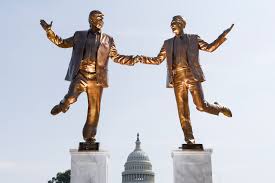
Artists have always used their art as a tool to create a debate on highly sensitive political issues as well as commentary on social and environmental awareness. There are many artists and art groups who use public spaces to push their ideas and concern in a way to get maximum response. Particularly In recent years, public spaces have increasingly become stages for political satire and artistic protest. One recent striking example was the controversial statue installed by the anonymous activist art collective Secret Handshake, depicting Donald Trump alongside Jeffrey Epstein. The installation drew immediate public attention, not only because of the figures it portrayed but also because of the provocative symbolism embedded in both the artwork and the name of the group behind it.
The collective chose the name “Secret Handshake” deliberately. Traditionally, a secret handshake refers to a private gesture shared by members of exclusive societies, allowing them to recognize one another while remaining hidden from outsiders. By adopting this name, the artists sought to evoke the idea of hidden networks of influence—elite circles where relationships, power, and privilege operate away from public scrutiny. The title therefore served as a metaphor for insider connections and the unseen dynamics that often shape political and social power.
The statues themselves were conceived as satirical political art. One version presented the two figures in an exaggeratedly friendly pose, highlighting their past social acquaintance and inviting viewers to reflect on the nature of such associations. Another installation referenced the famous scene from the film Titanic, recreating the dramatic pose of standing at the bow of the ship with arms outstretched. By placing Trump and Epstein in this recognizable cinematic moment, the artists employed irony and visual humor while also hinting at themes of power, spectacle, and hubris.
Unlike traditional monuments, these sculptures were not meant to be permanent. They were temporary, guerrilla-style installations placed in public spaces with the intention of provoking discussion before authorities removed them. The approach reflects a broader trend in contemporary protest art, where artists use unexpected public interventions to challenge political narratives and stimulate debate. Such works rely heavily on symbolism and immediacy: a single striking image can communicate a complex critique and spread rapidly through media and social networks.
Regardless of where one stands, the episode illustrates the evolving role of art in public discourse. In the digital age, a temporary sculpture placed in a prominent location can quickly become a global conversation. The “Secret Handshake” installations demonstrate how contemporary artists continue to use satire, symbolism, and public space to challenge perceptions of power and to spark dialogue about politics, accountability, and the relationships that shape them.