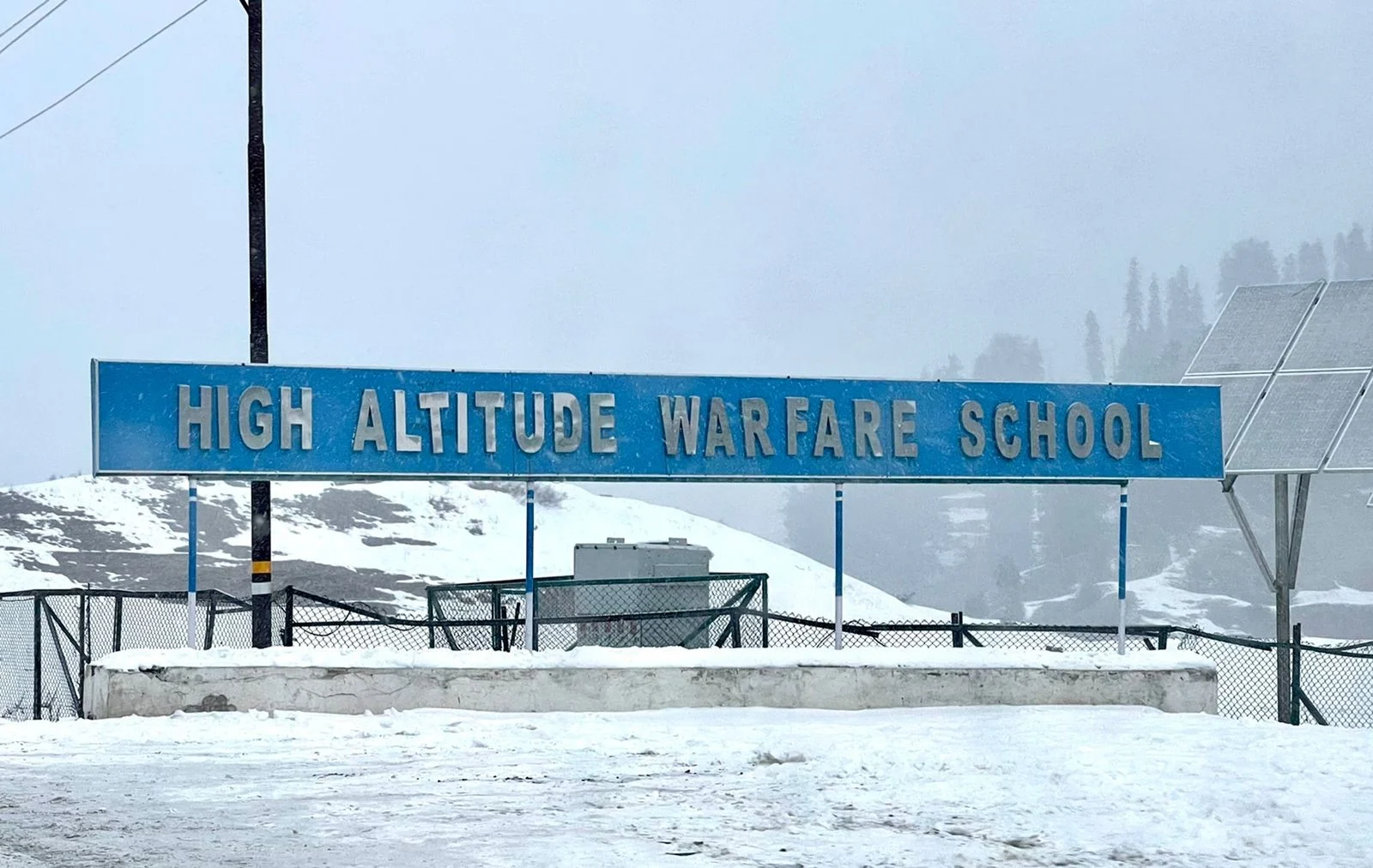
Gulmarg: The medals glittered under the pale mountain sun at the Khelo India Winter Games, but many of the athletes did not credit the podium for their success. Instead, they pointed uphill — toward the snow-covered ridges above Gulmarg and the disciplined training environment of the Indian Army’s High Altitude Warfare School (HAWS).
At the 6th edition of the Khelo India Winter Games, held from February 23 to 26, competitors representing states, Union Territories and institutional teams — including the Indian Army, Central Reserve Police Force (CRPF) and Indo-Tibetan Border Police (ITBP) — repeatedly credited HAWS for their performance, calling it the foundation of India’s modern winter sports ecosystem.
Originally established in December 1948 by Brigadier (later General) K.S. Thimayya as the 19 Infantry Division Ski School, the institution began as a necessity for troops operating in avalanche-prone terrain. It later evolved into the Winter Warfare School and, on April 8, 1962, was upgraded to a Category-A training establishment and renamed the High Altitude Warfare School, with a mission to master mountain warfare and survival in extreme snow conditions.
Perched at nearly 9,000 feet in Gulmarg, HAWS specialises in snowcraft and winter warfare, conducting elite mountain and winter warfare courses combining high-altitude combat preparedness, survival skills and intelligence training. Over the decades, however, the same rigorous training environment has also produced elite winter sports athletes.
Twenty-five-year-old CRPF athlete Kajal Kumari Rai from Shillong exemplified that transformation. Having never seen snow before 2024, she won gold in the Nordic women’s 15 km and 10 km sprint events within a year. She credited a 15-day skiing initiation at HAWS for changing her career trajectory.
“Joining the CRPF gave me direction, but HAWS and the Army gave me belief,” she said.
Bhavani T.N., another standout performer who won gold in the Nordic women’s 1.5 km sprint and bronze medals in the 15 km and 10 km races this season, also trained at HAWS after first learning skiing at the Indian Institute of Skiing and Mountaineering (IISM). The 23-year-old athlete from Karnataka said the Gulmarg training refined her balance, endurance and competitive edge.
In the men’s Nordic 10 km race, Army athletes dominated the podium with Padma Namgail winning gold, Aman silver and Manjeet bronze. The Army again swept medals in the 1.5 km sprint through Sunny Singh, Shubam Parihar and Manjeet. Athletes described HAWS not merely as a training centre but as a “crucible” for winter champions.
Namgail said the institution plays a crucial role in grooming athletes from the armed forces and beyond. “There are no issues of funding, training, coaching or competition exposure. The best even get training opportunities in Europe. The tracks are tough and the ice is hard, but HAWS prepares us for that,” he said.
Indian Army team manager Col. Kumar Singh Negi termed the system “structured and scientific,” noting that expert trainers from Italy, Norway, Sweden and Kazakhstan help athletes reach international standards.
Army coach Rameez Ahmad said HAWS maintains a steady pipeline of 250 to 300 Army winter sports athletes annually, in addition to civilian trainees. Currently, 24 athletes train in Alpine skiing, 16 in snowboarding and about 20 in Nordic skiing, with some also participating in ski mountaineering. Each athlete logs at least 600 training hours a year.
The facility includes ski simulators — reportedly the only such setup in India — roller skis for off-season training, a modern gymnasium and an indoor sports complex allowing uninterrupted conditioning even during heavy snowfall. Nutrition plans are monitored by dieticians, while physiotherapy support and specialised equipment comparable to international competitions are provided.
Physiotherapist Vivek Kaktwan described the infrastructure as “world-class,” adding that altitude itself gives athletes a competitive advantage.
HAWS’ influence extends beyond the Army. CRPF team manager Magesh K said Army coach and Olympian Nadeem Iqbal has worked with CRPF athletes over the past three years, improving technique and raising performance standards.
The results were evident throughout the Games, where multiple medal winners traced their journey back to the same institution.
In Gulmarg, medals may hang around individual necks, but their story leads back to a single address in the snow — a military school built for survival that has quietly evolved into India’s most consistent producer of winter sports champions.