PIB BACKGROUNDER
On a mild February morning in New Delhi, the glass façade of Bharat Mandapam reflected more than sunlight. It reflected possibility. Inside, thirteen country pavilions stood in a sweeping arc, each a statement of intent. Australia, Japan, Russia, the United Kingdom, France, Germany, Italy, the Netherlands, Switzerland, Serbia, Estonia, Tajikistan and a collective African pavilion had all arrived with ideas, investments and quiet ambition. This was the hook of the India AI Impact Summit 2026. The world had not just come to attend. It had come to collaborate.
From 16 to 21 February 2026, the India AI Impact Expo unfolded alongside the Summit, spreading across ten arenas and more than 70,000 square metres. Global delegates, technology leaders, researchers and students moved through expansive halls designed for dialogue and demonstration. In response to the overwhelming interest, the Government of India extended the exhibition by an extra day, keeping it open to the public on Saturday, 21 February, to ensure a more comfortable experience. The gesture was simple but telling. This was not a closed room conversation. It was a public moment.
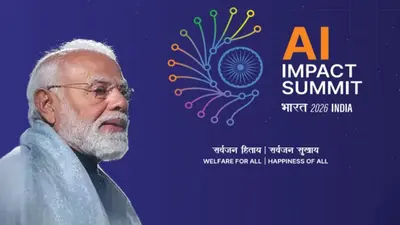
At the centre of it all lay a theme rooted in civilisational confidence — ‘Sarvajan Hitaya, Sarvajan Sukhaya’ (Welfare for all, Happiness of all). In his inaugural address, Prime Minister Narendra Modi said this was India’s benchmark for artificial intelligence. He spoke of diversity, demography and democracy as India’s enduring strengths. Any AI model that succeeded in India, he noted, could be deployed globally. Then came the invitation: design and develop in India; deliver to the world; deliver to humanity. The words travelled far beyond the hall.
The thirteen country pavilions gave those words texture. At the French Pavilion, visited by President Emmanuel Macron and Prime Minister Modi, twenty-nine companies displayed France’s technological edge. The visit marked an energetic beginning to the India-France Year of Innovation. President Macron was candid in his praise. India, he said, had built what no other country had built — a digital identity for 1.4 billion people, a payment system processing 20 billion transactions every month, and a health infrastructure that had issued 500 million digital health IDs. This, he reminded the audience, was the India Stack — open, interoperable and sovereign. “We are at the beginning of a huge acceleration,” he added.
A few steps away, Estonia’s pavilion drew steady crowds. Known for its digital governance model, Estonia found resonance here. President Alar Karis observed that digital public infrastructure was no longer merely a technical backbone; it was the foundation of how modern states operated. When AI was embedded into these systems, algorithmic transparency and human oversight became essential conditions for public trust. His words echoed across discussions on ethics and accountability. Collaboration here was not abstract. It was structural.
Slovakia’s President Peter Pellegrini offered a grounded perspective. India showed the world an important truth, he said: technology could be built at scale and could help real people. Slovakia might be smaller, but it could move fast and wanted practical outcomes. Finland’s Prime Minister Petteri Orpo called the Summit timely, noting that the world urgently needed shared understanding, common rules and political will for responsible AI. Switzerland’s President Guy Parmelin spoke of inclusive dialogue and multilateral cooperation. Responsible AI did not hinder innovation, he insisted — it enabled it. India and Switzerland, he added, were building a bridge between ambition and implementation.
These voices converged across seven thematic Chakras that organised the Expo: Human Capital; Inclusion for Social Empowerment; Safe and Trusted AI; Resilience, Innovation and Efficiency; Science; Democratizing AI Resources; and AI for Economic Growth and Social Good. The Chakras translated People, Planet and Progress into concrete areas of action. Delegations moved between them, finding intersections between research labs, startups and public institutions. Conversations shifted from compute capacity to classroom skilling, from data governance to green energy grids.
The Pavilion of the International Solar Alliance introduced another dimension. It showcased practical models where AI, digital platforms and geospatial tools modernised utilities and accelerated renewable integration. The Global Mission on AI for Energy emerged as a point of convergence. Solar deployment met digital intelligence; real-time optimisation met smarter grid management. The collaboration was technical, yet its implications were social. Energy resilience across member countries became a shared objective.
Across the ten arenas, global technology firms, startups, academia, Union Ministries, State Governments and research institutions created a mosaic of capability. The scale was unmistakable. Yet the tone remained collaborative rather than competitive. The presence of multilateral institutions and political leaders underscored the Summit’s stature. This was not a trade fair alone. It was a defining platform shaping how AI would be governed and deployed in an interconnected world.
As the Summit unfolded, the pavilions began to feel less like national enclosures and more like open laboratories. Delegates exchanged notes on data standards. Researchers discussed ethical frameworks. Entrepreneurs spoke of co-development. The extended public day brought families, students and young innovators into the fold. Curiosity replaced caution. The international flavour did not dilute India’s presence. It amplified it.
What emerged was a portrait of India as both host and heavyweight — a country confident in its digital public infrastructure, a nation willing to share its stack and learn from others, and a platform where sovereign ambition coexisted with global accountability. The thirteen pavilions stood as visible proof that collaboration was no longer optional in the AI age. It was foundational.
As evening lights settled over Bharat Mandapam, the glass façade reflected a different glow — the glow of dialogue, of agreements in progress, of partnerships yet to be signed. The India AI Impact Summit 2026 closed not with finality but with forward motion. In the quiet hum of conversations that lingered, one message was clear: the world had found in India not just a market, but a partner in shaping the future of artificial intelligence.
Courtesy: Press Information Bureau, Srinagar