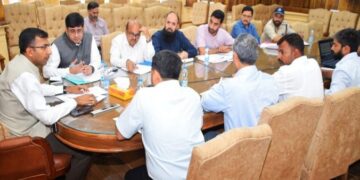
Ahmedabad/Jammu: A media delegation from Jammu and Kashmir, currently on a Press Information Bureau (PIB)-led tour of Gujarat, visited the National Forensic Sciences University (NFSU) and the Space Applications Centre (SAC) of the Indian Space Research Organisation (ISRO), where officials highlighted technological initiatives benefiting the Union Territory.
During an interaction with journalists, NFSU Vice Chancellor Dr J.M. Vyas said the university has provided 23 mobile forensic vans to Jammu and Kashmir to strengthen the criminal justice delivery system and enable on-site scientific investigation at crime scenes.
He said the vans, equipped with advanced forensic tools and gadgets, are expected to speed up evidence collection and improve conviction rates. Dr Vyas added that the university houses around nine Centres of Excellence dealing with various aspects of physical and digital crimes and provides education, specialised training and advanced research support to law enforcement agencies in India and abroad.
Campus Director Prof S.O. Junare said forensic science has become integral to modern investigations, including terrorism and cybercrime. He noted that NFSU experts handle major cases such as cyber frauds, cryptocurrency crimes, data breaches and smart-device investigations, and also contribute to investigations originating from Jammu and Kashmir.
The visiting delegation toured several laboratories on the campus, including the digital forensics, DNA testing, ballistics and narcotic and psychotropic substances testing laboratories. Experts demonstrated procedures related to DNA analysis, drug identification and testing of protective equipment and specialised vehicles.
The team also visited the Nutritional Supplements Testing Laboratory, where officials explained testing procedures conducted in accordance with World Anti-Doping Agency guidelines and Food Safety and Standards Authority of India norms.
Established as an Institute of National Importance, NFSU operates 14 campuses across India and an international campus in Uganda. Originally founded in 2009 as Gujarat Forensic Sciences University, it was reconstituted as the National Forensic Sciences University in 2020.
Later, the delegation visited ISRO’s Space Applications Centre in Ahmedabad. Officials briefed the team on satellite payload development and advanced semiconductor research undertaken at the facility.
SAC Director Dr Nilesh Desai said the centre is responsible for the design, development and application of satellite payloads and is working on upcoming missions, including Chandrayaan-4, expected to launch in 2028 with an orbiter and lander for collecting lunar soil samples. He also mentioned future missions such as the Venus mission and Mars Orbiter Mission-II.
The delegation toured key facilities, including the Planetary Immersive Lab and the Semiconductor Laboratory, where researchers demonstrated work on semiconductor packaging technologies and miniature high-performance components for space applications.
Officials also briefed the delegation about the Indian Astronomical Observatory at Hanle in Ladakh, which tracks space objects, and environmental monitoring initiatives in the region.
The media representatives also visited the ISRO Museum, where they were shown satellite models and informed about applications of satellite imagery in navigation, disaster management and agriculture.
Officials said the tour was aimed at providing journalists exposure to major national scientific institutions and enhancing awareness about technological and developmental initiatives relevant to Jammu and Kashmir.