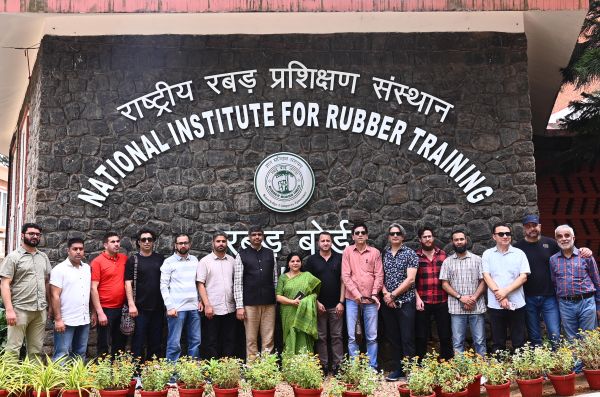
Kottayam (Kerala): On the second day of the ongoing press tour organised by the Press Information Bureau (PIB), Srinagar, the press delegation from Jammu and Kashmir visited the National Institute for Rubber Training (NIRT) and the Rubber Research Institute of India (RRII) at Kottayam, Kerala.
Both institutions function under the aegis of the Rubber Board, a statutory body constituted under the Rubber Act, 1947, for the overall development of the rubber industry in India and functioning under the Ministry of Commerce and Industry, Government of India.
The delegation held an interactive session at NIRT with M. Vasanthagesan, IRS, Executive Director, Rubber Board, and Priya Varma, Director (Training), NIRT. The interaction provided an in-depth understanding of policy initiatives and developmental interventions undertaken by the Rubber Board to strengthen India’s rubber sector.
Addressing the media delegation, M. Vasanthagesan, IRS, outlined the mandate and functioning of the Rubber Board, stating that the Board is implementing key policy interventions of the Government of India aimed at tapping the potential of the predominantly small and marginal rubber-growing sector. He said that sustained efforts are being made to achieve self-sufficiency in natural rubber production while ensuring long-term sustainability.
The Government of India is focusing on sustainable natural rubber production through scientific interventions, policy support and traceability mechanisms. The Bharath Sustainable Natural Rubber (BSNR) platform has been launched to ensure legality and traceability across the rubber value chain, Shri Vasanthagesan said.
He explained the processes of latex extraction and elaborated on various forms of rubber, including latex-based products and dry rubber-based goods, noting that a major share of domestic rubber production is consumed by the tyre industry. He also informed that the Rubber Board is exploring diversification through alternate varieties and has recently signed an MoU with the Himalayan Forest Research Institute to initiate experimental trials at feasible locations across different agro-climatic zones.
Subsequently, the press delegation visited the Rubber Research Institute of India (RRII). The delegation interacted with senior scientists, including Dr. C. Narayanan, Senior Scientist and Officer-in-Charge, Germplasm Division; Dr. Kala, Officer-in-Charge, Biotechnology Division; Dr. Bindu Roy, Senior Scientist, Pathology Division; and Madhusoodhanan, Officer-in-Charge, Rubber Technology Division.
The scientists briefed the delegation on RRII’s role in enhancing productivity and quality through scientific breeding programmes, biotechnology interventions and disease management strategies. The delegation was given a practical demonstration of rubber tapping techniques.
The team also visited the International Hevea Clone Museum at RRII, which serves as a repository of advanced genetic resources. It was informed that India is a signatory to the international clone exchange programme. The research done at the institute plays a crucial role in developing high-yielding and disease-resistant rubber clones. RRII’s efforts in transforming research ideas into commercially viable technologies for the benefit of farmers and industry were also highlighted.
The press tour to Kerala led by Majid Pandit, Media & Communication Officer, PIB Srinagar, is part of media outreach programme, aimed at providing journalists from Srinagar with firsthand exposure to key Central Government institutions, research ecosystems and national development initiatives.