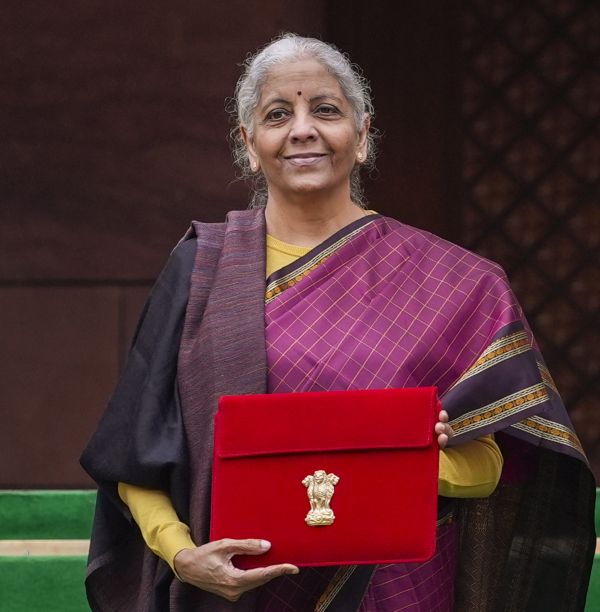
New Delhi: Finance Minister Nirmala Sitharaman on Sunday presented a Rs 53.47 lakh crore Budget for 2026-27, up 7.7 per cent from the current financial year ending March 31.
As per the Revised Estimate, the size of the Budget for the current fiscal is Rs 49.64 lakh crore, lower from Rs 50.65 lakh crore estimated in February 2025.
The Budget for fiscal 2024-25 was at Rs 46.52 lakh crore.
The government estimates its total expenditure at Rs 53.47 lakh crore in the next fiscal.
In 2026-27, the non-debt receipts and the total expenditure are estimated as Rs 36.5 lakh crore and Rs 53.5 lakh crore, respectively. The Centre’s net tax receipts are estimated at Rs 28.7 lakh crore.
“To finance the fiscal deficit, the net market borrowings from dated securities are estimated at Rs 11.7 lakh crore. The balance financing is expected to come from small savings and other sources. The gross market borrowings are estimated at Rs 17.2 lakh crore,” Sitharaman said.
Sitharaman also said the government will meet the fiscal deficit target of 4.4 per cent of GDP for the current fiscal, as estimated in the Budget for 2025-26.
The fiscal deficit in BE 2026-27 is estimated to be 4.3 per cent of GDP or Rs 16.95 lakh crore.
To finance the fiscal deficit during 2026-27, the net market borrowings from dated securities are estimated at Rs 11.7 lakh crore.
The balance financing is expected to come from small savings and other sources. The gross market borrowings are estimated at Rs 17.2 lakh crore.
“The GDP for FY 2026-27 is estimated at Rs 393,00,393 crore, which is 10 per cent over the Advance Estimates for FY 2025-26 of Rs 357,13, 886 crore released by NSO,” according to the Budget documents.
Sitharaman said that the government has been delivering on fiscal commitments consistently without compromising on social needs.
To strive towards accepted standards of fiscal management, in Budget 2025-26, she had indicated that the central government would target reaching a debt-to-GDP ratio of 50±1 per cent by 2030-31.
“In line with this, the debt-to-GDP ratio is estimated to be 55.6 per cent of GDP in BE 2026-27, compared to 56.1 per cent of GDP in RE 2025-26,” she said.
A declining debt-to-GDP ratio will gradually free up resources for priority sector expenditure by reducing the outgo on interest payments, she added.
Meanwhile, according to the RE for 2025-26, the non-debt receipts are pegged at Rs 34 lakh crore, of which the Centre’s net tax receipts are Rs 26.7 lakh crore.
The Revised Estimate of the total expenditure is Rs 49.6 lakh crore, of which the capital expenditure is about Rs 11 lakh crore during the current fiscal.
Meanwhile, Finance Minister proposed transfer of over Rs 43,290 crore to Jammu and Kashmir for 2026-27, higher by 4.72 per cent over the current fiscal.
According to the budget document, total transfers to the Union Territory have been pegged at Rs 43,290.29 crore, up from Rs 41,340.22 crore in 2025–26 Revised Estimates (RE).
The funds have been proposed as ‘Central Assistance to Union Territory’, which has risen by Rs 2,030.97 crore, from Rs 40,619.30 crore in 2025–26 to Rs 42,650.27 crore in 2026–27, an increase of 5 per cent.
There is a rise in the funding for the Jhelum–Tawi Flood Recovery Project (JTFRP-EAP) from Rs 185.34 crore to Rs 259.25 crore in 2026–27, a rise of 39.9 per cent.
The fund transfer towards disaster relief and capital support stands at Rs 279 crore, same as in 2025-26. Also, the amount for capital expenditure of the UT has been retained at Rs 101.77 crore for the next fiscal year.
FM’s push for high-value nut crops sparks hope for J&K walnut trade
The announcement by Union Finance Minister Nirmala Sitharaman in her budget speech on Sunday to support the high-value nut crops, including walnut, has brought a fresh wave of optimism for nearly seven lakh people whose livelihoods depend on the struggling walnut trade in Jammu and Kashmir.
Following the announcement, the air in the valley orchards feels a little lighter and a possible answer to the struggle which was not limited to the harvest but also about their survival.
The walnut trade of Jammu and Kashmir contributes over 90 per cent of the crop output, but those associated with the trade had been appealing to authorities as it had become increasingly burdensome to sustain.
For farmers like Mohammad Shafi, president of the Walnut Growers Association, the “old ways” were becoming a dead end. Traditional Kashmiri walnut trees are massive, making the harvest a dangerous climb and the yield unpredictable.
“The current trees pose real risks to our farmers,” Shafi explained. “But it’s not just the height; it’s the heart of the nut. Traditional varieties have shells so hard they often crush the kernel inside during extraction.”
Meanwhile, sleeker, soft-shelled walnuts from California and Chile have been “cracking” the Indian market, leaving local growers in the shadows.
The Finance Minister’s pledge to support high-density cultivation is more than just a policy shift; for the 86,000 hectares of walnut groves in Jammu and Kashmir, it is a modernisation lifeline.
“This is a very good development. It will help our economy and finally let us compete on a global stage,” says Shafi.
Jammu and Kashmir is the backbone of India’s walnut industry, producing over 90 per cent of the country’s output. Yet, over the last decade, the sector has been crumbling.
Poor infrastructure and a lack of modern packaging saw processing units shut their doors, leaving families who have farmed this land for centuries in a deep crisis.
Shafi said the high-density crops, as envisaged in the budget announcement, will help the local growers compete with California and Chile walnuts.
“The current walnut trees have low yield and also pose risks to the farmers. The high-density plants have better yield and uniform size, which fetches a good price,” he said.
For the farmers who have long been “fighting for survival,” the hard shell of the past decade is finally starting to crack, revealing a much brighter future inside.
As per the data of the Agriculture and Processed Food Products Export Development Authority (APEDA) under the union commerce ministry, Jammu and Kashmir occupies the largest share in the total area and production of walnut in over 86,000 hectares.
Besides, Jammu and Kashmir, states like Uttarakhand, Himachal Pradesh and Arunachal Pradesh also produce the crop and together amount to 3 to 6 per cent of 3 lakh metric tonnes of walnuts in 2024.
Over 2134 metric tonnes of walnut worth 7.8 million dollars was exported to countries like the UAE, Turkey, Iraq, Singapore, Algeria, Qatar, Bhutan, Kuwait, Seychelles and Nigeria.