By: Ulvee Muneer
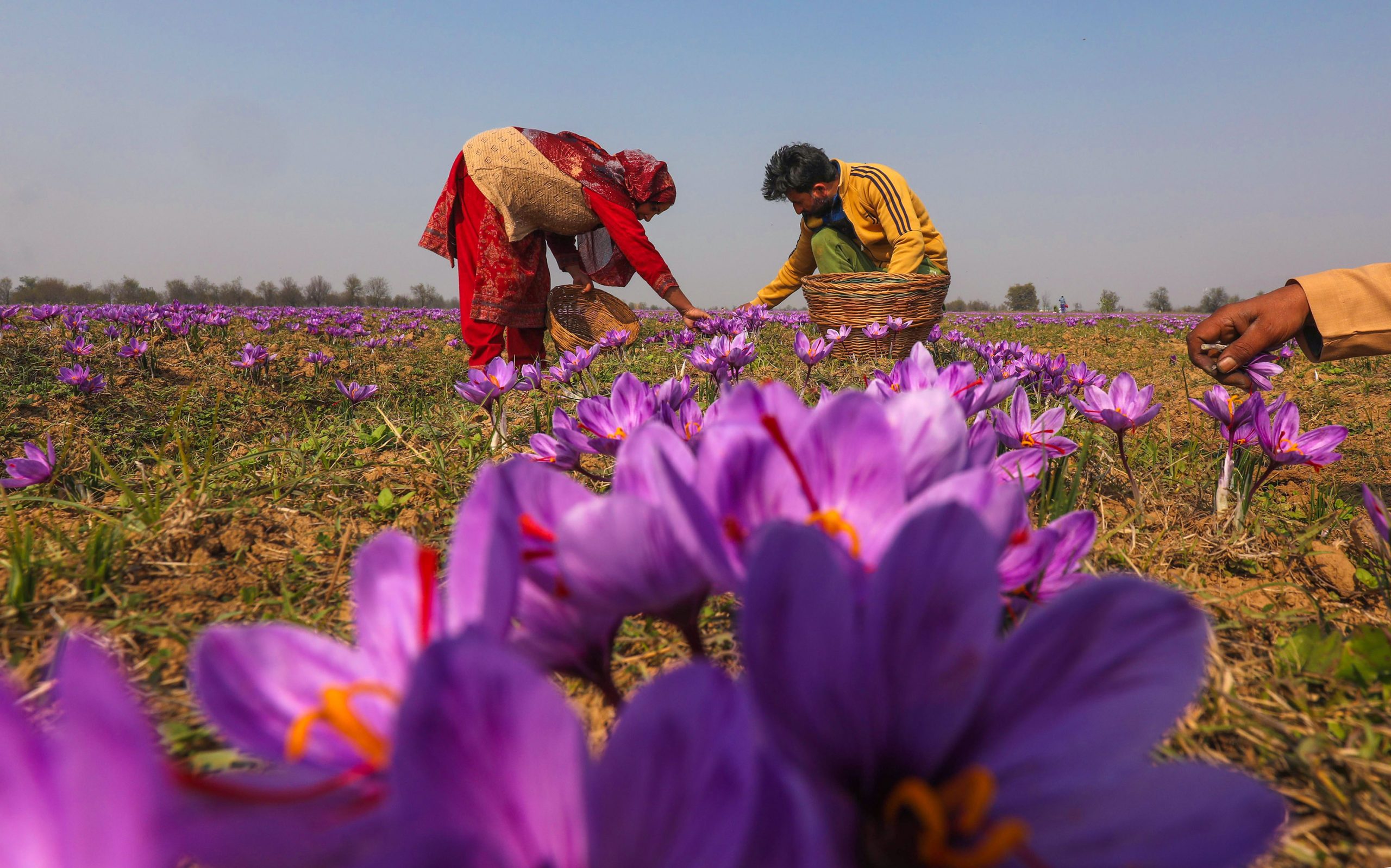
In the lush landscape of south Kashmir is Pampore, widely referred to as India’s saffron town. Its soil is not only fertile, it is holy to its people, tilled by generations of tradition and labour. Here, on the elevated tablelands called karewas, blooms one of the world’s most precious crops: saffron, or Zafran, prized for its deep crimson strands, rich aroma, and unmatched medicinal qualities.
India is the world’s second-largest saffron producer, and a whopping 90% of it is produced by Pampore alone. This delicate strip of land produces close to 7% of the world’s saffron output. What makes Kashmiri saffron stand out from its international rivals, specifically Iran, the largest saffron-producing country, is its high content of crocin. Crocin decides colour as well as antioxidant value. Whereas Iranian saffron has approximately 6.82% crocin, Pampore’s saffron has a remarkable 8.72%, which not only makes it more colourful but also more effective in medicinal properties. For centuries now, this has rendered Kashmir’s saffron the most popular type in the culinary and pharmaceutical sectors across the globe. Beyond its global prestige, saffron plays a deeply local role. In the Valley, over 32,000 families, 11,000 of whom are women, depend directly on saffron cultivation. From plucking delicate purple flowers to drying and packaging, saffron provides both livelihood and a sense of identity for these communities. The heritage crop is not merely agriculture, it is memory, ritual, and survival. Even after enduring decades of political unrest, market adulteration, and smuggling in transit, the Kashmir saffron fields today are threatened by a more insidious, though equally damaging, menace, one that digs underground: the Indian crested porcupine.
Deforestation and Climate Change: The Origin of the Problem
This emerging crisis is not coincidental, it is systemic. Deforestation within and around the Zabarwan and surrounding forest belts has driven wildlife, including porcupines, out of their natural habitats. Reducing forest cover and uncontrolled urban sprawl have altered food chains and pushed animals towards human-settled and cultivated lands.
Kashmir’s ecological landscape has also been shaken by climate change. Irregular rainfall, prolonged dry seasons, and abnormally warm winters have changed vegetation patterns and lowered the food supply in forests. Porcupines, which were seldom spotted around farmland, are now becoming regular night-time visitors to saffron fields. As Mir Muskan Un Nisa, a research scholar with Sher-e-Kashmir University of Agricultural Sciences and Technology, notes, “Habitat loss and climate change have compelled these rodents to find sustenance elsewhere, and saffron corms are a bountiful, convenient alternative.”
In contrast to surface-grazing pests, porcupines dig deep into the ground, tunnelling into saffron beds and consuming the bulbs—the plant’s very centre. Their feeding not only ruins the existing crop but also destroys the soil structure, making it less fertile for future cultivation. Over the past few years, farmers have lost as much as 30% of their yearly saffron harvest to porcupine raids. It’s not a nibble here and there,” says a Pampore farmer. “They come in large groups at night and can strip entire patches in days.” As the issue expands, so do the losses. In 1997–98, saffron production in Kashmir was 15.97 metric tonnes. By 2021–22, it had fallen to 3.48 metric tonnes. To date, in 2024, federal statistics indicate that production has declined yet further to only 2.6 metric tonnes, threatening an industry worth $45 million and thousands of families.
Traditional Solutions Are Failing
To repel the invasion, farmers have turned to a variety of native measures—setting thorny bushes around fields, adding floodlights, and even taking turns patrolling the land themselves at night. But none of these have worked. “The porcupines are relentless,” another farmer points out, indicating how these do not deter the night diggers.
Others have resorted to more scientific measures. Malik, a local farmer, advises setting wire traps and employing smoke-based repellents. He also advises planting some species that deter porcupines. Species such as Astragalus Polianthes (locally referred to as “Gagar-kond”) and Iris (referred to as “Mazarmond”) are said to deter porcupine presence. Nevertheless, mass use of these methods remains low, and none guarantees a foolproof solution
Kashmir’s saffron is not just a regional product—it is a global commodity. Any disruption in supply affects international pricing and market dynamics, particularly as Iran already dominates 85% of the global saffron trade. With Kashmir’s production declining, the fear is that the quality-centric Kashmiri brand may lose further ground to quantity-driven competitors.
Experts say that unless the porcupine crisis is structurally and urgently addressed, Kashmir’s saffron heritage can be lost. It’s not just a pest issue, but a policy issue. It intersects with deforestation, land use planning, climate resilience, and wildlife management. Absent an integrated strategy, from conservation of forests to research-led agriculture methods, the Pampore saffron fields could soon be lost to memory.
Policy Considerations: A Call for Sustainable Intervention
The porcupine incursion, based on ecological mismanagement and intensifying climate pressure, requires more than short-term solutions—it requires a strong, multidisciplinary policy response. Scientists and farmers alike emphasise that the situation at hand has to be addressed through a unified effort between forest departments, agricultural scientists, wildlife conservationists, and local governments.
Wildlife Management and Controlled Relocation: The Indian crested porcupine is a protected species, but its uncontrolled spread into agricultural lands calls for a planned wildlife management intervention. Governments need to invest in scientific monitoring and controlled relocation programs that relocate porcupines to restored forest habitats without causing harm to the species. This would involve establishing monitoring units, encouraging research on non-lethal repellents, and deploying humane wire traps at scale.
Forest Restoration and Rewilding Initiatives: At the core of the problem are deforestation and habitat destruction. The Forest Department of Jammu and Kashmir needs to work together with ecologists to reforest degraded areas, especially around saffron-growing regions, and restore native flora that previously supported wildlife in the region. Encouraging community-based forest stewardship programs can help promote lasting ecosystem equilibrium.
Agroecological Buffer Zones: The creation of agroecological buffer belts—plant species belts that deter porcupines, e.g., Astragalus Polianthes (Gagar-kond) and Iris (Mazarmond)—can be encouraged through subsidies and government-sponsored training. This combination of indigenous knowledge and scientific assistance could provide an environmentally friendly barrier between forests and fields.
Compensation and Insurance Schemes: To mitigate the financial hardship induced by repeated losses of crops, the government should increase crop insurance schemes to cover losses caused by wild animals, such as rodents such as porcupines. Compensation channels, made clear and digitally monitored, would ensure immediate relief for the affected farmers.
Saffron cultivation in Kashmir is not merely cultivation—it is culture, economy, and heritage interwoven. But this heritage now teeters on the edge. What was once a slow encroachment is rapidly developing into a full-blown crisis. The porcupine, a shy and guarded animal of the woods, has emerged as the unlikely mascot of systemic failure—one that betrays the intertwined challenges of environmental abandonment, climate disturbance, and agricultural susceptibility. (For author bio and references, visit www.jkpi.org)