Kinetic art refers to any artwork that incorporates movement, either physically or virtually, as a fundamental element of its expression. The earliest examples of kinetic art can be traced back to Canvas paintings that incorporate multidimensional movement. Kinetic art in contemporary times is applied to dynamic sculptures and mobiles, the term has evolved to include artworks that convey movement through optical illusions and interactive mechanisms. Kinetic art spans a broad spectrum of styles and techniques, from early Impressionist paintings to contemporary interactive installations.
Origins and Early Development
The origins of kinetic art can be traced back to the late 19th century with the Impressionist movement, where artists like Édouard Manet, Edgar Degas, and Claude Monet began experimenting with movement in their canvas works. They sought to capture the dynamism and immediacy of life through their brushstrokes and compositional techniques.
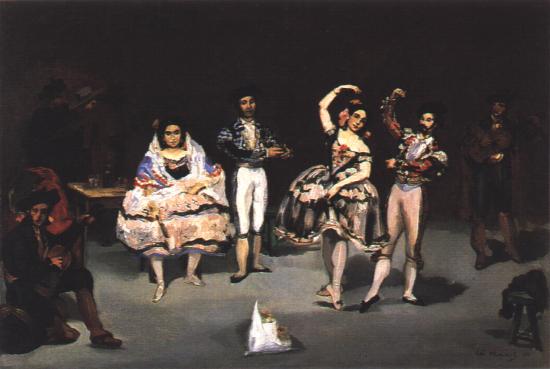
Édouard Manet pushed the boundaries of static representation in works such as Le Ballet Espagnol, where he used blurred lines and dynamic compositions to evoke a sense of fleeting motion. Similarly, Le Déjeuner sur l’Herbe employed spatial manipulation to suggest movement.
Edgar Degas explored movement through his depictions of ballet dancers and horse races. His paintings, like At the Races and The Orchestra at the Opera, presented dynamic compositions that transcended the limitations of the canvas.
Claude Monet captured movement in his impressionistic landscapes, using quick, fluid brushstrokes to convey the ever-changing qualities of light and scenery, as seen in Gare Saint-Lazare.
Early 20th Century Innovations
The early 20th century saw the emergence of kinetic art as a distinct genre. Russian artist Naum Gabo is often credited with pioneering this movement. His sculpture Kinetic Construction, also known as Standing Wave, is considered one of the first kinetic sculptures, incorporating movement as an essential element of its design.
The Constructivist movement, spearheaded by artists like Vladimir Tatlin and Alexander Rodchenko, further developed kinetic art. Tatlin’s Contre-Reliefs Libérés Dans L’espace and his ambitious project for the Monument to the Third International reflected his vision of kinetic architecture. Rodchenko’s Hanging Construction expanded on these ideas with mobiles that rotated and shifted in space.
20th Century Developments
The Abstrct Expressionism and surrealist art movement of the 20th century provided fertile ground for kinetic art. Artists like Jackson Pollock and Max Bill explored new techniques and materials that pushed the boundaries of traditional art forms. Pollock’s drip painting technique, characterized by spontaneous application of paint, and Bill’s mathematically-influenced sculptures represented different facets of kinetic art’s evolution.
Max Bill focused on the intersection of mathematics and art, creating sculptures with precise geometric forms that manipulated perception and space. His works, such as Construction with Suspended Cube, exemplified his belief in the power of mathematical principles to convey movement and dynamism.
Alexander Calder and the Mobile Revolution
Alexander Calder is perhaps the most iconic figure in kinetic art. His mobiles, such as Mobile and Red Mobile , defined the genre. Calder’s innovative use of materials and balance created sculptures that moved with the air, engaging viewers with their fluid motion. His mobiles can be divided into object-mobiles, which are supported on structures, and suspended mobiles, which hang freely.
Modern and Contemporary Kinetic Art
By the mid-20th century, kinetic art began to incorporate new technologies and concepts. Victor Vasarely and other artists explored virtual movement, where the perception of movement is created through optical illusions and interactive elements. Vasarely’s Gordes/Cristal , for instance, used electrical components to create dynamic light and color effects.
Apparent movement emerged as a term for artworks that create the illusion of movement without actual physical motion. This includes many of Calder’s mobiles as well as the optical art (op art) movement, which used visual effects to create the appearance of movement.
Contemporary Trends
In recent years, kinetic art has continued to evolve with advances in technology. Exhibitions like the MIT Museum’s 5000 Moving Parts highlight contemporary kinetic artists such as Arthur Ganson, Anne Lilly, Rafael Lozano-Hemmer, and Takis. These artists use modern materials and digital technologies to create interactive and dynamic artworks that engage audiences in new ways.
Neo-kinetic art has gained popularity in China, with public spaces like Wuhu International Sculpture Park and Beijing showcasing large-scale interactive installations.
Kinetic art has gradually evolved over the time, and with modern technologies and equipment it is going to make some unbelievable transformations in what we consider to be art. The movement that has always been an essential part of art, and paintings and sculptures represented movement with color and form, the advancements in material and technology has definitely helped that movement to be literal. Kinetic art is a dynamic intersection of movement, perception, and innovation. From its Impressionist roots to its contemporary manifestations, has come a long way rephrasing notions of movement in static art and embraces the potential of movement— physical and literal. It engages and captivates audiences and its pretty clear as the technology continues to advance, the possibilities for kinetic art to expand increases, promising exciting new directions for artists and viewers alike.