

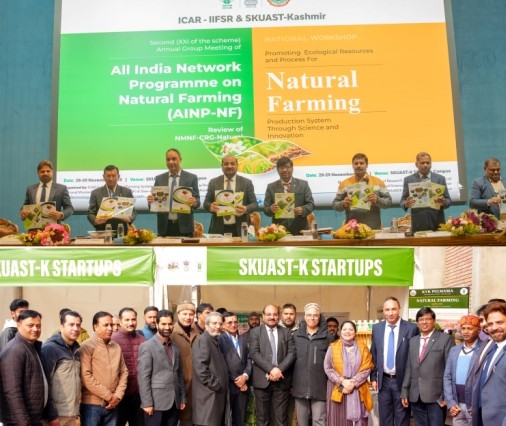

SRINAGAR: Secretary, Department of Agricultural Research and Education (DARE) and Director General of the Indian Council of Agricultural Research (ICAR), Dr M.L. Jat, on Saturday expressed confidence that Sher-e-Kashmir University of Agricultural Sciences and Technology of Kashmir (SKUAST-K) was on course to emerge as India’s number one agricultural university, citing its progress in research, innovation and farmer-centric initiatives.
Dr Jat made these remarks while inaugurating a three-day national workshop on natural farming at SKUAST-K’s Shalimar campus during his maiden visit to the university. The workshop, titled ‘Promoting Ecological Resources and Process for Natural Farming Production System Through Science and Innovation’, has brought together scientists, policymakers, researchers and progressive farmers to deliberate on sustainable and regenerative agricultural practices.
Calling for outcome-oriented discussions guided by the vision of ‘One Nation, One Agriculture, and One Team’, the ICAR Director General stressed that scientific deliberations should translate into practical policy recommendations and field-level interventions to promote sustainable farming.
The three-day event is being jointly organised by ICAR-Indian Institute of Farming Systems Research (ICAR-IIFSR), Modipuram, and SKUAST-K. It also marks the commencement of the Annual Group Meeting of the All India Network Programme on Natural Farming (AINP-NF) and the Review Meeting of NMNF-CRG.
During his visit, Dr Jat inaugurated the newly constructed Chinar Hostel and inspected several university facilities and research infrastructure, including the Fertigation System, Prototype Production Unit, Directorate of Innovation and Entrepreneurship, Research Centre for Residue and Quality Analysis (RCRQ), Artificial Intelligence (AI) Lab, Fabrication Lab and Health and Wellness Centre.
He also visited exhibition stalls showcasing the university’s patented technologies and innovations developed by agricultural start-ups.
SKUAST-K Vice-Chancellor Prof. Nazir Ahmad Ganai presented an overview of the university’s recent achievements in agricultural research, entrepreneurship and farmer-oriented extension activities. He stressed the need to harness Jammu and Kashmir’s niche crops while ensuring adherence to Good Agricultural Practices (GAP) and strengthening pesticide residue monitoring at the farm-gate level.
Prof. Ganai said scientific validation and effective extension mechanisms were essential to mainstream natural and regenerative farming practices.
Highlighting the current reach of natural farming in the country, National Principal Investigator of AINP-NF Dr. N. Ravisankar presented the programme’s progress report and said natural farming covered only 3.6 per cent of India’s agricultural area. He said the limited coverage indicated considerable scope for expansion through region-specific technologies and interventions.
ICAR Deputy Director General (Natural Resource Management) Dr. A.K. Nayak called for stronger institutional collaboration and scientific evidence to guide national research and policy frameworks on natural farming.
Vice-Chancellor of Gujarat Natural Farming Science University Dr. C.K. Timbadia also stressed the need for systematic scientific validation of natural farming practices, while ICAR-IIFSR Director Dr. Sunil Kumar highlighted the importance of institutional support in encouraging wider adoption among farmers.
SKUAST-K Director Research Dr. Syed Zameer Hussain underlined the role of integrated natural farming systems in protecting food security against the challenges posed by climate change. He advocated a transition towards an ‘Evergreen Revolution’ through sustainable agricultural practices.
Additional Director General (ADG), ICAR, Dr. A. Vellumuragan emphasised the need to mainstream regenerative agriculture through collective learning, institutional collaboration and knowledge exchange.
Several scientific publications were also released during the inaugural session.
The workshop is being attended by researchers, policymakers, Krishi Vigyan Kendra (KVK) specialists, Agriculture Department officials and progressive farmers from different parts of the country. The deliberations will include a review of AINP-NF milestones and the identification of future research priorities for advancing regenerative agriculture across India.