SRINAGAR: Communist Party of India (Marxist) leader Mohammad Yousuf Tarigami has questioned the use of heavy machinery near the Sheshnag glacial lake along the Shri Amarnath Ji Yatra route, alleging that the Border Roads Organisation’s (BRO) clarification on the work does not mention any environmental clearance.
In a detailed statement, Tarigami said Sheshnag, situated at an altitude of around 3,590 metres in the Himalayas, was not merely a stretch along the pilgrimage route but a glacial lake that serves as the source of the East Lidder river, which flows towards Pahalgam and other parts of Kashmir. He said the lake had been listed among the 14 high-risk glacial lakes identified in Jammu and Kashmir.
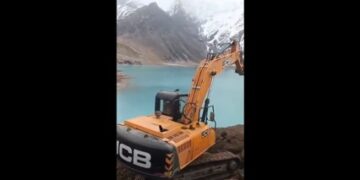
He said crawler excavators had been seen cutting and levelling earth near the lake and argued that heavy machinery should not be used in the area until independent experts assessed the geological and environmental risks.
Clarifying his position on the pilgrimage, Tarigami said he respected the religious significance of the Amarnath Yatra and acknowledged the efforts made by people from different communities in Kashmir to ensure its smooth conduct. He said his concern was the safety of pilgrims as well as residents living in the surrounding areas.
Referring to the BRO’s clarification, Tarigami said the organisation had maintained that the work was confined to existing tracks and that claims about new construction were incorrect. According to him, the BRO had stated that track widening was intended to ease congestion and improve safety, while environmental safeguards, natural drainage and proper disposal of excavated material were being taken care of.
However, he questioned the need for heavy earthmoving machinery if the work was restricted to existing tracks and sought details of the environmental safeguards being implemented.
Tarigami also linked the ongoing work to the proposed Khanabal-Baltal highway (NH-501). He referred to a January 2024 design report prepared by the National Highways and Infrastructure Development Corporation Limited (NHIDCL), which proposes two- or four-laning of approximately 90 kilometres of road between Khanabal and Baltal.
The proposed alignment includes a new stretch from Chandanwari to Baltal along the traditional Yatra route, passing through Pissu Top, Zojibal, Sheshnag and Panchtarni. He sought clarification from the authorities on how the ongoing work near Sheshnag relates to the proposed highway alignment.
He said the project report had been prepared before the cloudburst in Paddar in 2025 and the disaster in Nepal in 2026, and argued that the lessons from such events must be incorporated before undertaking large-scale infrastructure work in fragile Himalayan terrain.
Explaining the potential environmental risks, Tarigami said excavation at the base of mountain slopes could weaken their natural support and trigger landslides. He also cautioned that digging near glacial lakes could disturb surrounding material, alter water runoff and increase sediment flow into the lake.
He said improper disposal of excavated soil and rock could obstruct natural drainage and carry debris downstream. The slow regeneration of vegetation at high altitudes, he added, meant that damaged landscapes could take years to recover.
He further cautioned that motorable roads could increase traffic, construction activity, waste generation and sewage in ecologically sensitive areas with limited capacity to absorb such pressures. He maintained that roads, tunnels, pilgrim facilities and track-widening projects along the route should be assessed collectively rather than in isolation.
Referring to the Supreme Court’s intervention following pilgrim deaths during the 2012 Amarnath Yatra, Tarigami said the court had taken up the matter suo motu in Writ Petition (Civil) No. 284 of 2012. In its December 13, 2012 judgment, the court accepted recommendations made by a Special High-Powered Committee on arrangements along the Yatra route and constituted a subcommittee to monitor their implementation.
He said the ongoing work must comply with the court’s directions and called for public disclosure of how the project addressed those requirements.
Tarigami also raised concerns over forest land along parts of the route, asking the authorities to clarify whether forest clearance had been sought or obtained, whether the Forest Department had been consulted and what recommendations it had made.
Citing previous disasters, he referred to the 2025 cloudburst at Chasoti on the Machail Mata Yatra route in Kishtwar’s Paddar area, which killed 63 people, with 31 still reported missing two months later. He also cited the August 2026 rock and ice collapse in Nepal’s Langtang region, which triggered flooding in the Bhote Koshi and Trishuli rivers, claiming more than 1,400 lives in Nepal and dozens in Tibet.
He further referred to the 2013 Kedarnath disaster and the 2023 South Lhonak Lake disaster in Sikkim as reminders of the risks associated with fragile mountain ecosystems.
Stating that he was not opposed to roads or infrastructure development, Tarigami sought public answers on whether an independent expert body had assessed the stability of slopes around Sheshnag, whether environmental and forest clearances had been obtained and why they had not been made public, and how the ongoing work was linked to the NH-501 alignment.
He also demanded disclosure of the locations where excavated material was being dumped and the authorities responsible for selecting those sites.
Tarigami called for an immediate halt to work near the lake until these questions were addressed. He urged the Government of India and the Jammu and Kashmir Government to jointly constitute an independent team comprising glaciologists, geologists, hydrologists, forest officials and disaster-management experts to inspect Sheshnag, assess the lake and its catchment, examine the ongoing work and make its findings public.
He said the expertise of institutions that had studied the Himalayan region for decades should be sought before proceeding with the work, adding that development should not compromise the safety of pilgrims and local residents or the region’s fragile environment.