NEW DELHI: The Centre on Tuesday said India had achieved the milestone of becoming effectively free from Left-Wing Extremism (LWE), with no district in the country remaining LWE-affected as of March 31, 2026, attributing the development to a coordinated strategy combining security operations, infrastructure expansion, rehabilitation of surrendered cadres and improved governance.
In a detailed account of the government’s efforts, the Ministry of Home Affairs said the transformation followed a shift from fragmented, incident-driven responses to an integrated approach involving security, development, protection of rights and welfare delivery.
The government had set March 31, 2026, as the deadline to make the country Naxal-free on August 24, 2024, and claimed the target was achieved on schedule through intensified operations, improved coordination and accelerated development in affected regions.
The ministry said the strategy over the last 12 years rested on three interconnected priorities: restoring public trust in the state, expanding physical and digital infrastructure, and ensuring inclusive welfare delivery. It said improved security created conditions for development, while better services and connectivity strengthened public confidence in government institutions.
Left-Wing Extremism traces its origins to the Naxalbari uprising in West Bengal in 1967 and is rooted in Maoist ideology. Several extremist organisations subsequently merged under the Communist Party of India (Maoist) in 2004.
According to the government, the decade between 2004 and 2014 recorded 17,542 violent incidents, 1,913 security personnel deaths and 5,019 civilian deaths. Violence peaked in 2010, when 1,936 incidents were reported. The Centre said there had been no consistent national policy during the period, with state governments largely operating independently.
A major policy shift came in 2015 with the approval of the National Policy and Action Plan to address LWE. The framework combined security operations with development, protection of rights and perception management, under a more centrally coordinated approach led by the Ministry of Home Affairs.
Under the Special Central Assistance scheme, approximately Rs 4,318.52 crore has been released since its inception in 2017. Projects worth Rs 1,761 crore have been sanctioned under the Special Infrastructure Scheme to strengthen special forces, intelligence branches, district police and fortified police stations.
The government has also released Rs 3,877.98 crore under the Security Related Expenditure scheme since 2014-15 to support operational requirements, capacity building and training, rehabilitation of surrendered cadres and compensation to families of security personnel and civilians killed in violence.
Strengthening security infrastructure
The Centre said it had established 668 new security camps, compared with 169 before 2014, and constructed 615 fortified police stations to strengthen the security grid in remote areas.
It also built 68 night-landing helipads to facilitate troop deployment, casualty evacuation and surveillance, provided security forces with 400 bullet-proof and blast-proof vehicles, and constructed five hospitals for their welfare and medical support.
Specialised units, including the Commando Battalion for Resolute Action (CoBRA), Central Reserve Police Force (CRPF), District Reserve Guard (DRG), Special Task Forces and state units such as Jharkhand Jaguar and Andhra Pradesh’s Greyhounds, were integrated into a coordinated security architecture. Joint training was undertaken to improve interoperability and operational coordination.
Technology also became an important component of counter-insurgency operations, with the use of unmanned aerial vehicles, drones, satellite imagery and artificial intelligence-based data analysis for surveillance and monitoring. Location-tracking systems, call-log analysis, mobile data analytics and social media monitoring were also deployed to strengthen intelligence gathering.
Under its “Trace, Target, Neutralise” approach, the government conducted several major operations, including Operation Black Forest, Operation Octopus, Operation Double Bull, Operation Thunderstorm, Operation Bhimbandh and Operation Chakrabandha.
The Centre said Operation Black Forest dismantled a major Maoist stronghold, resulting in the elimination of more than 30 Maoists and an increase in arrests and surrenders. Operation Double Bull contributed to Gumla, Lohardaga and Latehar districts becoming Naxal-free.
It further claimed that all Politburo and Central Committee members of CPI (Maoist) had been neutralised, with 41 such members eliminated since 2014.
The government also targeted the financial networks supporting the Maoist movement. A dedicated vertical was established within the National Investigation Agency (NIA) to investigate Naxal financing. As of December 2025, the NIA had seized assets worth more than Rs 40 crore, while the Enforcement Directorate had attached assets worth Rs 12 crore and state agencies confiscated another Rs 40 crore.
As of June 2026, the NIA had registered 112 LWE cases and filed 100 chargesheets, according to the ministry.
Rehabilitation and surrenders
The Centre said its security strategy was accompanied by rehabilitation measures intended to encourage cadres to abandon violence and return to mainstream society.
Under the surrender policy, higher-ranked cadres receive an immediate grant of Rs 5 lakh and others Rs 2.5 lakh, along with a monthly stipend of Rs 10,000 for 36 months. An additional incentive of Rs 50,000 is provided for surrender, with the amount doubled in cases of group surrenders. Additional compensation is also offered for depositing weapons.
Approximately 8,526 Naxalites had surrendered by November 2026, the government said.
On July 28, 2026, 16 active Maoists from the Kolhan and Latehar regions surrendered in Ranchi under the ‘Nayi Disha, Nayi Pahal’ campaign. They included one regional commander, three zonal commanders, three sub-zonal commanders, six area commanders and three cadre-level members. The group deposited 11 sophisticated firearms, 38 magazines and 1,562 rounds of ammunition.
Eight more Maoists carrying a combined reward of Rs 49 lakh surrendered before Bijapur Police on July 29. On the same day, security forces arrested a senior Maoist leader and Politburo member carrying a reward of Rs 1 crore from the Dhanbad-Giridih border. A regional committee member carrying a reward of Rs 15 lakh, another Maoist cadre and two villagers were also apprehended during the joint operation.
Roads, telecom and financial connectivity
The government said security gains had enabled large-scale infrastructure development in areas previously affected by Maoist violence.
A total of 15,189 kilometres of roads have been constructed under the Road Requirement Plan and the Road Connectivity Project for LWE-Affected Areas. The Border Roads Organisation has also been assigned the construction of critical roads and bridges in areas where security threats had discouraged contractors from undertaking projects.
Under the telecom expansion programme, 9,561 mobile towers have been commissioned. The government said 44,728 of the 46,592 villages in the most affected areas, or around 96 per cent, now had mobile connectivity.
Railway connectivity has also been expanded. The 95-km Dalli Rajhara-Rowghat railway line has been completed, while the 140-km Rowghat-Jagdalpur section has been approved. A 153-km railway line between Dantewada and Manuguru has also been sanctioned.
The 150-km Kirandul-Jagdalpur doubling project has made significant progress, with the Jagdalpur-Kamalur and Bacheli-Kirandul sections, covering a combined 130 km, already commissioned.
Between April 2015 and March 2026, 1,804 bank branches were opened, 1,321 ATMs installed, 74,720 banking correspondents appointed and 6,025 post offices established in LWE-affected districts.
Welfare and governance in tribal areas
The Centre said special administrative measures were introduced to address geographical and infrastructure constraints in remote tribal regions.
Special campaigns were organised with the Unique Identification Authority of India and the postal department to improve Aadhaar coverage. In Chhattisgarh’s Bastar division, 294 post offices were opened after physical surveys took account of difficult terrain and local conditions.
In areas with limited internet connectivity and banking facilities, cash wage payments and offline attendance systems were permitted under the earlier version of the Viksit Bharat Guarantee for Rozgar and Ajeevika Mission (Gramin). Funds for toilet construction under the Swachh Bharat Mission were routed through Village Sanitation Committees where banking access was inadequate. An offline application was also introduced to facilitate the issuance of Ayushman Bharat cards in remote villages.
In healthcare, the government sanctioned a 240-bed super-speciality hospital at Government Medical College, Jagdalpur, under the Pradhan Mantri Swasthya Suraksha Yojana. The hospital was inaugurated by the Union Home Minister on May 18, 2026. Eleven CRPF field hospitals established for security personnel have also been opened to local tribal communities.
In education and skill development, 259 Eklavya Model Residential Schools were sanctioned, of which 179 have become functional. The government also established 47 Industrial Training Institutes and 49 Skill Development Centres, with an investment of nearly Rs 800 crore. Skill training has been provided to more than 90,000 youth and women.
Under the Tribal Youth Exchange Programme, 37,655 tribal youth from erstwhile LWE-affected areas have participated in exposure visits across the country since 2014.
The government has also released Rs 221.88 crore under the Civic Action Programme since 2014 to enable Central Armed Police Forces to organise medical camps, sports competitions and welfare activities in their operational areas.
The Centre said 21,26,273 title deeds had been distributed under the Forest Rights Act. Other initiatives include the Aspirational Districts Programme, PM-JANMAN for Particularly Vulnerable Tribal Groups and the Dharti Aaba Janjatiya Gram Utkarsh Abhiyan, aimed at improving access to housing, drinking water, education, healthcare and connectivity in tribal villages.
The rehabilitation framework also provides surrendered cadres with skill development, livelihood assistance, housing support under the Pradhan Mantri Awas Yojana and financial assistance for self-employment. Children of surrendered cadres are provided free education up to Class XII. Development grants have also been provided to villages that eliminated Naxal influence and established democratically elected panchayats.
Bastar’s transformation
The government cited Chhattisgarh’s Bastar region as an example of the combined impact of security operations and development initiatives.
The formation of the Bastariya Battalion in 2017, with 1,143 personnel, including around 400 local youth from Bijapur, Sukma and Dantewada, helped strengthen intelligence networks and improve trust between security forces and tribal communities, it said.
More than 3,240 kilometres of roads have been constructed across Bastar, Bijapur, Dantewada, Sukma, Narayanpur, Kanker and Kondagaon districts, while 889 mobile towers have been installed to improve connectivity.
A rehabilitation plan was also prepared for around 3,000 surrendered cadres, supported by an initial allocation of Rs 20 crore for skill development, education and livelihood opportunities.
In May 2026, the Shaheed Veer Gunda Dhur Seva Dera initiative was launched to convert security gains into development. Around one-third of CRPF camps are being transformed into Integrated Development Centres to provide access to government schemes, healthcare, banking, agricultural support and skill development.
The government said cultural initiatives such as Bastar Pandum and the Bastar Olympics had also encouraged tribal participation, promoted traditional identity and created opportunities for youth and local artists.
Violence and affected districts decline
The Centre said the number of LWE-affected districts had fallen from 126 in 2014 to zero by March-April 2026. The number of most-affected districts also declined from 35 to zero.
Naxal-related incidents fell from 870 in 2014 to 33 in 2026, as of July 29, while fatalities declined from 310 to 12 during the same period. The government said the figures reflected a substantial weakening of Maoist networks and an improvement in security conditions.
It added that 38 districts had been categorised as Legacy and Thrust Districts, where continued security and development support would remain in place.
Focus shifts to consolidating gains
Following the declaration of the country as free from LWE, the government said its focus had shifted towards preventing a resurgence and ensuring sustained development in formerly affected areas.
One-third of security camps in LWE-free regions are being converted into Seva Dera Kendras, or Integrated Development Centres, to provide citizen services.
The centres are envisaged as Jan Suvidha Kendras offering access to government schemes and digital services, alongside facilities for skill development, women’s empowerment, nutrition, healthcare, sports and cultural activities. They are also expected to promote local livelihoods through processing, branding and marketing of agricultural produce and minor forest produce, including mahua, tamarind and tendu leaves.
As a pilot initiative, the Ministry of Home Affairs has signed a memorandum of understanding with the National Institute of Design, Ahmedabad, to convert five security camps in Bastar into Shaheed Veer Gundadhur Seva Dera Kendras. The institute has completed the feasibility study and work has commenced, with expenditure to be met under the Special Central Assistance scheme.
The Ministry of Home Affairs also commissioned an independent survey in seven erstwhile LWE-affected districts of south Chhattisgarh to assess the coverage of welfare schemes, development initiatives and livelihood opportunities. Reported to Parliament in August 2026, the survey covered education levels, health indicators and the availability of primary schools, anganwadi centres and secondary healthcare facilities.
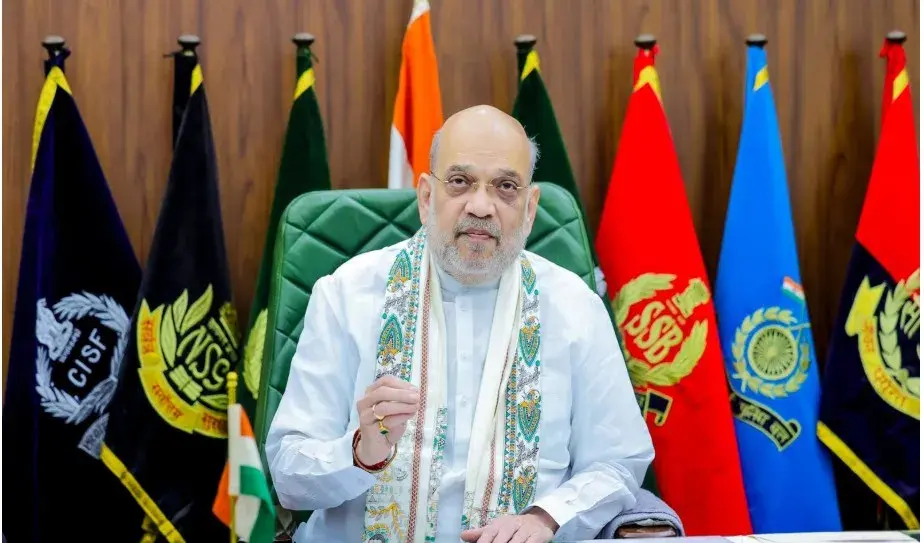
On October 15, 2026, the Union Home Minister addressed a ceremony for distribution of assistive devices to persons with disabilities, including victims of Naxal violence, under the ongoing Seva Sankalp Abhiyan.
On November 8, Prime Minister Narendra Modi celebrated Diwali with security personnel at the CoBRA Operations Base in Karanpur, Bastar. The government said he described it as the first Diwali in which every district in the country was free from Naxalism. He also noted that no CRPF personnel had lost their lives while on duty during the preceding year, the first such achievement in 47 years.
The Centre said the next phase would focus on consolidating security gains, completing the rehabilitation of affected communities and ensuring sustained development, effective governance and delivery of rights and public services.
It said the objective was to ensure that the end of the insurgency translated into lasting peace, inclusion and improved opportunities for tribal communities.