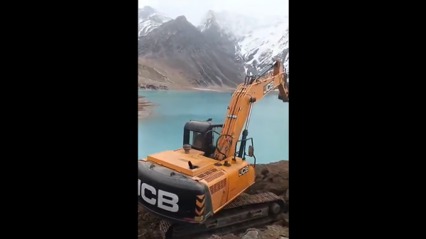
SRINAGAR: A purported video showing an excavator operating near Sheshnag Lake, a high-risk glacial lake along the traditional Amarnath Yatra route in south Kashmir’s Anantnag district, has triggered widespread concern, with political leaders, religious figures and environmentalists calling for an immediate halt to the activity.
The video, which has gone viral on social media, purportedly shows heavy machinery operating in close proximity to the high-altitude lake in the south Kashmir Himalayas.
Sheshnag is among the 14 high-risk glacial lakes identified across Jammu and Kashmir for monitoring because of their environmental vulnerabilities.
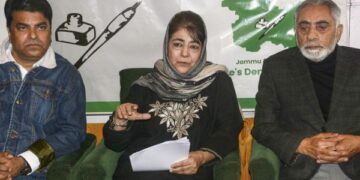
Former chief minister and Peoples Democratic Party (PDP) president Mehbooba Mufti described the issue as painful and criticised the government over what she termed its failure to intervene in activities affecting the environment.
“The government itself is having Chinar trees cut down. At the university, they are cutting down our old walnut trees. They just watch as spectators and don’t say a word. Our Kashmir will become another Uttarakhand. What can we say? When they built roads and expressways for the Char Dham Yatra, look at how many storms and calamities strike there today. It is very bad,” she said.
Mufti said her party risked being accused of opposing the Amarnath Yatra if it raised concerns over the issue.
“If we talk about it, they will say we are against the Amarnath Yatra. What can I say? They try to polarise everything,” she told reporters.
National Conference Lok Sabha member Mian Altaf said he had not seen the video and could not comment on the specific incident, but stressed the need to protect Kashmir’s natural resources.
“I have not seen that, so I cannot say anything to you about it. I will just say that Kashmir’s lakes must be saved. They must be saved at any cost. Its rivers must be saved, its forests must be saved,” he said.
Altaf said protecting lakes, rivers and forests was essential for Kashmir, its tourism, environment and the health of its people.
Former Srinagar Lok Sabha member Ruhullah Mehdi criticised the reported activity, saying Kashmir’s mountains were not the BJP’s real estate.
“A party that wins votes in the name of faith is now taking JCBs to a holy lake. First, the BJP pushed motor roads up to the Amarnath cave. Now heavy machinery is digging at Sheshnag, a high-risk glacial lake,” Mehdi said in a post on his official X handle.
Referring to recent events in Nepal, he said the Himalayas should not be treated as construction sites and called for the activity to be stopped.
In a statement, Kulgam MLA and CPI(M) leader M.Y. Tarigami expressed shock over the video, saying Sheshnag was no ordinary water body but a glacial lake surrounded by loose moraine and steep slopes.
” It is already listed among the 14 high-risk glacial lakes in Jammu and Kashmir. Disturbing such terrain with heavy machinery is an invitation to disaster,” he said.
Tarigami said nobody was opposed to development and that pilgrims, tourists and local residents deserved safe roads and better facilities. However, he stressed that development in the high Himalayas must be environmentally sustainable and in harmony with nature.
He said any work in such areas must be preceded by a scientific study and a proper environmental impact assessment, along with consultations with experts and local communities.
Warning that human interference in glacial zones could have serious consequences for people downstream, he referred to Pahalgam, the Lidder river and other areas across south Kashmir.
Tarigami urged the government to intervene without delay.
Kashmir’s chief cleric Mirwaiz Umar Farooq also expressed concern over the visuals and reports of heavy machinery operating near Sheshnag Lake.
“The visuals and reports of heavy machinery operating near the pristine Sheshnag Lake, in the glacial zone of Pahalgam, are very disturbing, raising serious concern among people about the ecological impact of construction in this fragile Himalayan region,” Mirwaiz said in a post on X.
He said the retreat of glaciers and recent devastating glacier-related floods in neighbouring Nepal had highlighted the growing vulnerability of the Himalayan region.
Mirwaiz said Kashmir had always warmly welcomed Amarnath Yatra pilgrims and that improving facilities for them had never been an issue, but should not come at the cost of the fragile ecosystem.
He said the government owed people an explanation over the environmental concerns raised by such development projects and called for the reported activity to be stopped immediately.
“Our precious mountains, glaciers and water bodies need protection not plunder, for now and for the future generations,” he said.
Apni Party president and former minister Altaf Bukhari said the authorities must first clarify whether the video was authentic.
“If the video is genuine, the government owes the public a clear explanation: What is such heavy machinery doing in an ecologically fragile zone, especially around a high-altitude glacial lake?” he said.
Bukhari said the Valley had already paid a heavy price for years of unchecked construction and human interference, resulting in the loss of glaciers, water bodies and natural habitats.
He said the region could not afford further damage to its fragile ecosystem and called on the authorities to act responsibly, ensure transparency and protect its natural heritage.
Development, he added, could never come at the cost of destroying the environment that sustains people.
Environmental activist Raja Muzaffar Bhat also questioned how heavy machinery had been allowed to reach Kashmir’s glaciers, describing the reported activity as a disaster.
Meanwhile, the Border Roads Organisation (BRO) on Monday denied allegations of environmental violations near Sheshnag Lake, maintaining that post-Amarnath Yatra road-widening works were being carried out in compliance with prescribed safety norms and environmental safeguards.
In a statement, the BRO said it was taking measures to ensure the safe disposal of excavated material, protection of natural drainage and minimum disturbance to the surrounding terrain.
It also disputed claims accompanying the video circulating on social media, describing them as incorrect.
“Based on experience of previous Yatra and requirement highlighted for wider road for Shri Amarnath Yatra, BRO has started widening of tracks focusing on stabilising vulnerable stretches and widening the tracks as prescribed to ease congestion and allow safer passage. The works are confined to the existing tracks,” the organisation said.
The BRO said its primary objective was to safeguard pilgrims throughout the Yatra and that the works were intended to make the tracks safer and more accessible for pilgrims, Yatra personnel and other users.
The organisation maintained that the road-widening work served the larger public interest by easing congestion and facilitating safer passage along the existing tracks.