

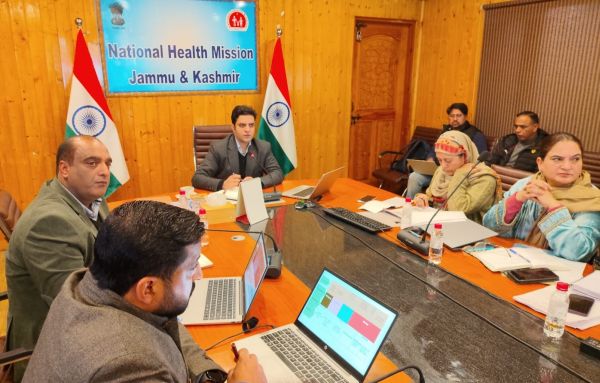

SRINAGAR: Mission Director, National Health Mission (NHM) Jammu and Kashmir, Athar Aamir Ul Shafi Khan, on Monday directed all districts to conduct a two-week intensive screening drive covering registered pregnant women to facilitate early detection and timely management of high-risk pregnancies.
The directions were issued during the third Task Force Committee meeting of the Anaemia Mukt Bharat (AMB) programme, chaired by the Mission Director at the Conference Hall of the State Health Society, NHM, Old Secretariat, Srinagar.
The screening drive will cover haemoglobin (Hb) testing, hypertension (HTN) and diabetes mellitus (DM).
The meeting was attended by the Directors of Health Services, Jammu and Kashmir; Director of Family Welfare, Maternal and Child Health (MCH) and Immunization; all Chief Medical Officers (CMOs); programme managers of NHM J&K; and nominated representatives from the departments of School Education, Integrated Child Development Services (ICDS), Rural Development and Social Welfare.
Reviewing the implementation of the AMB programme across the Union Territory, Khan, referring to National Family Health Survey-5 (NFHS-5) data, stressed the need to shift the programme’s focus from the mere distribution of prophylactic iron-folic acid (IFA) supplements to a beneficiary-centred and outcome-oriented approach.
He directed that every Ayushman Arogya Mandir (AAM) and Public Health Centre should anchor grassroots implementation through a structured continuum of screening, identification, treatment, referral, follow-up and reassessment.
Mid-Level Health Providers (MLHPs) and Auxiliary Nurse Midwives (ANMs), supported by Accredited Social Health Activists (ASHAs), Anganwadi Workers (AWWs) and Rashtriya Bal Swasthya Karyakram (RBSK) teams, will lead beneficiary mobilisation, haemoglobin screening, classification of anaemia and comprehensive line-listing of anaemic beneficiaries, he said.
The districts were also instructed to ensure optimal utilisation of digital invasive haemoglobin meters procured for health facilities and RBSK Mobile Health Teams. They were asked to maintain proper line-lists and ensure real-time data entry on dedicated portals, including AMB Abhiyaan, JANANI and RBSK.
Emphasising the 7×7×7 strategy, the Mission Director called for close coordination among stakeholder departments and programme divisions.
The strategy includes weekly iron-folic acid supplementation (WIFS), school-based deworming and monitoring of mid-day meals through School Health Ambassadors; biannual deworming, supplementary nutrition and promotion of Poshan Vatikas through ICDS; community mobilisation through Rural Development Self-Help Groups (SHGs) and Panchayati Raj Institution (PRI) members; and promotion of Water, Sanitation and Hygiene (WASH) practices.
Concluding the meeting, Khan urged all CMOs to address gaps in IFA compliance and data uploading, particularly in underperforming districts, through regular mentoring and review meetings.