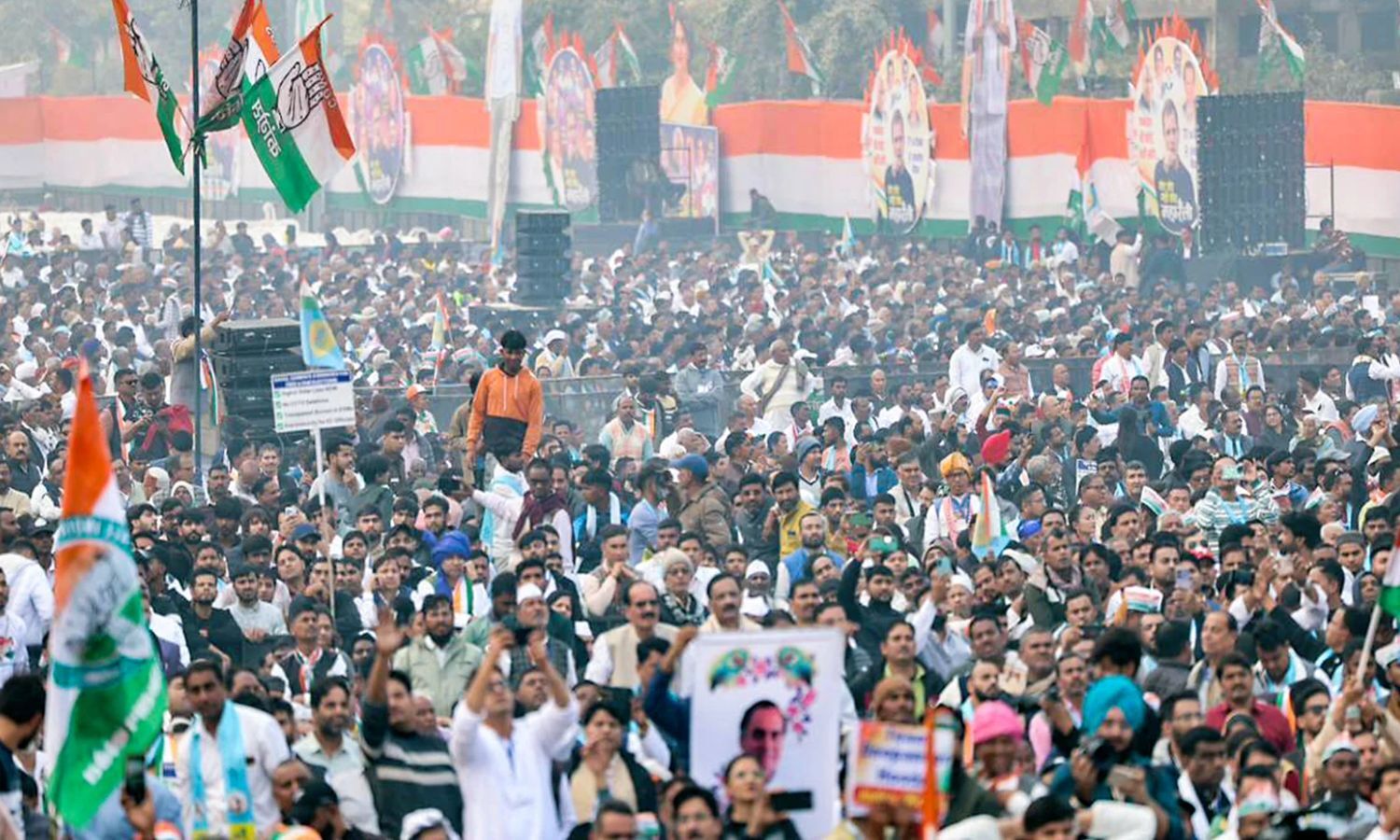
New Delhi: The stage is set for the INDIA bloc’s mega rally at Delhi’s Ramlila Maidan on Sunday, with opposition leaders and supporters from different states beginning to reach the national capital for a show of strength against alleged electoral irregularities and to demand the resignation of Chief Election Commissioner Gyanesh Kumar.
With a large tricolour canopy erected over the main stage, separate arrangements for representatives of INDIA bloc parties and security preparations in place, the Opposition is gearing up for a march from Minto Road to Ramlila Maidan, followed by a rally that is expected to bring together political parties, student groups and civil society organisations.
The mobilisation is not confined to the alliance’s political constituents.
The INDIA bloc has appealed to students, youth, women, workers and civil society members to join the demonstration, while the Cockroach Janta Party (CJP) and student organisations have also extended support.
The CJP, a youth-led outfit founded by Abhijeet Dipke, has also extended support to the November 1 mobilisation, reiterating its demand for Kumar’s resignation and saying it would stand with organisations fighting for free and fair elections.
The march, named ‘Chalo Dilli’, will begin at noon from the Minto Road-Connaught Place junction and culminate at Ramlila Maidan, where the rally is scheduled from 10 am to 5 pm. Leaders of the INDIA bloc are expected to travel in open buses from Congress president Mallikarjun Kharge’s residence to the starting point of the march.
Preparations at Ramlila Maidan have gathered pace over the past few days.
Workers have erected a large tricolour tent over the main stage for senior opposition leaders, while a second stage is being arranged for representatives of INDIA bloc state units. Rows of white canopy tents have been put up, metal barricades installed to regulate movement and temporary platforms assembled, while trucks have been bringing in chairs and other material.
Separate entry gates and enclosures are being arranged for different categories of attendees. Organisers have been asked to deploy volunteers to regulate the crowd, arrange drinking water and separate toilets for women, and coordinate parking with traffic police. Overnight stay at the venue is not permitted.
The INDIA bloc leaders have said they are expecting a turnout of up to 10 lakh people, while Delhi Police expects around 50,000.
Officials estimate that Ramlila Maidan can accommodate 45,000 to 50,000 people when empty, but the capacity would come down to around 30,000 to 40,000 with chairs, enclosures and designated passageways in place. Space will be kept outside the ground to manage any crowd spillover.
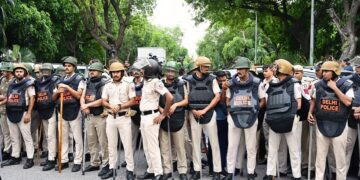
More than 4,000 police personnel, along with Central Armed Police Forces companies, will be deployed for security and crowd management along the march route and at the venue. Ramlila Maidan has been divided into 14 zones, each supervised by an officer of assistant commissioner rank. More than 200 CCTV cameras, drones and body-worn cameras will be used for surveillance, with a control room set up inside the ground.
Traffic restrictions will also be in place across parts of Delhi from 10 am to 5 pm on Sunday. Diversions are planned at key intersections, including ITO, Delhi Gate, Rajghat, Ajmeri Gate and Turkman Gate. Commuters have been advised to avoid stretches around Bahadur Shah Zafar Marg, Jawaharlal Nehru Marg, Minto Road and Desh Bandhu Gupta Road. Special arrangements will be made to ensure the movement of ambulances and emergency vehicles towards LNJP and GB Pant hospitals. Passengers travelling to New Delhi Railway Station have also been advised to plan their journeys in advance.
Delhi Police has said permission has been granted for the rally at Ramlila Maidan, but no application had been received for the proposed procession from the Minto Road-Connaught Place junction.
Sunday’s mobilisation follows a symbolic ‘public impeachment’ of Kumar held by the INDIA bloc at Kharge’s residence on Saturday. Former Lok Sabha Speaker Meira Kumar presided over the proceedings; Kharge moved a resolution listing the Opposition’s charges against the CEC, and Rahul Gandhi delivered the concluding remarks before it was adopted.
Leaders of several opposition parties, civil society representatives and people affected by the SIR exercise participated in the proceedings, which were modelled on parliamentary debates. The resolution accused Kumar of facilitating alleged electoral manipulation, large-scale deletion of voters and undermining the independence of the Election Commission, and called for his removal. The exercise was symbolic and did not constitute a formal constitutional impeachment.
The INDIA bloc has been holding a series of protests against what it describes as ‘vote chori’, accusing the Election Commission of facilitating large-scale deletion of voters’ names through the Special Intensive Revision (SIR) of electoral rolls. Opposition parties have also approached President Droupadi Murmu and the Supreme Court over the issue.