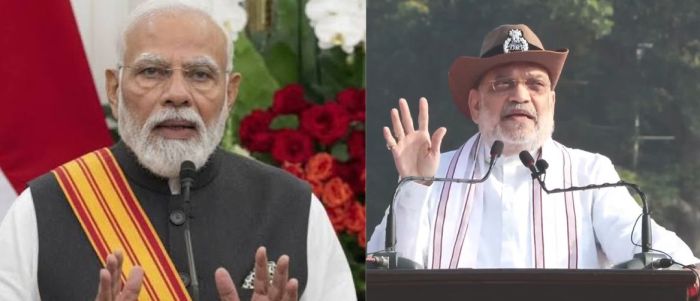
New Delhi, October 21: Prime Minister Narendra Modi on Wednesday paid tributes to police personnel who lost their lives in the line of duty, acknowledging their contribution to maintaining law and order, combating crime and ensuring public safety.
In a message posted on X, Modi said Police Commemoration Day was an occasion to express gratitude to personnel who serve in challenging circumstances, including responding to emergencies and protecting citizens.
He paid solemn tributes to the fallen personnel, saying their courage, dedication and sacrifice would remain etched in the nation’s memory.
Meanwhile, Union Home Minister Amit Shah on Wednesday set December 31, 2029, as the target to free the country from the drug menace, calling on police forces across India to implement the roadmap for a drug-free nation under the leadership of Prime Minister Narendra Modi.
Addressing the Police Commemoration Day ceremony at the National Police Memorial in New Delhi, Shah said drug abuse and trafficking threatened the future of young people, burdened the economy and could provide financial support to organisations with anti-national intentions.
He also flagged off a nationwide motorcycle rally carrying the message “Fight Against Drugs”. The rally includes around 90 riders from several states and Union Territories, central armed police forces and other central police organisations. The participants will travel to Ekta Nagar in Gujarat to take part in the Ekta Parade-2026.
Shah paid tribute to police personnel who lost their lives in the line of duty and said the National Police Memorial had become a place of remembrance for citizens across the country. He noted that 36,852 police personnel had made the supreme sacrifice since Independence.
‘Their dedication and sacrifice will remain etched in the nation’s memory’: PM pays tribute; HM sets December 2029 deadline to rid India of drug menace
Recalling the origins of Police Commemoration Day, he said 10 Central Reserve Police Force (CRPF) personnel were killed while resisting an attack by Chinese troops at Hot Springs in Ladakh on October 21, 1959. The incident led to the annual observance of the day.
Shah described 2026 as a significant year for the Indian police, claiming that the country had achieved freedom from Naxalism on March 31. He said more than 3,600 security personnel and nearly 13,700 civilians had lost their lives during the decades-long conflict between 1981 and March 2026.
He acknowledged the sacrifices of security personnel and civilians and expressed gratitude to the families of those killed, saying their contributions had helped the country move forward on the path of development.
The Home Minister said police personnel formed the first and last line of defence for internal security and continued to serve during festivals, elections, protests, emergencies and border security operations, often remaining away from their families.
He also credited the Central Armed Police Forces (CAPFs) with helping ensure the peaceful conduct of elections, citing the recently concluded West Bengal Assembly elections, which he said were conducted without a single fatality.
Shah said Kashmir, the northeastern region and areas affected by Left-Wing Extremism had been major internal security challenges for decades, adding that the government had achieved significant progress in curbing terrorism, facilitating peace agreements in the Northeast and tackling Naxalism.
He specifically acknowledged the contributions of the CRPF, its CoBRA Battalion and the Chhattisgarh Police in operations against Naxalism.
The National Police Memorial was inaugurated by Prime Minister Narendra Modi in 2018 to honour police personnel who died in the line of duty and inspire future generations to serve with dedication, Shah said.
The ceremony was attended by Union Home Secretary Govind Mohan, Intelligence Bureau Director Mahesh Dixit, Indo-Tibetan Border Police Director General Shatrujeet Kapoor, heads of other central armed police forces, Members of Parliament Krishna Prasad Tenneti and Rajiv Kumar, and senior officers.