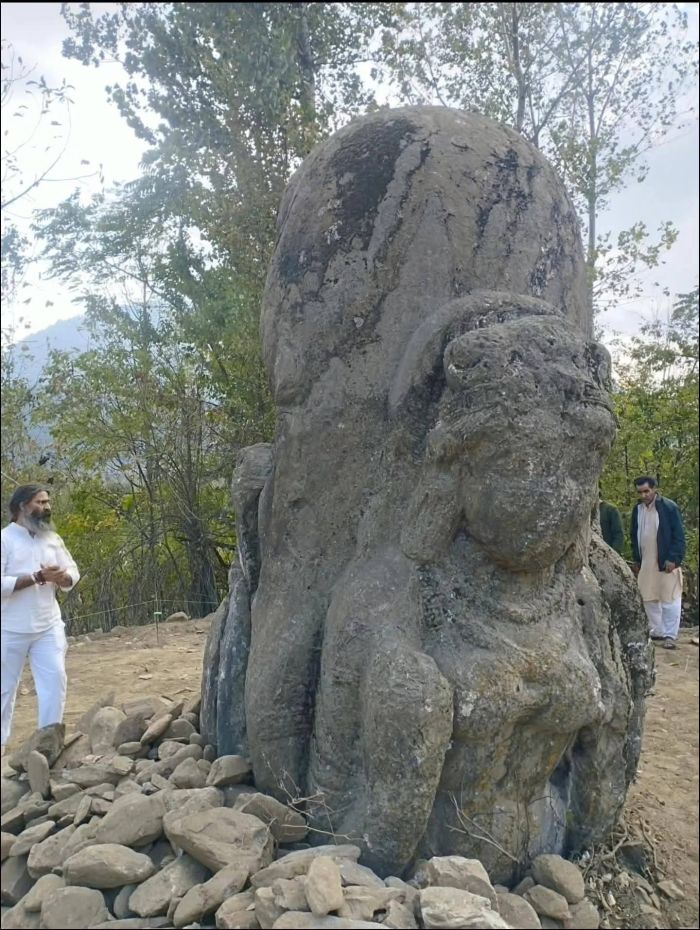
Baramulla: Restoration work at an ancient Shivling shrine in Kanlibagh has renewed attention on Baramulla district’s lesser-known Shaivite heritage, with residents and heritage enthusiasts calling for scientific conservation, archaeological documentation and formal land demarcation to protect the sites from further neglect.
Around ₹12 lakh has reportedly been sanctioned for restoration work at the Kanlibagh shrine, while another ₹53.3 lakh has been earmarked for a heritage-related project. The precise scope and implementation details of the larger allocation require official confirmation.
The renewed interest extends beyond Kanlibagh to a four-faced Shivling at Sheeri village and a stone structure measuring approximately 13 feet, believed by local heritage enthusiasts to be a Mukhalinga. Their age, provenance and historical associations remain to be established through specialist examination.
Pandit Shivanand Rohit, who has been pursuing the preservation of the Kanlibagh shrine, welcomed the administration’s intervention, particularly the visit by Deputy Commissioner Baramulla Syed Fakhurdin Hamid.
Rohit said the community had approached the administration and submitted representations over more than a year, seeking protection of the neglected shrine. He said restoration work had commenced following the Deputy Commissioner’s visit and directions for its revival and preservation.
A Bhoomi Pujan was subsequently performed to mark the beginning of the work.
According to local community members, the Kanlibagh Shivling could be around 400 to 500 years old, although its age has not been independently established. Residents said the site had remained neglected for years despite repeated appeals for administrative intervention.
Menakshi Pandita, a devotee, welcomed the commencement of restoration but said the shrine’s long-term protection required more than repairs to the structure.
She called for formal demarcation of the land associated with the shrine, saying clearly documented boundaries and regular inspections would help prevent encroachment and future disputes.
Residents have also sought a mechanism for the continued maintenance of the shrine and its surroundings after the current restoration work is completed.
At Sheeri, the four-faced Shivling has drawn interest because of its distinctive iconography. Rohit identified the carved faces as representations of Durga, Kali, Lakshmi and Uma, an interpretation that requires independent specialist documentation.
A Mukhalinga is a representation of Lord Shiva in which one or more faces are carved into the lingam, while a Chaturmukhi Shivling generally features four faces. Heritage enthusiasts believe the structures may be associated with ancient Shaivite and tantric traditions in Kashmir, but their precise historical context remains unverified.
Community representatives said teams had visited the Sheeri site to assess the sculpture, with further examination and conservation work expected to follow.
The renewed attention has also prompted calls for a coordinated heritage conservation programme covering Baramulla and adjoining areas. Heritage enthusiasts believe that, if properly documented and protected, the sites could form part of a cultural tourism trail highlighting north Kashmir’s historical and religious landscape.
They have called for professional archaeological surveys, photographic and written documentation, structural assessments and verification of land records before wider tourism initiatives are developed.
Experts in heritage conservation generally caution that tourism must follow appropriate conservation measures, as unregulated visitor access and restoration without specialist guidance can damage historically significant structures.
Residents and heritage enthusiasts have urged the administration to involve qualified archaeological and conservation agencies in the work, while ensuring community participation in decisions concerning access, maintenance and visitor management.
For Baramulla, they said, the immediate priority is to ensure that the restoration at Kanlibagh leads to lasting protection and that the distinctive structures at Sheeri receive the same attention through systematic assessment and conservation.