Srinagar: Chief Minister Omar Abdullah has described the Jammu and Kashmir Circular Economy Policy, 2026, as a step towards resource recovery, green growth and ecological sustainability, with a 10-year planning outlay of ₹3,548.7 crore.
The policy aims to establish a resource-efficient development model suited to J&K’s varied geography and settlement patterns, covering waste management, recycling, resource recovery and wastewater reuse.
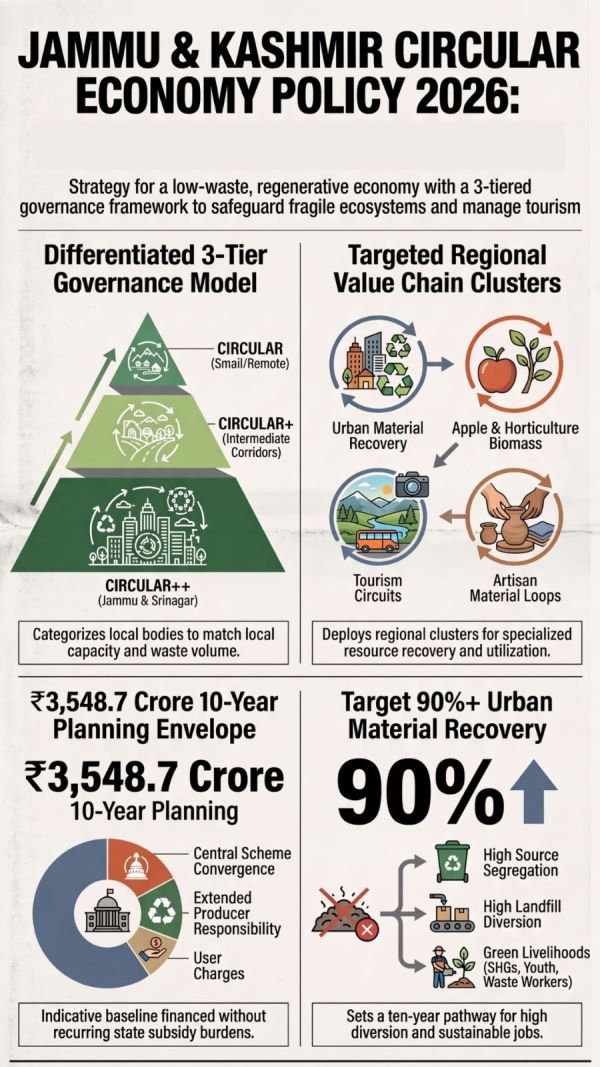
It proposes a three-tier governance framework — Circular, Circular+ and Circular++ — to align waste management systems with the capacities and needs of local bodies. The framework envisages decentralised processing in smaller and remote areas, hub-and-spoke logistics along intermediate corridors, and advanced circular economy systems in major urban centres, including Jammu and Srinagar.
The policy covers multiple waste streams, including municipal solid waste, food and wet waste, tourism-related waste, horticultural and agricultural biomass, packaging, construction and demolition debris, electronic waste and wastewater. It also promotes repair, refurbishment and reuse, including resource recovery linked to wool and handicrafts.
To address transportation and terrain-related challenges, the roadmap proposes regional value-chain clusters focused on urban material recovery, apple and horticultural biomass, tourism circuits and artisan material reuse. These clusters are intended to connect waste management with local economic activity and employment generation.
The indicative 10-year planning envelope of ₹3,548.7 crore is expected to be supported through convergence with Central government schemes, Extended Producer Responsibility mechanisms and user charges, alongside potential public-private partnerships.
A key target is to achieve more than 90 per cent urban material recovery through improved waste segregation, reduced landfill disposal and the development of green livelihoods. The policy also seeks to create opportunities for self-help groups, youth and waste workers by integrating resource recovery into local economic activity.
The framework aims to strengthen environmental sustainability and support more resilient urban and rural development across Jammu and Kashmir through decentralised solutions, regional specialisation and more efficient use of resources.