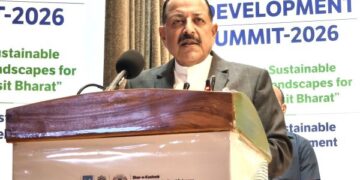
SRINAGAR: Minister for Jal Shakti, Forest, Ecology and Environment, and Tribal Affairs Javed Ahmed Rana on Wednesday stressed the need to integrate water security, forest conservation and ecological protection into the development model for Jammu and Kashmir and the wider Himalayan region.
Addressing the 13th Sustainable Mountain Development Summit (SMDS) 2026 at Sher-e-Kashmir University of Agricultural Sciences and Technology of Kashmir (SKUAST-K), Shalimar campus, as the guest of honour, Rana said economic growth must be balanced with environmental protection.
The three-day summit, organised from October 12 to 14 by SKUAST-K in collaboration with the Integrated Mountain Initiative (IMI), brought together scientists, policymakers, civil society representatives and community leaders from mountain regions across the country.
Speaking on the theme, “Contouring Sustainable Himalayan Landscapes for Inclusive Viksit Bharat”, Rana said forests, glaciers, rivers, springs and biodiversity sustained agriculture, horticulture, tourism and local livelihoods while maintaining ecological balance and supporting water security across large parts of the country.
“Water security must remain one of our foremost priorities,” he said, calling for the protection and rejuvenation of springs, conservation of catchment areas, rainwater harvesting, improved water-use efficiency and long-term sustainability of drinking water sources.
He said the expansion of water supply infrastructure must be accompanied by conservation and replenishment of natural resources that sustain these systems.
Rana welcomed discussions on the proposed Jammu and Kashmir Sustainable Mountain Development Policy, whose first draft has been jointly prepared by IMI and SKUAST-K and is under review by national experts.
The proposed policy covers ecological carrying capacity, mountain-sensitive land-use planning, responsible tourism, resilient infrastructure, waste management, watershed and spring security, disaster-risk reduction and sustainable livelihoods.
“The real measure of development is not simply the number of projects completed, but the quality of life we secure for our people and the natural heritage we preserve for future generations,” Rana said.
He called for a development framework that ensures safe drinking water for every village, protects forests and biodiversity, and creates sustainable livelihood opportunities for young people within their own regions.
SKUAST-K Vice-Chancellor Nazir Ahmad Ganai outlined key provisions of the draft policy, including the classification of four mountain sensitivity zones, integration of 11 policy verticals, tourism within carrying capacity, a proposed affordable green mountain cess and stronger interdepartmental coordination.
Ganai also stressed the need to address unplanned and unregulated development and reform education to promote ecological responsibility among future generations.
IMI Counsellor Rajan Kotru presented the summit report, highlighting outcomes from six technical sessions. He said the recommendations would inform further refinement of the draft policy.
IMI Secretary Roshan Rai said inclusivity and equity should guide Himalayan development, while former IMI president P.D. Rai said the J&K draft policy could strengthen policy advocacy and offer a framework for other Himalayan states.
A.H. Mughal, Dean of the Faculty of Forestry at SKUAST-K, welcomed the participants and acknowledged IMI’s partnership in organising the summit and preparing the reports. The session concluded with a vote of thanks by Khursheed Ahmad Dar.
Panel discussions involving civil society members, former government officials and youth representatives examined the proposed policy and offered recommendations to make it responsive to different stakeholder concerns.
The summit emphasised the need to link scientific research with policymaking, while incorporating indigenous knowledge, community participation and coordinated action to strengthen the resilience of Himalayan ecosystems and communities.