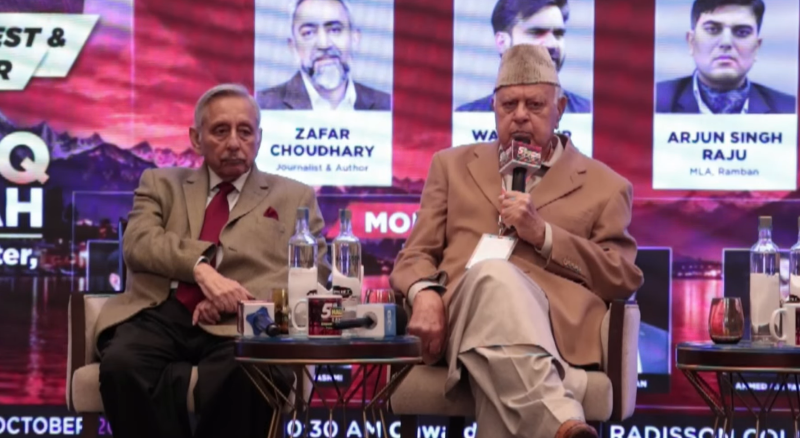
SRINAGAR: Restoration of statehood, governance under the Union Territory framework, political representation, youth aspirations and the future direction of Jammu and Kashmir dominated discussions at the fifth Halla Bolle conclave here on Sunday, with leaders from across the political spectrum presenting sharply different visions for the region’s future.
The conclave brought together National Conference president Farooq Abdullah, PDP chief Mehbooba Mufti, Congress leader and MLA Ghulam Ahmad Mir, BJP leader and former J&K BJP president Ravinder Raina, National Conference MP Aga Syed Ruhullah Mehdi, former Union minister Mani Shankar Aiyar and former separatist leader Bilal Ahmad Lone.
The restoration of statehood emerged as the central political issue during the discussions, reflecting its continued importance in Jammu and Kashmir’s post-2019 political discourse.
Congress leader Ghulam Ahmad Mir questioned the delay in restoring statehood, arguing that political parties had participated in elections after assurances that the issue would be addressed. He said the absence of statehood had created administrative complications and affected governance by creating what he described as dual centres of authority.
Mir maintained that an accountable and empowered government was necessary for addressing public grievances and ensuring faster decision-making. He also argued that elected institutions should have greater authority in matters affecting the daily lives of people.
Responding to those concerns, BJP leader Ravinder Raina reiterated that the Centre remained committed to restoring statehood and said his party also supported the move. He rejected suggestions that the elected government lacked powers, asserting that the chief minister and council of ministers possessed the necessary financial and administrative authority to govern effectively.
Raina also pointed to what he described as significant improvements in the security situation since 2019, arguing that the changes had enabled greater mobility, economic activity and normal public life across Jammu and Kashmir.
National Conference president Farooq Abdullah acknowledged that the elected government was functioning under difficult circumstances but defended its performance, saying ministers were actively engaging with people and attempting to address issues despite financial and administrative limitations.
Abdullah said public expectations were understandably high after the Assembly elections, but argued that the government had inherited significant challenges and was attempting to address them within the resources available to it. He stressed that governance should be assessed in the context of prevailing realities rather than expectations alone.
The veteran politician also spoke about the need for greater self-reliance and economic participation, saying Jammu and Kashmir needed to strengthen its own productive capacity and reduce dependence on outside support. He urged people to play a larger role in building local economic resilience.
PDP president Mehbooba Mufti focused on the need for political unity, arguing that parties in Jammu and Kashmir should draw lessons from Ladakh, where diverse political and social groups have come together on common issues despite ideological differences.
She said no single party could effectively address the region’s political, economic and social challenges in isolation and advocated the creation of a broader platform through which parties could jointly engage with New Delhi on issues affecting Jammu and Kashmir.
Mehbooba also repeatedly returned to the issue of youth, describing it as the most significant challenge facing the region. She noted that a large section of Jammu and Kashmir’s population comprises young people whose outlook has been shaped by technology, social media and global connectivity.
According to her, policymakers and political leaders must move beyond merely responding to questions raised by young people and instead address their aspirations, concerns and expectations regarding education, employment and opportunities.
Youth concerns also featured prominently in remarks by Bilal Ahmad Lone, who urged society to look forward rather than remain trapped in debates over the past.
Lone argued that decades of conflict had imposed a heavy burden on ordinary families and that future generations should not be made to inherit the same uncertainty and instability. He called for rebuilding trust between people and political institutions and emphasised the need for a political discourse centred on opportunities, reconciliation and democratic participation.
National Conference MP Aga Syed Ruhullah Mehdi used the platform to advocate a more assertive political approach on issues concerning Jammu and Kashmir’s constitutional and political aspirations.
He argued that electoral mandates carried responsibilities and that political objectives required sustained mobilisation, strategic planning and engagement beyond the boundaries of Jammu and Kashmir. Mehdi said broader national outreach, alliance-building and public engagement were essential if long-term political goals were to be pursued effectively.
Former Union minister Mani Shankar Aiyar, meanwhile, focused on regional diplomacy and broader political trends. He advocated continued dialogue between India and Pakistan, arguing that engagement remained the only viable path for addressing difficult issues. He said differences between countries could not be resolved without communication and called for greater regional cooperation in South Asia.
Aiyar also spoke about changing geopolitical realities and India’s role in the evolving international order, emphasising the importance of diplomacy, dialogue and regional stability.
Despite sharp differences on a range of political issues, the discussions revealed broad agreement on several concerns, particularly the need to improve governance, expand economic opportunities, strengthen democratic participation and address the aspirations of young people.
The conclave also reflected the evolving nature of political discourse in Jammu and Kashmir, where debates that were once dominated by questions of conflict and security are increasingly intertwined with discussions on governance, development, employment, political representation and institutional accountability.
While no consensus emerged on the path forward, the exchanges highlighted the competing narratives currently shaping Jammu and Kashmir’s politics, with statehood remaining the most prominent demand cutting across party lines and youth emerging as the constituency that virtually every political leader sought to address.
The event was attended by political leaders, academics, civil society representatives, students and professionals, and provided one of the most diverse political platforms seen in the Valley in recent months, bringing together voices from mainstream parties, dissident political groups and former separatist circles under one roof to debate Jammu and Kashmir’s future.