Srinagar: The Jammu and Kashmir administration has begun exploring the creation of a “Multiversity” ecosystem to bring universities and premier educational institutions onto a common collaborative platform aimed at strengthening higher education, research, innovation and employability in the Union Territory.
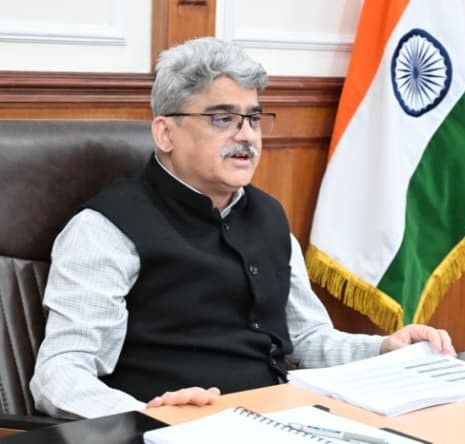
The proposal was discussed at a high-level consultation chaired by Chief Secretary Atal Dulloo on Thursday, attended by vice chancellors of universities in J&K, Commissioner Secretary Higher Education Department Ram Niwas Sharma, Director Colleges Dr Twinkle Suri and other senior officials.
The meeting focused on developing an institutional framework that would allow universities and higher educational institutions to share academic resources, promote multidisciplinary learning, facilitate student and faculty mobility, strengthen research collaborations and build stronger links with industry in line with the National Education Policy (NEP) 2020.
Addressing the participants, Dulloo said rapid technological changes were transforming workplaces and creating new challenges that required multidisciplinary knowledge and skills. He observed that while technology was replacing certain conventional jobs, it was also generating opportunities that demanded continuous learning and adaptability.
He stressed that future generations would need to upgrade their skills continuously and work across institutional and professional boundaries, adding that such capabilities could not be developed in isolation.
The Chief Secretary said the proposed Multiversity model could serve as a mechanism for creating a future-ready workforce by bringing together the strengths of different institutions and enabling students to access a wider range of academic opportunities.
Emphasising the importance of research and innovation, Dulloo called for a shift “from papers to patents” and directed officials to prepare a framework with clearly defined milestones, timelines, institutional responsibilities and measurable outcomes.
The concept was presented by Vice Chancellor of the Islamic University of Science and Technology (IUST), Prof Shakil Ahmad Romshoo, who outlined the relevance and potential of developing such a collaborative model in Jammu and Kashmir.
Romshoo said the region possessed a diverse higher education ecosystem that included universities, agricultural institutions, AIIMS, SKIMS, IIT, IIM, technical institutions and a large network of colleges. He argued that these institutions could complement one another by sharing expertise, infrastructure and academic resources instead of creating duplicate facilities.
According to the presentation, the proposed framework could include shared courses, interdisciplinary learning pathways, common laboratories and facilities, mobility of students and faculty, internships, apprenticeships and stronger engagement with industry and public-sector organisations. It also proposed measurable key performance indicators to assess progress.
Vice Chancellor of the University of Kashmir, Prof Neelofar Khan, said inter-institutional collaboration was not entirely new to J&K and noted that educational institutions had previously undertaken collaborative initiatives on a limited scale. She emphasised the need to strengthen skill development and industry-academia linkages as part of the proposed model.
University of Jammu Vice Chancellor Prof Umesh Rai said the NEP-2020 already provided a broad framework for such initiatives and suggested building upon existing mechanisms such as Massive Open Online Courses (MOOCs) and the Academic Bank of Credits. He stressed the need for seamless transfer and recognition of academic credits among participating institutions.
Cluster University Srinagar Vice Chancellor Prof Mohammad Mobin said the cluster university model already represented an example of institutions functioning under a common academic framework and suggested building on those experiences while addressing implementation challenges.
Similarly, Cluster University Jammu Vice Chancellor Prof K.S. Chandrasekar described the cluster universities established in J&K as among the country’s early collaborative higher education models and said further academic integration could be explored through the proposed framework.
Shri Mata Vaishno Devi University Vice Chancellor Prof Pragati Kumar highlighted the Government of India’s I-STEM platform, which facilitates sharing of advanced scientific equipment and research resources among institutions. He also underlined the need for financial mechanisms to support student and faculty exchanges.
Baba Ghulam Shah Badshah University Vice Chancellor Prof Jawaid Iqbal described the cluster universities as “mini-Multiversities” and suggested expanding the concept by bringing more institutions under a common academic ecosystem through online, offline and hybrid modes.
Commissioner Secretary Higher Education Ram Niwas Sharma informed the meeting that several private universities in the country had successfully implemented collaborative arrangements involving faculty, students and shared resources. He suggested identifying a Special Purpose Vehicle (SPV) or anchor institution to coordinate the initiative, initially through a select set of courses.
Director Colleges Dr Twinkle Suri stressed the importance of ensuring equitable access to opportunities across institutions, noting that J&K already possessed a substantial higher education infrastructure comprising universities, technical institutions and hundreds of colleges.
The meeting also discussed issues related to shared laboratories, credit transfer systems, research partnerships, internships, financing mechanisms and institutional responsibilities.
Dulloo directed officials to further develop the concept into a time-bound and outcome-oriented framework. He said the objective should be to create greater opportunities for students and researchers by enabling access to expertise and facilities across institutions while enhancing the quality, innovation and research potential of Jammu and Kashmir’s higher education ecosystem.