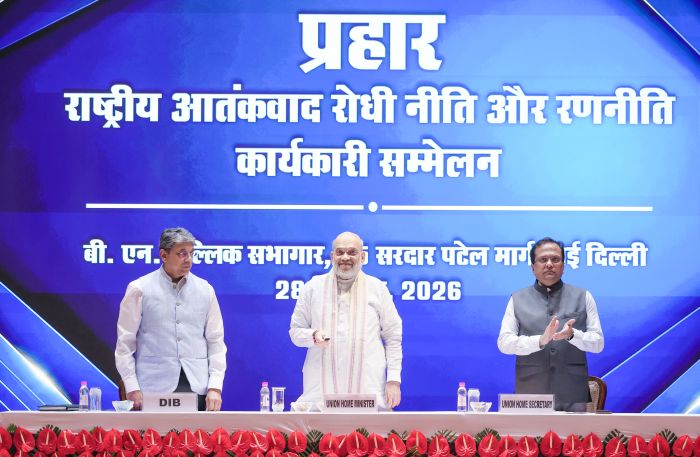
New Delhi: Union Home Minister Amit Shah on Monday unveiled a comprehensive national counter-terrorism framework under the banner of ‘PRAHAAR – CT Policy and Strategy’, calling for its implementation down to the police station level and stressing the need for a robust, technology-driven mechanism to combat terrorism over the next decade.
Inaugurating a high-level conference on counter-terrorism strategy in New Delhi, Shah said the Government of India follows a policy of “zero tolerance” towards all forms and manifestations of terrorism and emphasised the need for continuous analysis of terror incidents to strengthen the country’s security architecture.
The conference deliberated on the seven pillars of PRAHAAR — Prevention, Response, Aggregating Internal Capacities, Human Rights, Attenuating Conditions for Terrorism, Aligning International Efforts, and Recovery & Resilience — through what officials described as a whole-of-society approach to counter-terrorism.
Shah said consistent efforts were required to build a strong and sustainable PRAHAAR mechanism for the next ten years, asserting that every component of the framework must translate into concrete action on the ground. He stressed that the strategy should not remain confined to policy discussions and must be effectively implemented at the grassroots level, including police stations.
Calling for a proactive security approach, the Home Minister advocated the institutionalisation of an automated counter-terrorism response system across all levels of the security framework. He also underlined the importance of seamless coordination among agencies and stakeholders to ensure that each pillar of the PRAHAAR strategy delivers measurable results without delays in response and implementation.
Highlighting the government’s efforts against transnational crime and terrorism, Shah said that 288 fugitive criminals had been brought back to India from 36 countries between 2019 and 2026. To strengthen such efforts, he launched a new Extradition Portal, which is expected to streamline and accelerate the process of securing the return of wanted fugitives from abroad.
The Home Minister urged state police forces to establish dedicated teams to work in close coordination with central agencies on extradition matters and other national security challenges.
Shah also cited recent successes against organised criminal and terror-linked networks, stating that coordinated action by security agencies had led to the busting of more than 40 modules linked to the Shahzad Bhatti network, which was allegedly involved in cross-border smuggling of weapons, explosives and narcotics. He said over 100 FIRs had been registered and 350 persons arrested across 15 states in connection with the network, which has since been declared a terrorist organisation under the Unlawful Activities (Prevention) Act (UAPA).
The conference was attended by the Union Home Secretary, Foreign Secretary, heads of Central Armed Police Forces and Central Police Organisations, Directors General of Police of 15 states and Anti-Terrorism Squad chiefs from across the country. Other senior police officers participated virtually.