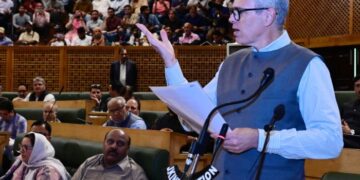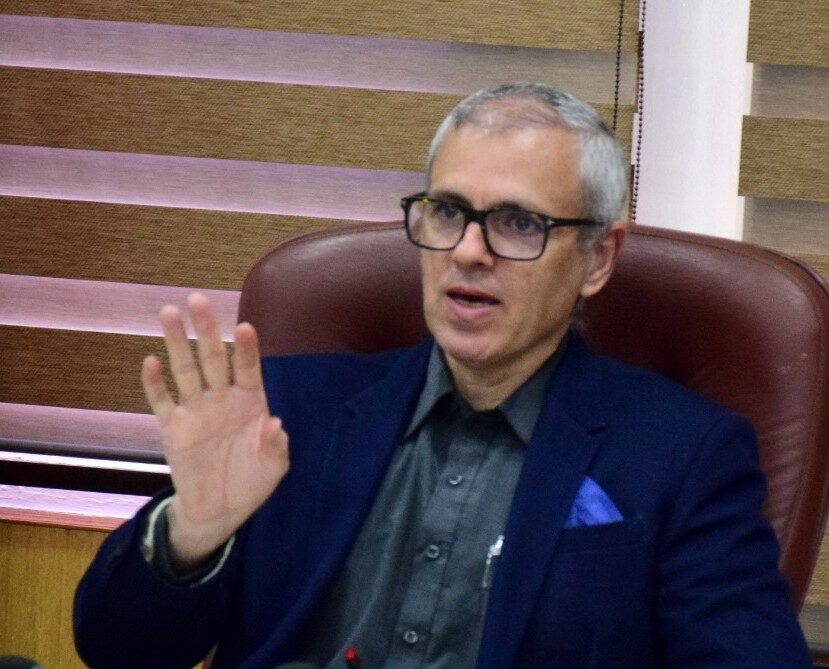
SRINAGAR: Chief Minister Omar Abdullah on Friday put the BJP on the spot over its position on restoration of Jammu and Kashmir’s statehood, challenging its 29 legislators to debate the issue in the Assembly and then make their stand clear through a vote.
Omar said the resolution moved by him in the Legislative Assembly was aimed solely at seeking the immediate and full restoration of statehood and had nothing to do with Article 370, special status, or autonomy.
“Today we are only asking the BJP to vote on statehood. We are not asking them to vote on Article 370, special status, or autonomy. Those resolutions have already been passed by the House,” Omar told the media.
Nearly two years, he said, had passed since the Assembly elections, yet the commitment made to the people of J&K regarding restoration of statehood had not been fulfilled.
Omar said the Assembly, being representative of the wider political spectrum of Jammu and Kashmir, was the appropriate forum to send a collective message to the Government of India vis-à-vis immediate restoration of statehood to the erstwhile state.
“Statehood is not about the government, my family, any political party, or any individual. Statehood is about the entire J&K,” he said.
The Chief Minister alleged that the BJP was attempting to avoid voting on statehood by raising objections to the resolution, asserting that its legislators should instead participate in the debate and clearly state whether they support or oppose restoration of statehood.
He asked BJP members not to abstain, walk out, or disrupt proceedings, but to vote in favor if they support statehood and against it if they do not.
“Let the people know,” Omar said.
He also alleged that the BJP’s 29 MLAs in the Assembly were an obstacle to restoration of J&K’s statehood, saying the party had contested the elections with restoration of statehood as one of its major commitments.
Omar said the BJP repeatedly reminded his government of its manifesto but alleged that it was not remembering its own commitment regarding restoration of statehood.
Reacting to the BJP’s description of the resolution as “anti-national,” Omar questioned how seeking restoration of statehood could be considered anti-national.
“How can moving a resolution on statehood be anti-national?” he asked, challenging the opposition to point out any anti-national or unconstitutional wording in the resolution.
He also clarified that references to earlier resolutions passed by the House did not mean those resolutions were being reconsidered, replaced, or diluted.
Omar said those resolutions were already the “property of the House” and that the present resolution was being brought “in addition” to them.
He said if the BJP wanted the earlier resolutions to be replaced; it could bring a separate resolution seeking their withdrawal or replacement and test it through a vote.
“If they get the votes, who am I to object? That is what democracy demands,” he said.
The Chief Minister also responded to BJP leader Sham Lal Sharma’s demand for an account of the government’s performance over the past two years, saying he was ready for a discussion in the Assembly on Monday.
“We will tell the House everything we have done in these two years. We will also put before the House the difficulties and problems we faced,” he said.
On claims by the BJP and the Leader of Opposition that the government could fall, Omar said the issue had nothing to do with the statehood resolution.
“If the Leader of Opposition wants to bring down the government, let him do it if he has the numbers. But what does that have to do with this resolution?” he said.
Omar said it would have been better if the opposition had allowed the Speaker to take up the resolution, participated in the debate, and placed its arguments before the House. He said the government was ready to respond to whatever was raised during the discussion before the House voted on the resolution.
Explaining why he chose to bring the issue before the Assembly, Omar said two years was a long time for J&K to wait for restoration of statehood.
He argued that the Cabinet represented the ruling party, whereas the legislature represented the wider political spectrum, including parties that were not part of the government.
“Clearly the voice of the Cabinet was not considered the voice of the people. The Cabinet only represents the ruling party. The legislature represents parties that are not part of the government,” he said.
Omar said this was why the resolution had been brought before the Assembly—to have the elected House speak with one voice and convey its demand to New Delhi.
On Congress supporting the resolution, he said there was nothing wrong or unconstitutional in its contents and welcomed the party’s position.
He reiterated that the resolution sought the immediate restoration of full statehood to Jammu and Kashmir and, if passed, would be forwarded to the Government of India.