Srinagar: Describing the abrogation of Articles 370 and 35A in August 2019 as the “fulfillment of Sardar Patel’s unfinished dream”, Lieutenant Governor Manoj Sinha Tuesday said the constitutional change was not a profound step towards psychological and emotional integration of J&K with mainland India.
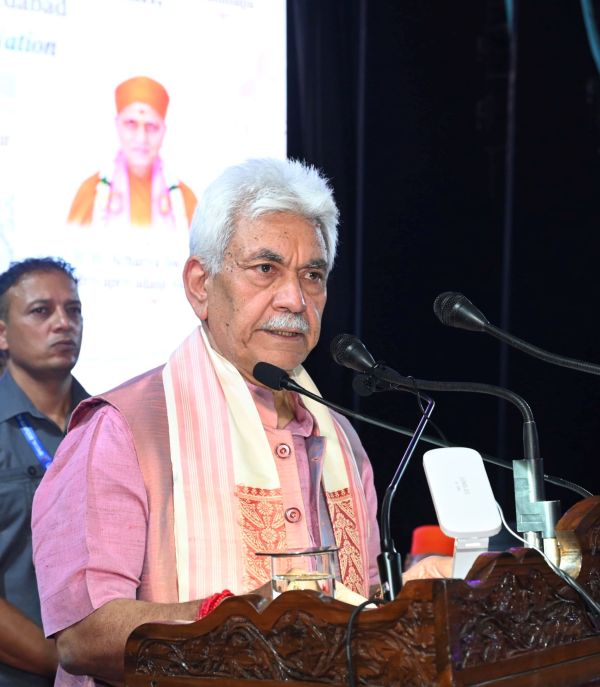
At the launch of the book “Sardar Patel and Kashmir: The Untold History”, Sinha paid homage to the foresight and nation-building genius of Sardar Vallabhbhai Patel and expressed gratitude to Bhagwan Shri Swaminarayan Ji, an official press release informed.
It said the LG also commended the Maninagar Shree Swaminarayan Gadi Sansthan for its unparalleled contributions to spiritual upliftment, education, and humanitarian service.
He also congratulated Dr. Rizwan Kadri for editing and publishing this important work.
In his speech, the LG described Sardar Patel as the “architect of modern India,” whose indomitable will and practical wisdom ensured the integration of 562 princely states into a united country. He emphasized that Patel’s vision of “Ek Bharat, Shreshtha Bharat” continues to define the essence of India’s democracy and unity in diversity.
The LG recalled Patel’s firm stance on Jammu & Kashmir, noting his declaration that “we will not give even an inch of Jammu & Kashmir’s territory to anyone.”
He reflected on Patel’s deep understanding of the nation’s pulse and his ability to connect with the common people, workers and communities across India.
“Through his indomitable willpower, clear vision, selfless diligence, and skilful organisational strength, he ensured that the dream of an undivided India became a reality. I also believe that had Sardar Patel been given the responsibility for Jammu & Kashmir, perhaps the problems that the people here endured for more than six decades would not have arisen,” he said.
The LG highlighted the book’s significance as a “serious attempt to re-evaluate history with honesty and impartiality”. He cautioned that for too long, historical narratives were shaped by ideological biases that overlooked the decisive contributions of leaders like Sardar Patel. He urged the new generation of writers to treat history as a mirror of truth, not as a tool for glorification, and to learn from past decisions to guide the future.
He also described the abrogation of Articles 370 and 35A in August 2019 as the fulfillment of Sardar Patel’s unfinished dream. The LG noted that “this constitutional change was not merely legal but a profound step towards psychological and emotional integration, ensuring equal rights and opportunities for all communities” in Jammu & Kashmir.
“In August 2019, under the leadership of Prime Minister Narendra Modi, the nation witnessed a historic constitutional change. New possibilities of education, employment, entrepreneurship and development opened up for the youth,” he said.
“The Prime Minister’s decision proved that when national interest becomes the supreme priority, no obstacle remains permanent. This is the same firm willpower whose glimpse we saw in Sardar Patel’s nation-building efforts in 1947. I believe that by consigning the era of Article 370 to history, Jammu & Kashmir now stands at the threshold of a new future,” he said.
The LG also outlined four priorities for Jammu & Kashmir’s future- “peace through zero tolerance towards terrorism, rapid development through infrastructure and connectivity, empowerment of youth by linking them to India’s digital economy and startup culture, and revival of cultural heritage to strengthen tourism and human values”.
He envisioned Srinagar, Jammu, and other cities of the Union Territory as vibrant centres of education, trade, and innovation.
He described the book as a “lighthouse” that illuminates Sardar Patel’s dream of a united, confident India. He called upon citizens to dedicate themselves to the ideals of unity, integrity, and patriotism, and to build an India that leads the world not only economically but also through moral leadership, cultural richness, and democratic values.
In the age of AI, students must embrace lifelong learning, values: LG
Lieutenant Governor Manoj Sinha on Tuesday urged students to embrace lifelong learning, creativity, empathy and values in the age of artificial intelligence.
He made the remarks while inaugurating new facilities at the University of Jammu, including a modern sports complex, a shooting range, high-mast lights for the cricket stadium and the Tawi Guest House complex, developed at a cost of nearly Rs 10 crore, an official press release informed.
These facilities, the LG noted, will empower the university’s athletes, scholars, and visitors, strengthening its role as a hub of excellence in the Union Territory.
Congratulating the Vice-Chancellor and stakeholders, the LG emphasized that while infrastructure is important, the true transformation of an institution lies in the values, ideas, and innovations nurtured within its walls. He reminded the audience that every generation experiences change, but the intensity of transformation in the present era, which is driven by artificial intelligence, is unparalleled.
The LG in his address raised a critical question: in the age of AI, what does it mean to be educated? He highlighted global concerns about AI’s accelerating power, citing experts.
He warned that AI, as a “quadruple-use” technology, could operate independently, producing both beneficial and harmful outcomes.
Stressing that technology must remain humanity’s servant, he declared that decisions affecting human dignity, livelihood, health, and freedom must always be made by accountable humans, not machines.
“The day technology becomes the master of humanity, our very existence will be at risk. Machines can calculate, but they cannot feel. Machines can predict, but they cannot bear responsibility for decisions. Machines can mimic the language of compassion, but they do not stand at a patient’s bedside at midnight, nor do they carry the moral weight of a judge’s verdict.
“My clear view is that every decision that deeply affects a person’s freedom, livelihood, health, education, or dignity must have a human behind it, who understands the decision, accepts responsibility for it, and can be held accountable,” he said.
The LG outlined five pressing challenges for higher education. He said focus should be on relevance and curricula must adapt rapidly to match the pace of change. He observed that rote learning should be avoided and classrooms must focus on application and purpose, not memorization. He highlighted that students must provide original answers, prioritizing curiosity and reasoning and technology must not widen the gap between rural and urban learners.
“It is true that no technology can replace a teacher. But it is equally true that technology will certainly change the teacher’s role. The teacher of the future will not merely be an information-giver; they will be a mentor, a guru, a questioner, and an inspiring personality who ignites curiosity and builds character in students,” the LG said.
For students and teachers, the LG shared six guiding messages- embrace lifelong learning, cultivate uniquely human capacities like creativity and empathy, build bridges across disciplines, contribute to national development, balance academics with sports, and remain rooted in traditions and values. He urged students to become embodiments of both science and Sanskar.
The LG encouraged youth to dream big, linking aspirations to service for society and the nation. He reminded them that they are the first generation growing up with AI as a companion, and bear the responsibility of shaping a future where humanity flourishes.
“Powerful tools in honest hands can achieve great work, but in the wrong hands, the same tools can cause serious harm. In the age of AI, the modern tools and machines have become more powerful than ever, and so the hands that wield it must possess greater steadiness, values, Sanskar, and wisdom,” the LG said.