Srinagar: Lieutenant Governor Manoj Sinha on Tuesday called for making millets a people’s movement in Jammu and Kashmir, saying the region has the potential to lead the revival of climate-resilient and nutrition-rich grains while strengthening farmers, empowering women and youth entrepreneurs, and promoting healthier lifestyles.
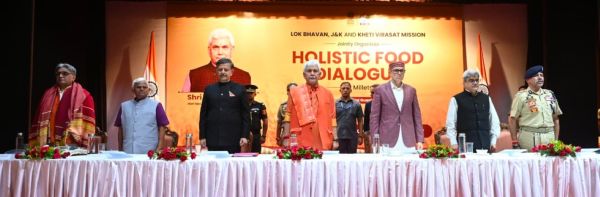
Addressing the valedictory session of the National Seminar on “Millets for One Health” at Lok Bhavan, Srinagar, the Lieutenant Governor said the two-day programme had brought together farmers, scientists, chefs, doctors, students and policymakers to deliberate on building a sustainable food system.
The event, organised in collaboration with Kheti Virasat Mission, was attended by Chief Justice of the High Court of Jammu & Kashmir and Ladakh Justice Pushpendra Singh Bhati, Chief Minister Omar Abdullah, Padma Shri awardee and food scientist Dr Khadar Veli, Chief Secretary Atal Dulloo, Director General of Police Nalin Prabhat, Executive Director of Kheti Virasat Mission Umendra Dutt, millet advocate A. Rambabu, judges, ministers, legislators, senior officials, academicians and civil society members.
Congratulating the participating institutions, Sinha said the seminar had highlighted the nutritional, ecological and economic significance of millets. He described traditional grains such as jowar, bajra, ragi, kodo, kangni and kutki as crops that had nourished human civilisation for centuries and said their return to everyday diets was both a health necessity and a civilisational responsibility.
Referring to increasing concerns over soil degradation, water stress and biodiversity loss, the Lieutenant Governor said millets offer a sustainable alternative capable of addressing several environmental and health challenges.
He noted that millets require minimal water, thrive in rain-fed conditions and generally need fewer chemical inputs. He added that their high nutritional value, including fibre, iron, calcium and protein content, and their low glycaemic index make them useful in addressing lifestyle-related diseases such as diabetes.
The Lieutenant Governor identified three major benefits of promoting millets in Jammu and Kashmir: tackling malnutrition, addressing lifestyle diseases and enhancing incomes of marginal farmers.
He stressed the need for a comprehensive ecosystem covering seed diversity, farmer training, processing, value addition, marketing and consumer awareness to ensure wider adoption of millet-based products.
“All stakeholders should focus on seeds and crop diversification so that we can revive the diversity of our rich agricultural heritage. We must move beyond seminars to the field and the market. Initiatives such as processing, value addition, chef training, grain-to-plate programmes and women-led millet cuisine campaigns should become a people’s movement,” he said.
Sinha described millets as climate-smart crops capable of withstanding weather uncertainties and changing rainfall patterns. He said a sustainable food system was essential not only for public health but also for workforce productivity and environmental protection.
The Lieutenant Governor also urged policymakers, experts, officials and media organisations to actively promote millet consumption and integrate it into everyday discourse. He said the goals of farmer prosperity and environmental conservation could be pursued simultaneously through wider cultivation and consumption of millets.
The programme concluded with a millet-based dinner showcasing a variety of traditional dishes prepared from different millet grains, highlighting their nutritional value and culinary versatility.