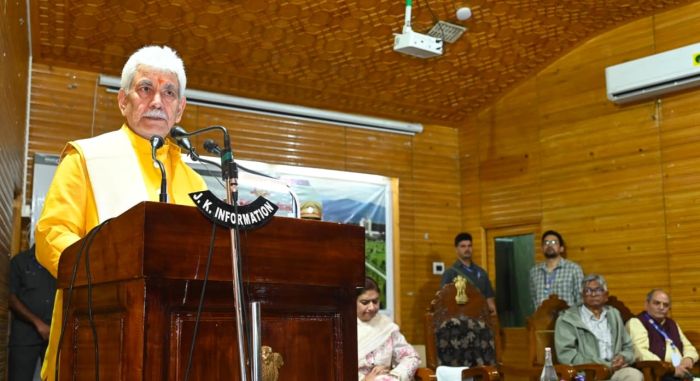
Srinagar: Lieutenant Governor Manoj Sinha on Thursday called for bridging the gap between science and policymaking to effectively address the challenges posed by climate change, saying India must work towards becoming a climate-resilient and inclusive nation by 2047.
He was addressing the valedictory session of a three-day national seminar on “Environment, Climate and Sustainability: Science, Policy and Pathways” at the University of Kashmir. The seminar brought together ecologists, hydrologists, soil scientists, policymakers and researchers from across the country to deliberate on pressing environmental challenges.
In his address, Sinha said climate change, biodiversity loss and pollution are interconnected dimensions of what he described as a “triple planetary crisis”, requiring integrated and holistic solutions rather than isolated departmental approaches.
“Although government machinery has separate departments for water, forests and climate policy, these issues are deeply interconnected. Recognising that connection is the first step towards solving these challenges,” he said.
Emphasising the role of technology in environmental governance, the Lieutenant Governor described geospatial intelligence, including Geographic Information Systems (GIS), remote sensing and unmanned aerial vehicles (UAVs), as critical tools for climate resilience. He said governance must move from a reactive to an anticipatory approach, supported by climate sensitivity maps and spatial decision-support systems.
“We must create systems that not only record what has already happened to a glacier, forest or river valley but can also help predict what may happen next. Scientists and environmental experts must become co-creators of early warning systems. The era of waiting years for reports has passed; today we need real-time information for real-time decisions,” he said.
Sinha stressed that while scientific data, climate models and artificial intelligence-based tools are increasingly available, institutional mechanisms to translate scientific findings into development planning and policy implementation remain inadequate.
“If we can bridge the distance between what science knows and what policy delivers, even the most complex climate challenges can be addressed. What we lack is not data or technology, but institutional arrangements capable of converting scientific knowledge into timely action,” he said.
The Lieutenant Governor also urged policymakers to be more receptive to scientific inputs and encouraged young researchers to think beyond disciplinary boundaries.
“Development must be accompanied by responsibility, conservation and duty. We need researchers who can work across disciplines and policymakers who can understand the language of science,” he said.
Looking ahead to the vision of a developed India by 2047, Sinha said the country’s growth must be both climate-resilient and inclusive. He expressed hope that the discussions initiated during the seminar would continue beyond the conference halls and influence research institutions, universities, district administrations and policymaking processes.
Vice Chancellor of the University of Kashmir Prof Nilofer Khan, former Vice Chancellor Prof Talat Ahmad, former Director of the National Centre for Polar and Ocean Research Dr Rasik Ravindra, Dean Academic Affairs Prof Shariefuddin Pirzada, along with experts, researchers, faculty members, students and senior officials, attended the valedictory session.
… releases three books at Lok Bhavan
Lieutenant Governor Manoj Sinha on Thursday released three sets of books at separate functions held at Lok Bhavan here, highlighting literary, cultural and philosophical themes.
In the first event, the Lieutenant Governor released Journal of the Waypoints, a book based on the Kashmiri poetry of noted multilingual poet Dr Satish Vimal. Authored by writer, translator and poet Mushtaque B. Barq, the book features English translations and critical interpretations of 40 selected Kashmiri poems by Dr Vimal.
Sinha appreciated Barq’s efforts in translating and analysing the poems and extended his best wishes to both the author and the poet. Publisher Sheikh Waseem was also present on the occasion.
In another function, the Lieutenant Governor released Living the Gita Today, authored by Prof Vandana Sharma, Dr Shachi Sood and Dr Vinay Kumar.
The book presents a contemporary interpretation of the Bhagavad Gita and examines its relevance to modern-day issues such as stress, leadership, ethical decision-making, purpose and inner conflict. Published by Allied Publishers, Noida, with the support of Bharatiya Shikshan Mandal, the volume discusses 90 selected verses of the Gita across ten chapters.
Several academics, educationists and representatives of Bharatiya Shikshan Mandal attended the event.
Later, Sinha also released two books published by Gulshan Books Kashmir — History of Kashmiri Language and Poetry, authored by Abdul Ahad Azad and translated by Umar Shah, and The Stranger Besides Me by Prof Neerja Mattoo.
Congratulating the authors and publishers, the Lieutenant Governor said such works contribute to preserving and promoting Kashmir’s literary and cultural heritage.
Representatives of Gulshan Books, including Chairman Sheikh Ajaz and Managing Directors Sheikh Meelad and Sheikh Maied, were present at the release ceremony.