

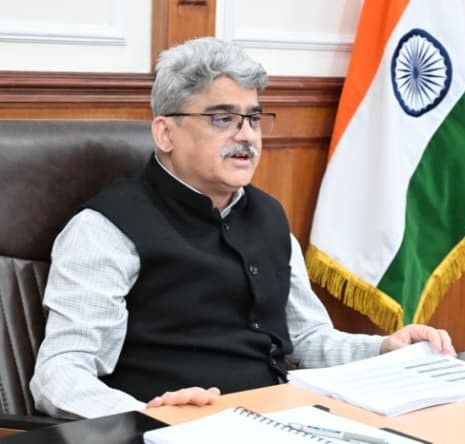

Srinagar: Chief Secretary Atal Dulloo on Thursday reviewed a newly framed Action Plan for promotion of handicraft and handloom exports, aimed at increasing Jammu and Kashmir’s textile and apparel exports from the current ₹800 crore to ₹2,000 crore by 2030.
The meeting was attended by Commissioner Secretary, Industries and Commerce, Vikramjit Singh; directors of Handicrafts and Handloom for Kashmir and Jammu; Managing Director of J&K Handicrafts (Sales and Exports) Corporation; Director of the Indian Institute of Carpet Technology (IICT); representatives of NIFT and other officials.
Dulloo stressed the need for a detailed assessment of the sector’s strengths, competitive advantages and challenges before finalising the implementation framework. He directed the department to identify bottlenecks requiring immediate attention and develop a year-wise strategy with clearly defined targets and timelines up to 2030.
The Chief Secretary also called for a comprehensive plan focusing on capacity building, infrastructure development, cluster creation and better organisation of artisans and craftsmen. He emphasised the need to effectively utilise Central government schemes while designing Union Territory-specific interventions to achieve export targets.
He said the projections and assessments underpinning the action plan should be scientific and evidence-based, noting that the quality of planning would directly influence outcomes.
During the meeting, Commissioner Secretary Industries and Commerce Vikramjit Singh outlined the strategic framework for 2026-2030, which seeks to align national export goals with coordinated interventions at the Union Territory and district levels.
He noted that Jammu and Kashmir had improved its position in the national Export Preparedness Index, moving from 36th place in 2020 to second place in 2024 among small states, northeastern states and Union Territories.
According to officials, the proposed framework includes a State Export Action Plan and district-level export action plans tailored to the strengths of individual districts.
Director Handicrafts and Handloom Kashmir, Mussarat Islam, informed the meeting that the plan aims to expand the active exporter base to 15,000 by 2030. At present, Jammu and Kashmir has 269 active RCMC exporters and a potential pipeline of around 1,000 users.
The action plan also targets 100 per cent GI-QR tagging of exports to improve authenticity and traceability, promotion of ₹100 crore worth of e-commerce exports and increasing utilisation of Free Trade Agreements (FTAs) to over 50 per cent from the current level of less than 20 per cent.
Officials said immediate priorities over the next two years include expansion of the Artisan Credit Card scheme, establishment of Export Textile Planning Cells under Tex-RAMPS and launch of the unified “Soulful J&K” GI branding campaign.
Medium-term measures include introducing ESG and European Union Deforestation Regulation (EUDR) compliance certifications for more than 100 manufacturing units and setting up raw material banks to strengthen the production ecosystem.
The plan also proposes leveraging Central schemes such as RoSCTL and SAMARTH, while utilising the J&K Export Subsidy Scheme, 2021, under which eligible exporters can avail a subsidy of 10 per cent, subject to a maximum of ₹5 crore per exporter.
Concluding the meeting, Dulloo stressed the need for sustained coordination, effective monitoring and timely implementation to strengthen the export ecosystem, expand the global reach of traditional crafts and support the livelihoods of nearly 4.5 lakh artisans and craftsmen across Jammu and Kashmir.