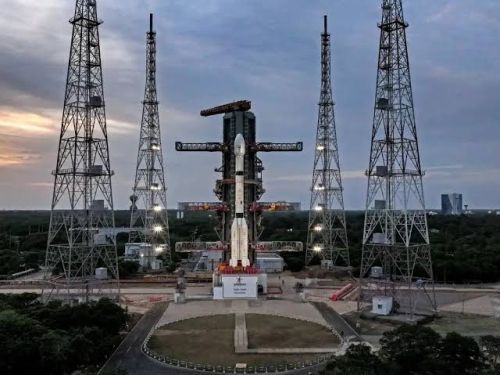
Sriharikota (Andhra Pradesh): ISRO on Friday made its way into history books yet again with the successful launch of the country’s first ever imaging satellite in geo-orbit, placing the over 2,300 kg payload into a precise orbit using a GSLV rocket.
“The eye in the sky,” as one of the senior scientists involved in the mission described the satellite, is set to provide real-time imagery and help the nation in areas including agriculture, and disaster management. Friday’s launch marked the space agency’s maiden success for the year 2026.
Prime Minister Narendra Modi, Union Home Minister Amit Shah, chief ministers of various states, Congress president Mallikarjun Kharge, among others, hailed the successful launch of the EOS-05 earth observation satellite.
The satellite was successfully placed in the intended sub-geosynchronous transfer orbit, about 18 minutes after it lifted off from the spaceport here, ISRO announced.
The space agency dismissed speculations that EOS-05 was a “spy satellite”.
While several earth observation satellites operate from low earth orbit (LEO), the EOS-5 satellite is set to hover at an altitude of roughly 36,000 km above earth, which is the geosynchronous orbit and at that level, the satellite will match Earth’s rotational speed.
At over 2,300 kg, this is the heaviest satellite ever to be carried by a GSLV and the satellite was perfectly ahead in its trajectory.
The mission success, following some earlier failures, was apparently a morale booster.
A beaming ISRO chief V Narayanan said: “I am very happy to announce that the GSLV F-17 vehicle has successfully and precisely injected the advanced EOS-05 geo imaging satellite in the intended and required orbit.”
“This is the 107th launch from Srihariharikota and the 19th mission of GSLV,” the Secretary, Department of Space, flanked by key scientists involved in the mission, said soon after the launch.
He recalled that the first launch of GSLV (D1) was done with a payload of 1,536 kg and since then, gradually, ISRO improved the performance of GSLV by optimising the structural mass, and improving the propulsion systems. “Today, we have injected the heaviest satellite 2,367 kg using this launch vehicle.”
Once the EOS-05 is operationalised in the orbit, it will become India’s first dedicated imaging satellite from the geo-orbit providing “strategic data” for the country, he said.
Quoting satellite data, he confirmed that all the systems were operating perfectly well and that the solar panel has been successfully deployed. “The health of satellite is perfectly alright,” he said.
“This is a great achievement for our country’s space programme because this is the first EOS that will be placed on the geo platform for the national activities.”
In the days to come, the orbit raising maneuvering will be done and the satellite will be elevated to required orbit and will be placed in the geo platform, he said, adding the success is the culmination of team work of ISRO and its industrial partners.
Mission Director Thomas Kurien said the mission carried uniquely configured EOS capable of near real time imaging. “It is the heaviest satellite ever launched by GSLV into a GTO or sub-GTO orbit,” he added.
Project Director (Satellite) Imteyaz Ahamad described the EOS-05 as a unique, one of its kind satellite with multi-band operating capabilities. “It is a complex satellite in terms of configuration, content and capability.”
Earlier, at the end of a smooth 27-hour countdown, which commenced at 23.30 hours on Wednesday, the rocket began its ascent on dot at 2.55 AM from the second launch pad at Satish Dhawan Space Centre. The odd hour and rain could not deter the enthusiasm of members of public as many, armed with umbrellas, turned up in good numbers to cheer the launch.
The 3-stage, 51.7 meter Geosynchronous Launch Vehicle (GSLV), with its third stage being cryogenic, has a lift off mass of 420.5 tonne and the heavy satellite is ensconced on the rocket nose cone.
The GSLV-F17/EOS-05 mission is said to be a replacement for the unsuccessful GSLV-F-10/EOS-03 mission of 2021.
An onboard computer had aborted that mission at 307 seconds into the flight then. A probe into the post-flight data had indicated that an anomaly in the Cryogenic Upper Stage led to the mission failure, according to ISRO.
The pre-dawn launch on Friday follows a gap of nearly eight months and brings ISRO its first success of the year.
On January 12, ISRO’s PSLV-C62 rocket carrying 16 satellites failed to place them in the intended orbit after encountering an “anomaly” in the critical third stage of the launch.
Later, addressing a press conference, the ISRO chief said the earth observation satellite’s operational lifetime is nine years and dismissed speculations that it was a “spy satellite.”
Days ago, Narayanan visited the Tirumala Tirupati Lord Venkateshwara Swamy temple and prayed for the mission’s success.
Meanwhile, PM Modi said the success was a proud moment for the country.
“Yet another outstanding achievement by ISRO and a proud moment for our nation. The successful launch of GSLV-F17 carrying EOS-05, India’s first-ever imaging satellite from Geosynchronous orbit is a reflection of the excellence, innovation and growing capabilities that define India’s space sector,” Modi said in a post on X.
HM Shah congratulated ISRO scientists on successfully placing the country’s first-ever imaging satellite into geosynchronous orbit.
Taking to X, he said, “Congratulations to @ISRO scientists as GSLV-F17 successfully carried EOS-05 into orbit. India now has its first-ever imaging satellite operating from geosynchronous orbit.”
In a post on X, AICC chief Kharge said, “Congratulations to the entire @isro team on the successful GSLV-F17/EOS-05 mission! EOS-05, India’s first imaging satellite, from Geosynchronous orbit, will further strengthen our Earth Observation capabilities that we have been developing for years.”
“We are immensely proud of our scientists, space engineers and researchers whose dedication and ingenuity continue to take India’s space programme to greater heights,” the Congress chief said.
The Congress party has always remained deeply committed to scientific temper and space research, he said.
Andhra Pradesh CM N Chandrababu Naidu said: “A proud moment for India’s space journey. Congratulations to ISRO on the successful launch of GSLV-F17 and the precise placement of EOS-05 into its intended orbit.”
CMs of Uttar Pradesh and Arunachal Pradesh, Yogi Adithyanath and Pema Khandu, respectively, hailed ISRO for the success.
BJP national president Nitin Nabin said the successful launch of the GSLV-F17 rocket was a testament to India’s scientific expertise and technological prowess.
“India’s space programme continues to soar to extraordinary new heights. Under the leadership of Prime Minister Narendra Modi, our space programme continues to advance with a strong focus on indigenous innovation and self-reliance,” he said in a post on X.