Baramulla: Archaeologists on Saturday launched the second phase of excavation at the ancient Buddhist site of Zehanpora in Sheeri area of Baramulla district, with researchers expecting fresh discoveries from a 100-day campaign aimed at exploring unexplored sections of the nearly 2,000-year-old settlement.
The excavation at Zehanpora, identified as a Buddhist site dating to the Kushan period, resumed after the first phase conducted in November 2025 was cut short by winter. The extended field season is expected to provide archaeologists substantially more time to investigate the site and recover additional structures, artefacts and other material evidence linked to Kashmir’s early historic past.
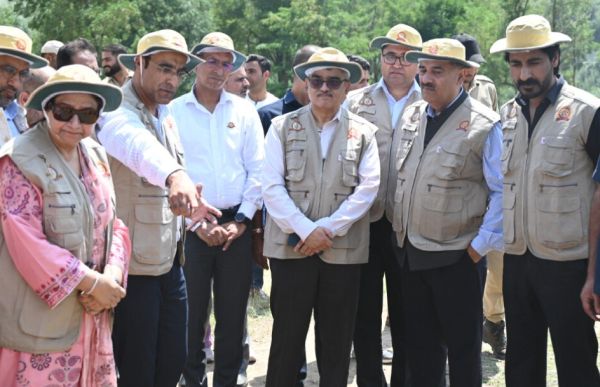
Jammu and Kashmir Chief Secretary Atal Dulloo visited the site on Saturday to review the ongoing work. Describing the findings from the first phase as “surprising and very interesting”, he said a clearer picture of the ancient settlement would emerge only after more extensive excavation.
“The main things that are understood so far, however, when they do the whole excavation, the whole story will be revealed,” Dulloo said during the visit.
He was accompanied by University of Kashmir Vice-Chancellor Prof Neelofar Khan, Deputy Commissioner Baramulla Syed Fakhruddin Hamid, SSP Baramulla Gurinderpal Singh and other senior officials.
The excavation is being carried out jointly by the Directorate of Archives, Archaeology and Museums (DAAM), J&K, and the University of Kashmir under an MoU signed last year for systematic archaeological investigations at the site.
Officials said expanded trenches and focused investigations have been planned across unexplored portions of the archaeological complex. Excavation is being undertaken using scientific methods and modern technology, while recovered material is being subjected to laboratory analysis, including carbon dating, to establish chronology and cultural sequence.
The site gained attention after archival research and satellite-based surveys indicated the presence of buried structures. Subsequent excavations uncovered multiple stupas, apsidal structures, monastic remains, pottery, terracotta objects and other artefacts associated with Buddhist occupation.
Archaeologists believe the discoveries point to a substantial Buddhist monastic complex dating between the 1st and 3rd centuries CE, when Kashmir was linked to broader cultural and commercial networks across northern India, Gandhara and Central Asia.
Located near the Jhelum River along an ancient cultural corridor, Zehanpora is considered significant for understanding historical trade routes and religious exchanges in the region.
Researchers say the structures and artefacts recovered from the site could provide insights into construction techniques, religious practices, material culture and everyday life in Kashmir nearly two millennia ago.
Dr Javid, a surveyor associated with the excavation, said the site offers rare archaeological continuity and could help fill important gaps in the historical narrative of the Kashmir Valley.
The excavation has also received national attention after Prime Minister Narendra Modi referred to the site in the 129th episode of Mann Ki Baat. The Prime Minister highlighted the role of archival research in bringing the forgotten ruins into focus and noted that the remains date back nearly 2,000 years to the Kushan period.
According to archaeologists, renewed attention to the site followed the discovery of a blurred 19th-century photograph in a French museum, which helped researchers identify the location and initiate scientific surveys that eventually led to excavation.
The project is being supervised by Project Director Dr Ajmal Shah, who said the Prime Minister’s mention of the site had encouraged the research team and generated wider interest in the excavation.
University of Kashmir students are also participating in the fieldwork, receiving practical training in excavation techniques, documentation and archaeological research. Dulloo commended the university and its Department of Archaeology for involving students in the exercise.
Archaeologists have also called for measures to protect and preserve the site. Dr Shah has advocated the establishment of a site museum and formal demarcation of the archaeological complex to support conservation efforts and facilitate future research.
Officials said the district administration has acknowledged the site’s historical importance and would explore measures related to conservation, demarcation and preservation in coordination with the concerned departments.
Despite the discoveries made so far, researchers believe only a small portion of the site has been explored. Dulloo said complete excavation and documentation of the archaeological complex could take up to five years because of the scale of the remains and the meticulous nature of scientific excavation.
Archaeologists expect the ongoing phase to help establish a clearer understanding of the settlement’s chronology, religious significance and links with the wider Buddhist cultural landscape of Kashmir.
Experts believe the discoveries could significantly enhance understanding of Baramulla’s place in Kashmir’s ancient history and eventually develop into an important heritage destination for visitors interested in archaeology, Buddhism and the region’s cultural past.