SRINAGAR: Jammu and Kashmir has set a target of increasing its operational hydropower generation capacity to 10,969.65 MW by December 2035, more than three times its current installed capacity of 3,540.15 MW, officials said on Friday.
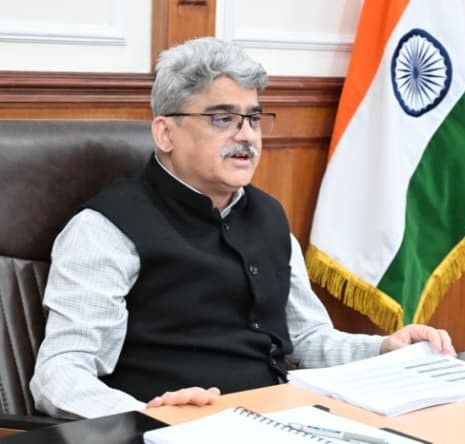
The roadmap was reviewed at a high-level meeting chaired by Chief Secretary Atal Dulloo, which assessed the progress of major hydropower projects, commissioning schedules and capacity-addition milestones aimed at strengthening the Union Territory’s energy security and reducing dependence on external power sources.
The meeting was attended by Additional Chief Secretary, Power Development Department (PDD), Ashwani Kumar; Commissioner Secretary, Law; Secretary, Revenue; Managing Director, Jammu and Kashmir Power Corporation Limited (JKPCL); deputy commissioners, project heads, representatives of NHPC and other senior officers.
During the meeting, the Chief Secretary stressed the need for close inter-departmental coordination, continuous monitoring and timely resolution of issues affecting project execution to ensure adherence to commissioning schedules.
Giving an overview of the sector, Ashwani Kumar said Jammu and Kashmir has an identified hydropower potential of 14,635 MW, of which around 24.21 per cent has been harnessed so far through Union Territory, Central Sector and Independent Power Producer projects.
He said the Chenab basin accounts for 11,283 MW of the identified potential, followed by the Jhelum basin with 3,084 MW and the Ravi basin with 500 MW. The department, he added, has adopted a phased strategy to systematically tap the available resources and move towards greater energy self-sufficiency.
Managing Director, JKPCL, Rahul Yadav informed the meeting that the first major capacity additions are expected by the end of 2027 through the commissioning of the 1,000 MW Pakal Dul Hydroelectric Project (HEP), 624 MW Kiru HEP and 12 MW Karnah HEP. These projects are expected to raise the cumulative installed capacity to 5,176.15 MW.
The commissioning of the 37.5 MW Parnai HEP is projected to increase the capacity further to 5,213.65 MW.
According to officials, another significant increase is expected in 2028 with the commissioning of the 540 MW Kwar HEP and 850 MW Ratle HEP, taking the cumulative capacity to 6,630.65 MW.
By December 2029, an additional 500 MW is expected from Central Sector projects, including the 260 MW Dulhasti Stage-II and 240 MW Uri-I Stage-II projects, raising the total installed capacity to 7,103.65 MW.
The roadmap also envisages commissioning of major projects between 2031 and 2035, including the 820 MW Kirthai-II, 390 MW Kirthai-I and 1,856 MW Sawalkote HEP. With these additions, Jammu and Kashmir is expected to achieve an installed hydropower capacity of 10,969.65 MW by December 2035.
Reviewing individual projects, the Chief Secretary was informed that the 1,000 MW Pakal Dul HEP has achieved 85 per cent physical progress and 77.54 per cent financial progress. Testing and commissioning of Units 3 and 4 are scheduled for March 2027, while Units 1 and 2 are expected to be commissioned by May-June 2027.
The 624 MW Kiru HEP has recorded 88.75 per cent physical progress and 73.21 per cent financial progress, with commissioning targeted for March 2027.
Officials said the 540 MW Kwar HEP has achieved 37.82 per cent physical progress and is on track for commissioning by March 2028, while the 850 MW Ratle HEP has recorded 31.53 per cent physical progress and is expected to be fully commissioned by November 2028.
Among Union Territory sector projects, the 12 MW Karnah HEP has reached 93 per cent completion, while the 37.5 MW Parnai HEP has achieved 72.5 per cent physical progress.
Officials said the planned expansion is expected to provide a stronger energy base for industrial growth, infrastructure development, tourism and other economic activities, helping Jammu and Kashmir move towards greater energy security and self-reliance.