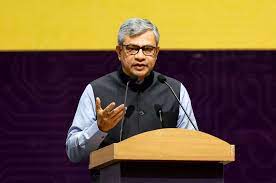
New Delhi: The government on Monday approved 31 fresh proposals under the ambitious Electronics Component Manufacturing Scheme (ECMS), involving investments of Rs 7,877 crore, taking the total number of projects cleared across five tranches to 106 with cumulative investments surpassing Rs 69,000 crore.
After awarding approval certificates to players, Union Electronics and IT Minister Ashwini Vaishnaw noted the scheme has attracted private investments that have exceeded targets set originally.
“When we made the Electronic Components Scheme, the manufacturing scheme, we kept a target of Rs 59,000 crore. I am so glad the scheme has already achieved Rs 69,000 crore investment. Private investment is happening now, and it is coming in very crucial sectors,” Vaishnaw said.
The approvals come as India looks to deepen domestic value addition in electronics by strengthening local supply chains, reducing dependence on imports of critical components and building advanced manufacturing capabilities. It is in line with the government’s broader goal of positioning India as a global hub for electronics manufacturing.
Electronics and IT Secretary S Krishnan announced that Meity (the Ministry of Electronics and IT) has cleared almost 31 applications, in the latest round, involving a total investment of Rs 7,877 crore. The approvals involve projects in areas such as capital goods, camera modules, display modules, connectors, anode material, enclosures, rare earth permanent magnets, speakers and microphones, antenna, metallised films for capacitors, and coils, among others.
The specific proposals greenlit in the latest round include Jyoti CNC Automation (Rs 1,021 crore), Micromax Precision Moulding (Rs 565 crore), VVDN Technologies (Rs 100 crore), Resolute Group’s SkyQuad Electronics and Appliances (Rs 740 crore), Mitsubishi Electric India (Rs 99 crore), Wipro Global Engineering and Electronic Materials (Rs 1,033 crore additional investment), Gruner India (Rs 79 crore), Centum Electronics (Rs 54 crore).
The list of proposals also includes GX Group, Bhagwati Products, Ennovi Mobility Solutions, Allied Engineering Works, Globe Capacitors, Syrma SGS Technology, Rosenberger Interconnect, Sensata Technologies, and Britannia RFID Technologies, among others.
Vaishnaw said the fresh approvals will result in a total output or production of goods worth Rs 82,243 crore and lead to the generation of close to 10,000 jobs.
The fresh proposals saw Wipro Global scaling up investments in copper clad laminate, a category that is seeing a shortage as well as price rise due to pent up demand in artificial intelligence servers.
Quantum Magnetics has received approval for producing rare earth magnets – a segment that is dominated by China, which is crucial for all high-tech electronics products, especially to support advanced audio technologies. Companies like Mitsubishi Electric, Ind Sphinx, Accurate Gauging and Instruments, VVDN Technologies and Jyoti CNC Automation received approval for capital goods – a key segment to reduce dependence on imports and help Indian electronics manufacturers scale up their production.
The fresh tranche of investment will be spread across 10 states. The Electronics Components Manufacturing Scheme (ECMS), launched in April 2025, offers incentives for setting up domestic manufacturing facilities.
Vaishnaw reiterated that the industry must keep a razor-sharp focus on four key areas, including design capabilities, indigenous supply chain, Six Sigma quality, and workforce development.
Emphasis in these areas is an absolute must for the electronics industry to be globally competitive and for sustaining growth.
Highlighting the need to build strong design capabilities, Vaishnaw said rapid changes in electronics make it essential for companies to be able to respond quickly to shifts in technology, markets and customer expectations. Strong domestic design capabilities, he said, would enable players to go after sustained growth and scale.
Vaishnaw also called on players to deepen their indigenous or ‘Swadeshi’ supply chains by mapping components down to the level of sub-components and smaller parts, and identifying locally-made inputs. A ‘Swadeshi’ supply chain, he said, would create jobs and strengthen supply-chain resilience, he asserted.
The minister also stressed that ‘Six Sigma’ quality and lean manufacturing are critical for competing in the electronics sector.
“Without Six Sigma quality, there is no chance of survival in electronics manufacturing,” he said, noting that an ELCINA latest presentation showed nearly 60 per cent of companies are now moving towards ‘Six Sigma’ quality standards.
Vaishnaw identified talent and workforce development as the fourth priority, saying investments in skills are essential for improving quality, productivity and manufacturing efficiency.
He exhorted the industry to continue investing in workforce and talent development.
The minister said industry bodies, including ELCINA, MAIT and ICEA, have been asked to work on talent development in a “structured way”, and assured that ministries of skill development, electronics and IT, and education will provide all the support needed.