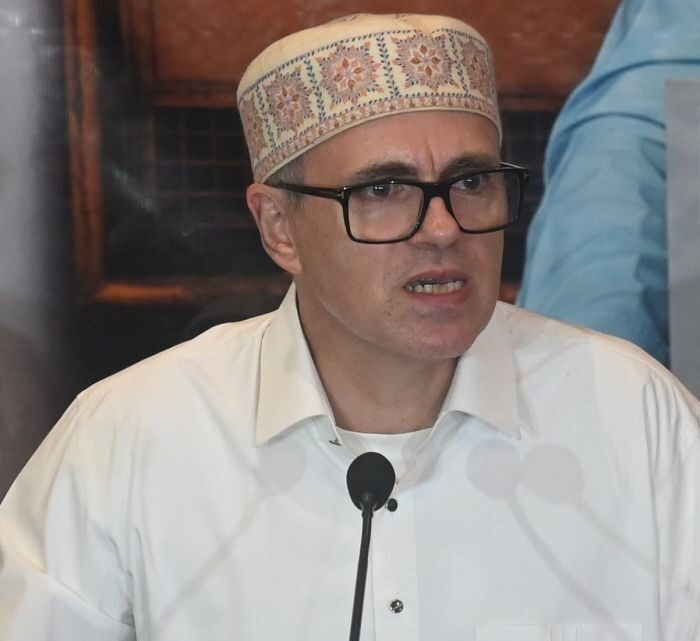
Srinagar: Chief Minister Omar Abdullah on Saturday said if he were to write an autobiography ever, he would keep it locked away to be published only after his death as he would not risk upsetting anyone.
He made the remarks at the launch of “When The Heart Speaks”, the second edition of the autobiography of renowned cardiologist and Padma Shri winner Dr Upendra Kaul.
Speaking at the event, the chief minister said he believes there are only two ways to write an honest autobiography: publish it in one’s lifetime and ruffle a few feathers, or publish it after one’s death.
Lauding Dr Kaul’s candid writing, Abdullah said he and the cardiologist are on opposite sides of the prism.
“Kaul has written his book honestly, and it is there for you to read. If you look through his book, as I had the opportunity to do, you will realise that he does not write about just one aspect of his life. As a good writer, he does not mince words when he thinks that something needs to be said.”
The chief minister added, “If I were to ever write a book, it would be written and locked away, to be opened after I have left this world, so that I do not have to worry whether I have upset anybody, and how many people I will have to apologise to after the book has been published.”
He said if one were to sit back and think what one has written about someone and how that person would respond, then one would never be able to write a book.
Abdullah described the autobiography as a “love letter to a land Kaul holds dear”.
“It is an account of life’s struggles and how to overcome them. It is also an effort to shine light on some practices in the medical profession that many would prefer not to talk about. But, true to the person that he is, Kaul writes knowing that perhaps there will be people who won’t be happy having read it. He writes nonetheless,” he said.
On the title of the book, Abdullah said it was a clever use of words, because “When The Heart Speaks” could be anyone’s autobiography, but coming from a cardiologist, it is almost tongue-in-cheek. He said Dr Kaul wrote the book as a cardiologist who has left a lasting mark in his own lifetime.
Dr Kaul established the Gauri Kaul Foundation, in memory of his late mother Gauri Paul, which runs a cardiac clinic in his native village of Hawal in south Kashmir’s Pulwama.
He also launched Heart Clinic on Wheels, a fully equipped mobile unit bringing advanced cardiac diagnostics to the doorsteps of underserved communities, after he realised that waiting for patients to reach them was not enough in remote, mountainous terrains.
The cardiologist has now turned his focus to the children, with cardiac screening programmes in schools.
The chief minister expressed gratitude for the services he rendered to the people of the Valley.
“We are grateful for everything that Professor Kaul has done as a doctor, as a surgeon, as a cardiologist, but perhaps more than that, for everything that he has done as a human being wanting to help people,” he said.
“We hope this continues for many, many years to come, because if a cardiologist doesn’t live a long life, what hope do the rest of us have?” he said in a lighter vein, drawing laughter from the audience.
Speaking on the occasion, Dr Kaul said that his book, as its title suggests, is “plain speaking from the heart without any prejudices”.
“What I felt was right, I praised it. What I felt wasn’t going right, I pointed that out too. It talked about the wrong things that I saw happening in society. I talked about my own life too,” he said.
Dr Kaul said that when he found his calling in medicine and rose in his career — from the corridors of AIIMS to becoming a leading interventional cardiologist in major private hospitals — he realised something vital: “True medicine is not practised only in high-tech catheterisation labs; it is learnt in human connection.”
He said his book shared stories not just of complex cardiac surgeries, but of his travels across the globe, including to Pakistan and China.
“More than the medical conferences or high-level summits, what stayed with me were my interactions with everyday people — cab drivers, street vendors and beggars. As a professor of cardiology, listening to a patient’s heartbeat is (my) second nature. Islamabad, Beijing or New Delhi, the human heart beats the exact same, but listening to a stranger’s life story — their fears, hopes and desire for dignity — teaches you empathy,” he said.
Speaking on the occasion, National Conference leader and Anantnag-Rajouri MP Mian Altaf Ahmad described Dr Kaul as a doctor par excellence, who never takes his patients lightly.
Ahmad said despite the situation in the Valley in the past, the love for Kashmir never left the cardiologist’s heart.