Walk through a Renaissance painting and you may notice something curious: a dog at someone’s feet, a bird perched in a child’s hand, a rabbit hiding among flowers, or a serpent coiling through a biblical scene. To the modern eye, these details can seem incidental. To a Renaissance viewer, however, they could carry an entire vocabulary of meaning.
During the Renaissance, animals were rarely included simply to make a painting more attractive. They could represent virtues and vices, love and loyalty, death and resurrection, temptation and redemption, or even the social identity of the person being portrayed. Their meanings were shaped by the Bible, medieval bestiaries, classical mythology, popular beliefs and the symbolic traditions inherited from earlier European art.
Yet these meanings were not always universal. The same animal could signify completely different things depending on the subject, its position in the composition and the circumstances in which the artwork was created.
The Ermine’s Dual Identity
Leonardo da Vinci’s Lady with an Ermine offers one of the Renaissance’s most fascinating examples of animal symbolism.
The elegant white ermine held several associations. Because the animal was traditionally believed to prefer death to soiling its white coat, it became associated with purity, chastity and moral integrity. In the portrait, the ermine may therefore contribute to the idealized image of Cecilia Gallerani, the sitter.
But the animal may have another, more personal meaning. Cecilia was the mistress of Ludovico Sforza, Duke of Milan, who had been associated with the Order of the Ermine. The animal may consequently allude to Ludovico himself, transforming the portrait from a simple likeness into a sophisticated visual statement about identity, relationships and power.
Birds of the Soul
Birds occupied a special place in Christian art because their ability to fly between earth and sky made them natural symbols of the soul and the spiritual world.
The goldfinch became particularly associated with Christ’s Passion. According to a later Christian legend, the bird attempted to remove a thorn from Christ’s crown and was marked by a drop of blood. Its red head consequently became associated with Christ’s suffering.
This symbolism appears in Raphael’s Madonna of the Goldfinch, where the young John the Baptist presents a goldfinch to the Christ Child. The seemingly innocent interaction between the children therefore contains a darker prophetic meaning: the bird foreshadows Christ’s future suffering.
Other birds carried different meanings. The dove was associated with the Holy Spirit, peace and purity, while the eagle could represent divine authority, strength and spiritual elevation. The owl, by contrast, could suggest wisdom but could also carry darker associations with darkness and death.
The Serpent: Evil, Wisdom and Renewal
Few animals possessed a more complicated symbolic history than the serpent.
In Christian art, the serpent became one of the principal symbols of temptation and sin because of its role in the story of Adam and Eve. In Albrecht Dürer’s Adam and Eve, the serpent embodies the temptation that leads humanity toward the Fall.
But the serpent was not inherently evil in every tradition. In classical and ancient symbolism, snakes could be connected with healing, wisdom and renewal. Their ability to shed their skin made them powerful images of regeneration and rebirth.
This duality is important: Renaissance symbolism was often built upon layers of older traditions rather than a single dictionary of meanings. A serpent could therefore signify both destruction and renewal depending on its artistic and religious context.
Loyal Companions: The Dog
Dogs frequently appear in Renaissance portraits, and their presence was often meaningful.
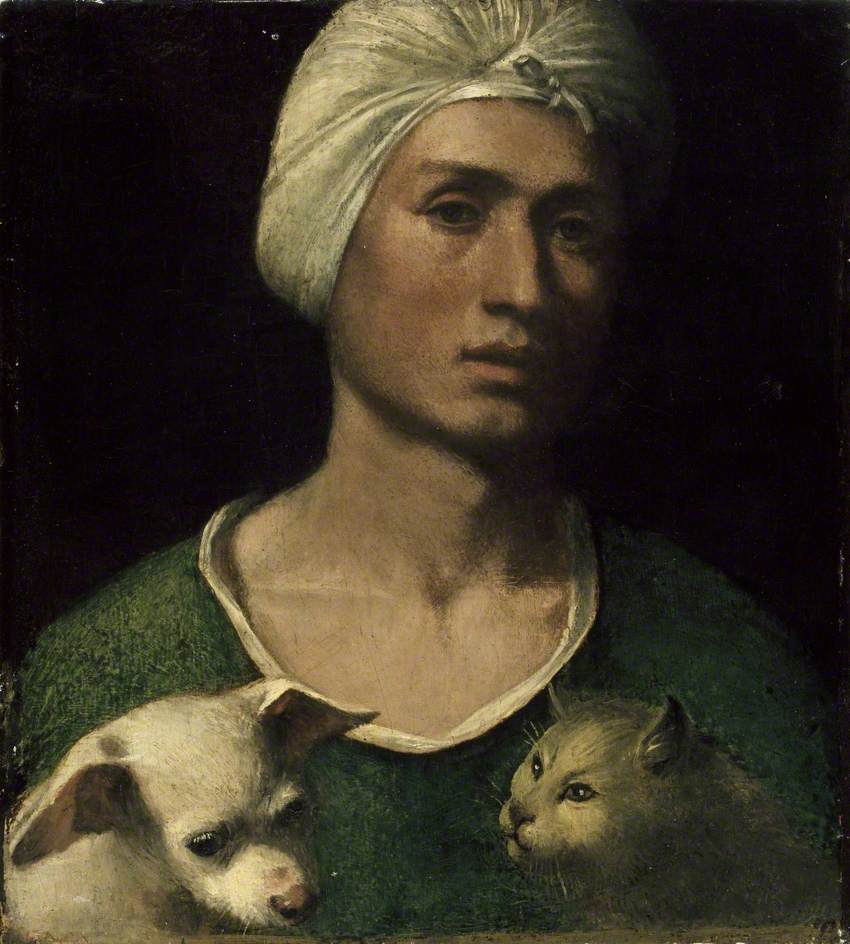
The dog traditionally represented loyalty, fidelity and devotion. In portraits of married couples, it could therefore reinforce the idea of marital faithfulness.
Titian’s Venus of Urbino provides a famous example. A small dog sleeps comfortably at Venus’s feet, creating a quiet domestic detail within an otherwise sensual composition. The dog has often been interpreted as a symbol of fidelity, adding another layer to a painting concerned with love, marriage and domestic life.
Dogs could also communicate social status. A carefully bred hunting dog, for example, might indicate aristocratic identity and the sitter’s connection to hunting culture.
Peacocks and the Promise of Eternity
With its extraordinary feathers and shimmering “eyes,” the peacock was almost destined to become a symbol.
Medieval Christian traditions associated the peacock with immortality and resurrection. An ancient belief claimed that the bird’s flesh did not decay after death, helping establish its association with eternal life.
For Renaissance artists, the peacock could therefore function as a visual reminder of resurrection and the promise of eternal existence. Its magnificent feathers also made it a symbol of beauty, majesty and, in some contexts, pride.
This ambiguity again reveals the richness of animal symbolism: the same magnificent creature could represent eternity or vanity, depending on the context.
The Rabbit: Innocence and Desire
Rabbits and hares appear frequently in Renaissance paintings, especially in scenes containing the Virgin Mary, children or landscapes.
Their rapid reproduction made them symbols of fertility and abundance. But the rabbit could also represent innocence, vulnerability and purity.
In some religious paintings, the white rabbit or hare contributes to an atmosphere of purity, while in other contexts its association with fertility can introduce themes of sexuality and earthly desire.
The meaning, therefore, depended heavily on the surrounding imagery.
The Lamb: Innocence and Sacrifice
The lamb was one of the most important animals in Christian art.
Its symbolism comes directly from biblical traditions, particularly the idea of Christ as the “Lamb of God.” Because lambs were associated with sacrifice, innocence and submission, they became powerful symbols of Christ’s Passion and redemption.
When the infant Christ is shown with a lamb, the scene may appear tender and playful, but it can also contain a prophecy of his eventual sacrifice.
The animal transforms an ordinary childhood moment into a theological statement.
The Lion: Strength and Divine Authority
The lion carried associations of courage, strength, royalty and authority.
In Christian art, the lion could represent Christ, particularly through the biblical image of the “Lion of Judah.” It was also associated with Saint Mark, whose Gospel symbol is a winged lion.
Consequently, a lion appearing in a religious painting might identify a saint, symbolize divine power or communicate moral strength.
In secular art, meanwhile, lions could reinforce ideas of aristocratic power and courage.
The Horse: Power, War and Nobility
The horse was closely connected to warfare, aristocracy and masculine power.
Equestrian portraits became particularly important in Renaissance Europe because the mounted ruler visually demonstrated control, authority and military capability. The horse was not merely transportation; it became an extension of the ruler’s identity.
A powerful horse could therefore communicate the strength of its rider and, by extension, the political power of the state.
The Stag: The Soul Searching for God
The stag carried a particularly beautiful religious association.
Psalm 42 compares the longing for God to a deer longing for flowing water. Consequently, the stag became associated with spiritual thirst and the soul’s desire for divine truth.
In Christian art, a deer or stag appearing near water could therefore suggest spiritual longing, purification or the search for God.
The animal’s natural behaviour was transformed into a metaphor for an inner human experience.
The Butterfly: Transformation and the Soul
Butterflies became associated with transformation because of their dramatic metamorphosis from caterpillar to winged insect.
Their transformation could be understood as an image of the soul moving from earthly existence toward spiritual life. Although butterfly symbolism became especially prominent in later European art, the broader association between metamorphosis, mortality and the soul has deep roots in classical and Christian traditions.
The butterfly thus offered artists a perfect visual metaphor: death-like transformation followed by new life.
The Fly: A Tiny Reminder of Death
Not every animal in Renaissance art represented something beautiful.
Flies could symbolize decay, corruption and the fleeting nature of earthly existence. Their presence in an otherwise beautiful painting could serve as a memento mori—a reminder that beauty, wealth and life are temporary.
This is one reason seemingly insignificant creatures can be important in Renaissance paintings. A tiny insect might deliberately disrupt an image of perfection and remind the viewer of mortality.
The Cat: Independence and Suspicion
Cats appear less consistently than dogs in Renaissance symbolism, but when they do appear, their meaning can be complex.
They could be associated with domestic life and feminine spaces, but medieval and Renaissance traditions sometimes connected cats—particularly black cats—with deception, sensuality or superstition.
Their ambiguous reputation made them useful visual symbols, especially when an artist wanted to introduce an element of mystery or unease.
The Owl: Wisdom and Darkness
The owl possessed another fascinating dual identity.
Because it could see in darkness, it became associated with wisdom and the ability to perceive what others could not. At the same time, its nocturnal habits caused it to acquire associations with darkness, isolation and death.
The owl therefore embodied a recurring Renaissance idea: knowledge can illuminate, but it can also reveal uncomfortable truths.
The Pelican: Love Through Sacrifice
One of the most striking Christian animal symbols was the pelican.
According to a medieval legend, a mother pelican would pierce her own breast to feed her young with her blood. Although biologically untrue, the story became a powerful metaphor for self-sacrifice.
Artists consequently used the pelican as a symbol of Christ’s sacrificial love and the Eucharist.
Like the goldfinch and lamb, the pelican demonstrates how an animal could turn a painting into a visual lesson in Christian theology.
The Peacock, Serpent and Dove: Three Different Ideas of Transformation
Perhaps the most interesting aspect of Renaissance animal symbolism is that animals were not simply assigned one permanent meaning.
A serpent could suggest sin or renewal.
A peacock could represent vanity or immortality.
A bird could symbolize earthly beauty, the human soul or divine presence.
The meaning emerged from the relationship between the animal, the human figures, the subject of the painting and the cultural knowledge of the viewer.
Renaissance paintings were therefore not simply pictures to be admired. They could function almost like visual texts, filled with clues that educated viewers were expected to recognize.
Why Did Renaissance Artists Use Animals So Often?
The answer lies partly in the Renaissance fascination with the natural world.
Artists increasingly studied animals, plants and the human body through direct observation. At the same time, they inherited centuries of symbolic traditions from the Bible, classical mythology, medieval bestiaries and religious literature.
A Renaissance artist could therefore combine observation and symbolism: the animal could look convincing as a living creature while simultaneously carrying an abstract idea.
This is what makes these paintings so rewarding to study. A dog is both a dog and an idea of fidelity. A goldfinch is both a bird and a prophecy of suffering. A lamb is both an innocent animal and a symbol of sacrifice.
Perhaps the greatest secret of Renaissance art is that its paintings were designed to be read as well as seen. The animals scattered throughout Renaissance paintings were therefore not merely decorative details. They formed part of a sophisticated visual vocabulary through which artists communicated ideas about love, morality, religion, power, death and the human condition.
The next time you encounter a Renaissance painting, look beyond the human figures. Look at the animals.
The smallest creature in the painting may be telling you the biggest story.