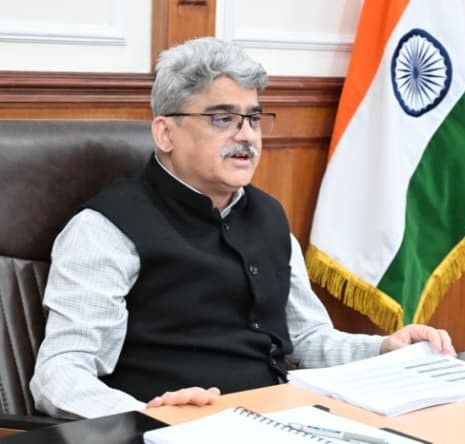
Srinagar: Chief Secretary Atal Dulloo on Monday reviewed the implementation of a five-pronged roadmap prepared by the Department of Disaster Management, Relief, Rehabilitation and Reconstruction (DMRR&R) to strengthen disaster management and improve resilience across Jammu and Kashmir.
Chairing a high-level review meeting, the Chief Secretary assessed the Action Taken Report on decisions taken during previous meetings and reviewed progress on key disaster risk reduction initiatives undertaken by various departments.
Dulloo said investments in disaster risk reduction would help minimise future economic losses, protect critical infrastructure and save lives. He called on all departments to adopt a coordinated approach for implementing the roadmap and building a disaster-resilient Jammu and Kashmir.
Highlighting the Union Territory’s vulnerability to earthquakes, floods, landslides, cloudbursts, glacial lake outburst floods (GLOFs), avalanches and forest fires, the Chief Secretary stressed the need for a scientific and proactive disaster management framework focused on risk reduction before disasters occur.
Principal Secretary, DMRR&R, Chandraker Bharti, informed the meeting that progress had been made on several priority initiatives, including the formulation of Standard Operating Procedures under the Disaster Management Act and preparation of Detailed Project Reports for landslide mitigation in vulnerable districts.
He said a Memorandum of Understanding with the Geological Survey of India was being finalised to establish a comprehensive landslide forecasting system across Jammu and Kashmir. The meeting was also informed about progress on Digital Terrain Modelling (DTM), Digital Elevation Modelling (DEM), flood protection measures, mitigation projects submitted by District Disaster Management Authorities and institutional reforms aimed at strengthening disaster preparedness.
Officials presented the department’s five-pronged roadmap, which focuses on scientific risk assessment, targeted mitigation measures, institutional capacity building, community participation and risk-informed development.
The roadmap includes preparation of a Geographic Information System (GIS)-based Multi-Hazard Risk Atlas, strengthening critical infrastructure, deployment of modern technologies, enhancement of emergency preparedness and promotion of localised early warning systems to improve disaster response.
Concluding the meeting, Dulloo said disaster resilience should be treated as an essential component of sustainable development and called upon all stakeholders to work together to build a safer, climate-resilient and disaster-ready Jammu and Kashmir.
The meeting was attended by Additional Chief Secretary, Public Works Department, Principal Secretary Home, Commandant of the State Disaster Response Force (SDRF), Commissioner Secretary Housing and Urban Development Department, Divisional Commissioners, Secretary Rural Development Department, Commissioners of the Jammu and Srinagar Municipal Corporations, Director of the India Meteorological Department (IMD), Chief Engineer, Irrigation and Flood Control (I&FC), representatives of the Border Roads Organisation (BRO), National Highways Authority of India (NHAI), National Highways and Infrastructure Development Corporation Limited (NHIDCL) and other officials. Deputy Commissioners participated through virtual mode.