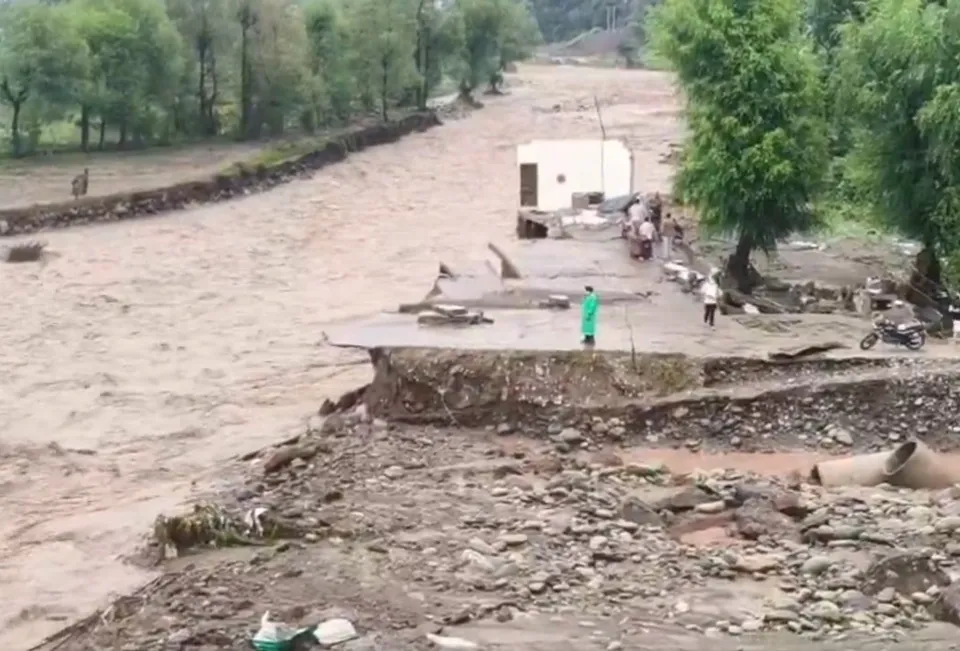
Srinagar/Poonch: At least 28 people have lost their lives in cloudbursts, flash floods and landslides across Jammu and Kashmir during the first three weeks of July, with six persons still missing a week after the devastating Murrah flash flood in Poonch district.
The prolonged spell of heavy rainfall caused widespread damage to roads, bridges, power infrastructure, drinking water schemes, agricultural land and residential areas across both the Kashmir and Jammu divisions. Several people were also injured as rescue teams carried out evacuation and relief operations in multiple districts.
Meteorological officials said the Union Territory witnessed 15 to 16 cloudbursts during the first fortnight of July alone, an unusually high number within such a short period. The active weather system continued thereafter, triggering more cloudbursts, flash floods and landslides in several districts.
According to official figures, at least 28 people died in rain-related incidents, with Poonch, Rajouri and Doda among the worst-affected districts. The fatalities were reported in flash floods, landslides, house collapses and other weather-related incidents.
The extreme weather damaged roads, bridges, irrigation canals and agricultural fields, while overflowing streams and nallahs inundated residential areas and washed away public infrastructure.
The Jammu-Srinagar National Highway (NH-44) remained repeatedly disrupted due to landslides and shooting stones in Ramban district, affecting passenger movement and the transportation of essential supplies.
In Kashmir, flash floods caused extensive damage in several districts. In Budgam’s Beerwah area, the diversion over Nallah Sukhnag was washed away, disrupting road connectivity for several days before traffic was restored. Similar damage to roads and public infrastructure was reported from Baramulla, Kupwara, Bandipora, Budgam, Anantnag and Ganderbal districts.
The adverse weather also disrupted the annual Shri Amarnath Ji Yatra. Pilgrim movement remained suspended for nearly a week after continuous rainfall damaged tracks and triggered landslides. While the Baltal route has resumed operations, the traditional Pahalgam route remains closed for restoration and safety assessments.
Power supply, drinking water schemes and communication infrastructure also suffered damage in several areas, prompting restoration work by government departments. The India Meteorological Department (IMD) issued repeated warnings of heavy to extremely heavy rainfall, cautioning about flash floods, landslides and cloudburst-like events. Rescue and relief operations were carried out by the State Disaster Response Force (SDRF), National Disaster Response Force (NDRF), police, civil administration and volunteers.
Meanwhile, six people remain missing a week after flash floods devastated Murrah village in Surankote subdivision of Poonch district.
The floods claimed eight lives and caused extensive damage to houses, roads and other infrastructure. However, despite seven days having passed, six persons are yet to be traced.
Residents said they have continued search operations with limited resources as the road to the village remains blocked, alleging that no large-scale recovery machinery has been deployed.
Locals said some human body parts have been recovered during the search, raising fears that the missing victims may have been swept away or buried under debris.
The Jammu and Kashmir Gujjar Bakerwal Youth Welfare Conference (JKGBYWC) expressed concern over the pace of rescue operations and urged the administration to deploy specialised teams with advanced equipment to intensify the search, restore road connectivity and electricity, and provide adequate compensation and rehabilitation to affected families. The organisation warned that the Gujjar Bakerwal community would launch protests if prompt action was not taken. (KNT)